
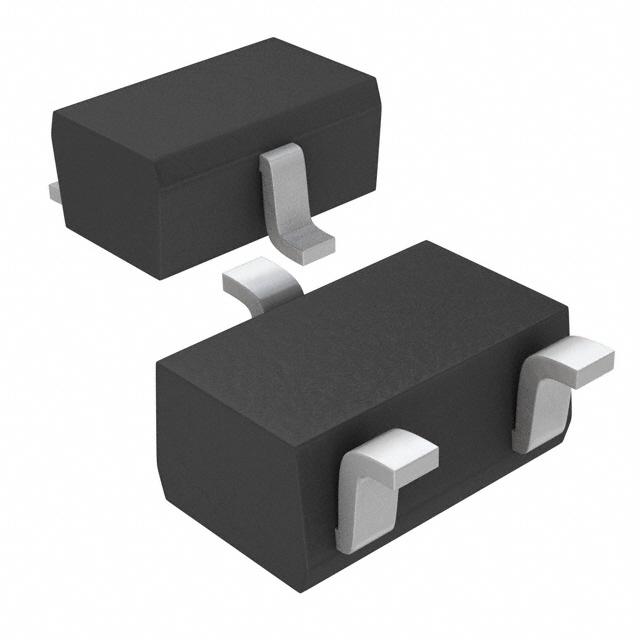
20V VCEO ceiling, 600mA collector limit, 200mW dissipation cap, UMT3 package
Quick Engineering Summary
| Field | Value |
|---|---|
| Manufacturer | Rohm Semiconductor |
| Category | Transistors (BJT) - Single, Pre - Biased |
| Package | UMT3 |
| Core function | TRANS PREBIAS NPN 20V 0. |
| Key electrical range | Collector Cut-off Current(Max): 500nA (ICBO); Frequency - Transition: 150MHz; Maximum Current Collector: 600mA; Maximum Power Dissipation: 200mW |
| Reported stock | 3000 pcs reported — confirm on RFQ |
Not for high-voltage or heat-heavy switching
Wrong fit first: don’t put this on a rail that can approach 20V and assume the current number saves you. DTC643TUT106 is a pre-biased NPN with a 20V VCEO ceiling, a 600mA collector ceiling, and 200mW maximum power dissipation, so voltage and heat usually settle the decision before the headline current does.
It fits compact board-level switching and interface work that benefits from the built-in 4.7k base resistor and the small UMT3 footprint. Active lifecycle and EU RoHS support new design-in as well as sustaining use, but only where the circuit already wants a pre-biased transistor instead of a bare BJT.
The 200mW limit is the real design gate
This is the gate.
The number that matters most is 200mW maximum power dissipation. It tells you DTC643TUT106 is not a free pass to use the full 600mA collector ceiling in any switching condition or ambient, and without a thermal resistance or derating curve in the listing, the real ambient headroom of the package stays undefined even though the current figure looks generous at first glance.
The 20V VCEO rating is another hard stop. It sets rail compatibility and transient tolerance at the transistor itself, but it says nothing here about safe overshoot, avalanche behavior, or inductive turn-off stress. Get that wrong and the failure mode is straightforward: the transistor was asked to block more voltage than its rating allows.
The saturation figure helps, but only at the stated point. 150mV max at 2.5mA and 50mA shows the device can pull low with modest drop there. It does not settle behavior at higher collector current, and it does not replace a switching-loss picture. The 500nA ICBO maximum also matters on leakage-sensitive nodes where an off path must stay off, but that figure is a ceiling, not a typical promise.
The built-in 4.7k resistor decides the use case
The constraint is fixed bias. DTC643TUT106 includes only R1, listed at 4.7k, so it belongs in circuits that want a pre-biased NPN input structure and can live with that fixed base path instead of tuning the bias network externally.
That makes it a sensible fit for dense logic-level drive, small signal inversion, and housekeeping switching on SMT boards where UMT3 matters. It is a poor fit when you need to choose both base resistors yourself, shape turn-off behavior, or push the transistor as a general-purpose power switch. The listed 150MHz transition frequency is useful context, but without capacitance or switching-time data it does not by itself make DTC643TUT106 a high-speed edge-control answer.
Stock is usable, but the datasheet gaps are real
The weak point is missing detail. The stronger point is that supply looks workable. Reel-TR packaging and listed stock of 3000 support a running SMT line, and the lifecycle status is Active with no conflict, so it makes sense to place it where reel consumption is predictable rather than treat the listed quantity as a buffer for a broad rollout.
What still blocks tighter electrical signoff is the missing thermal resistance, derating curve, pinout or package drawing, and switching-time data. For a pre-biased transistor, those omissions matter more than extra copy because they determine board heat, land pattern confidence, and whether the built-in resistor network matches the edge-rate behavior the circuit needs.
View the Win-Source product page for DTC643TUT106.
Key Takeaways for Engineers & Buyers
- Keep DTC643TUT106 off rails that can force more than 20V VCEO.
- Budget heat from the 200mW dissipation ceiling before using the 600mA collector rating.
- Buy on reel for the running line; listed stock is 3000.