
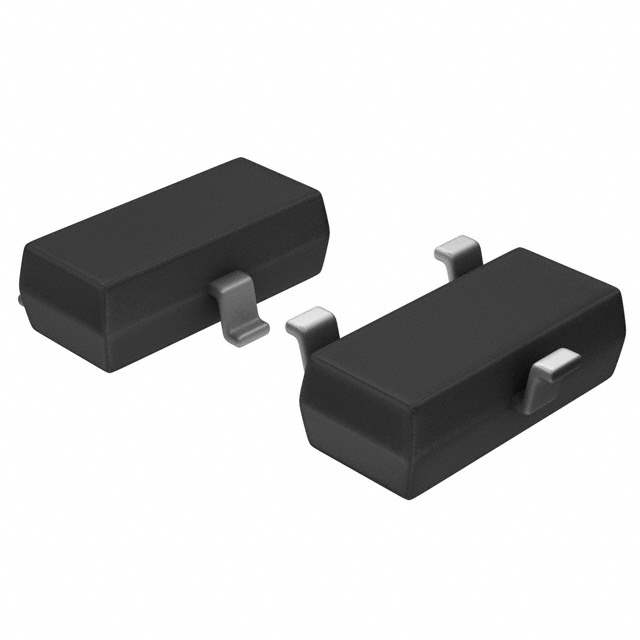
50V VCEO, 500mA collector ceiling, 200mW dissipation, SMT3 pre-biased NPN
Quick Engineering Summary
| Field | Value |
|---|---|
| Manufacturer | Rohm Semiconductor |
| Category | Transistors (BJT) - Single, Pre - Biased |
| Package | SMT3 |
| Core function | TRANS PREBIAS NPN 50V 0. |
| Key electrical range | Collector Cut-off Current(Max): 500nA; Frequency - Transition: 200MHz; Maximum Current Collector: 500mA; Maximum Power Dissipation: 200mW |
| Reported stock | 70300 pcs reported — confirm on RFQ |
The weak point is power, not lifecycle
The weak spot comes first: 200mW. That limit closes off any casual use of DTD123EKT146 as a general small-signal switch just because the collector current ceiling is 500mA. That 500mA figure is a ceiling, not a working point, and the listing gives no thermal resistance or derating curve to show how close the device can run to it in SMT3.
The stronger news is lifecycle. Active status appears with no stated conflict, so DTD123EKT146 is a reasonable new design-in choice when the load is modest and the internal bias network actually helps the circuit instead of boxing it in. EU RoHS is compliant.
The built-in resistors are the real convenience. R1 is 2.2k and R2 is 2.2k, which makes the part a better fit for pre-biased NPN duties that save parts count and placement than for stages where base drive needs to be chosen freely. The 50V VCEO ceiling gives useful rail headroom for logic-controlled switching and level interface work, but it does not answer dissipation, saturation loss, or transient stress on its own.
Availability is the one practical wrinkle. Stock is 70300, yet supply-and-demand is marked limited, so DTD123EKT146 looks available now rather than broadly abundant.
So the fit is narrow by design
And that is the point of the 2.2k/2.2k network. DTD123EKT146 fits compact bias-and-switch jobs better than open-ended transistor stages. Use it where resistor integration removes two externals and where SMT3 helps density. Skip it when base resistor values are part of the circuit tuning.
50V is rail margin, not permission to run hot
50V is the decisive ceiling. It tells you where DTD123EKT146 can sit in the signal chain without collector-emitter breakdown becoming the first failure mode, which makes it better suited to higher-voltage small-signal switching than low-voltage-only digital transistors, while the 200mW dissipation ceiling still controls the thermal budget.
The other useful number is 300mV @ 2.5mA, 50mA for VCE(sat) max. That gives a bounded saturation drop at the stated drive and load condition if the job is switching a modest load and pulling low cleanly matters. The 39 @ 50mA, 5V hFE minimum helps only in that same narrow operating neighborhood, and the 500nA collector cut-off current max supports low-leakage off-state behavior.
The missing curves are what still block a fast sign-off
The constraint is missing second-order data. DTD123EKT146 would be easier to clear with thermal resistance, a derating curve, and a package drawing tied to SMT3. Those set ambient headroom and footprint certainty.
A switching review still wants storage or switching time data, since 200MHz transition frequency is not a substitute for turn-on and turn-off behavior in a real saturated switch. Pinout detail is absent here too.
View the Win-Source product page for DTD123EKT146.
Key Takeaways for Engineers & Buyers
- Keep DTD123EKT146 on low-dissipation switching nodes; 200mW is the hard thermal ceiling.
- Use the built-in 2.2k and 2.2k bias network only where that divider matches the drive scheme.
- Book reel demand early if DTD123EKT146 is for production; stock shows 70300 while supply-and-demand is limited.