
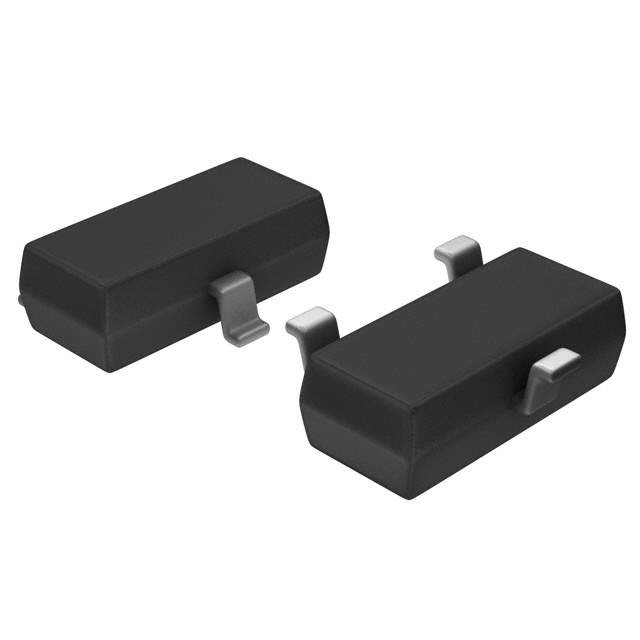
50 V, 500 mA, 200 mW SMT3 pre-biased NPN with fixed 3.3 kOhms and 10 kOhms resistors
Quick Engineering Summary
| Field | Value |
|---|---|
| Manufacturer | Rohm Semiconductor |
| Category | RF Transistors (BJT) |
| Package | Tape & Reel (TR) |
| Core function | TRANS PREBIAS NPN 50V 0. |
| Key electrical range | Current - Collector (Ic) (Max): 500 mA; Current - Collector Cutoff (Max): 500nA; DC Current Gain (hFE) (Min) @ Ic, Vce: 56 @ 50mA, 5V; Frequency - Transition: 200 MHz |
| Reported stock | 1696 pcs reported — confirm on RFQ |
Not for power switching; fine for small biased stages
Wrong tool for power switching. The 200 mW power limit and SOT-23-3 class body keep DTD133HKT146 in small-signal territory, even with a 500 mA collector-current maximum on the listing. That current is a ceiling, not a license to run a hot load in a tiny package.
It fits compact bias-and-switch work where the built-in network is the point: a pre-biased NPN with 3.3 kOhms on R1 and 10 kOhms on R2 in SMT3. Active lifecycle and EU RoHS support new design-in, and MSL 1 (Unlimited) removes one common handling nuisance on the line.
The real limit is heat, not headline current
Heat is the constraint. At 200 mW, the ceiling arrives before the 500 mA collector-current maximum becomes broadly useful. The 50 V collector-emitter breakdown is a ceiling too; it sets rail compatibility, not operating comfort.
The resistor pair decides whether it belongs in your schematic
3.3 kOhms and 10 kOhms decide the fit. In a pre-biased NPN, those internal values are the behavior you inherit, so they quickly rule in circuits that want that bias ratio and rule out ones that need a bare transistor or a different drive relationship.
The gain figure is hFE 56 @ 50mA, 5V, which anchors one test condition rather than every operating corner. The listed Vce saturation is 300mV @ 2.5mA, 50mA, useful for low-current switching expectations at that exact point, but not enough to settle losses elsewhere.
The buy call is straightforward, but the datasheet gaps are not
The weak point is visibility into second-order behavior. The listing is enough to put DTD133HKT146 on a shortlist, but not enough to close switching speed, thermal headroom, or footprint release without the full datasheet.
Supply is the easier part. Stock is 1696, the standard package is 3,000, and packaging is Tape & Reel, so it fits an SMT build flow but does not support a full reel pull. If this part is headed to a running line, reserve the available quantity early and align the build lot to reel handling rather than assuming deeper immediate stock.
The missing items are concrete: no thermal resistance, no derating curve, no pinout drawing, and no package drawing in this listing. On a transistor sold on a 200 mW ceiling in SMT3, thermal resistance and derating set ambient headroom. On a pre-biased device, pinout carries extra weight because the internal resistor network makes a wrong footprint error electrically messy, not just mechanically inconvenient. DTD133HKT146 may still be the right fit, but those are the gaps to close before release.
View the Win-Source product page for DTD133HKT146.
Key Takeaways for Engineers & Buyers
- Treat 50 V VCEO and 500 mA Ic as ceilings; don't use either as a normal operating point.
- Check the fixed 3.3 kOhms R1 and 10 kOhms R2 against your drive network before freezing the schematic.
- Buy to tape-and-reel flow: stock is 1696 while the standard package is 3,000.