
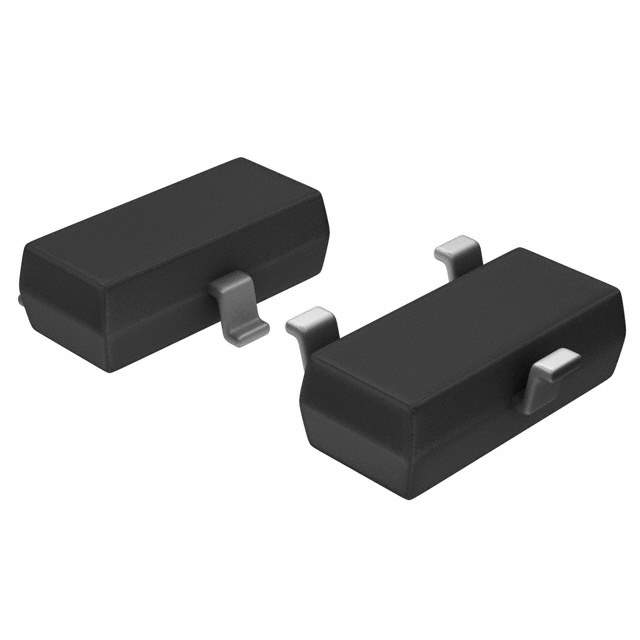
500 mA, 200 mW, SST3, 4.7 kOhms/4.7 kOhms, AEC-Q101: the limits that decide whether it fits
Quick Engineering Summary
| Field | Value |
|---|---|
| Manufacturer | Rohm Semiconductor |
| Category | Transistors (BJT) - Single, Pre - Biased |
| Package | SST3 |
| Core function | TRANS PREBIAS NPN 0. |
| Key electrical range | Supply and Demand Status: Limited |
| Reported stock | 2920 pcs reported — confirm on RFQ |
Not for high-current switching; fine for compact bias networks
Wrong part for designs that want current headroom or loose thermal margins. The 500 mA collector-current rating and 200 mW power rating are ceilings. In SST3, DTD143ECHZGT116 fits small-signal switching and logic-interface work, with R1 = 4.7 kOhms and R2 = 4.7 kOhms already built in for dense control paths.
200 mW is the number that really sets the boundary
200 mW is the boundary. It tells you whether this device belongs in a low-dissipation control path, but it does not answer ambient headroom, copper-area dependence, or pulse handling because the thermal resistance and derating curve are not listed.
The 500 mA collector-current rating is a ceiling too, not evidence that the package can sit there comfortably across real switching conditions, and that distinction matters more here than the headline current number. Put that beside the listed VCE(sat) of 300mV at 2.5mA, 50mA and the practical takeaway is straightforward: the useful operating clue is at 50mA, while the much higher current limit still lacks the thermal context needed to judge margin.
The resistor network is just as defining as the transistor ratings. R1 = 4.7 kOhms and R2 = 4.7 kOhms make DTD143ECHZGT116 easy to drop into a fixed bias scheme, but they also shut the door on designs that need to tune base drive or pull-down behavior. The hFE minimum of 47 at 50mA, 5V anchors gain expectations at one point, and the 200 MHz transition frequency says it is not a relay-only plodder. It doesn't tell you switching loss. No time-domain switching data is listed.
Can you actually keep a line running on it?
Can you buy enough of it on time? Yes, with one obvious catch. DTD143ECHZGT116 is Active, stock is 2920, package quantity is 3000, and lead time is 19 Weeks. That points to a healthy lifecycle and a tighter near-term buy if your build consumes full reels.
Treat it as a reel-managed part. If uninterrupted placement matters, book against the 19 Weeks lead time early rather than assuming the 2920 on hand covers the next turn. EU RoHS is compliant, REACH is unaffected, and MSL 1 (Unlimited) removes one handling nuisance.
The missing data is exactly what closes the thermal call
The constraint is missing stress detail. DTD143ECHZGT116 would be much easier to sign off with thermal resistance, a derating curve, and pulse or surge current data. Those are the numbers that separate a tidy pre-biased switch from a field-return risk.
The listing also stops short of pinout and package drawing detail beyond SST3 and TO-236-3, SC-59, SOT-23-3 naming. That is enough to shortlist the footprint class, not enough to release layout confidently. Another gap matters: no switching times are listed, so the 200 MHz figure cannot stand in for turn-on or storage behavior.
View the Win-Source product page for DTD143ECHZGT116.
Key Takeaways for Engineers & Buyers
- Treat 500 mA as a collector-current ceiling, not a normal load point.
- Budget around the 200 mW package limit before using the 300mV @ 2.5mA, 50mA saturation figure.
- Place the buy against reel quantity: 3000 per package, with 2920 in stock and 19 Weeks lead time.