
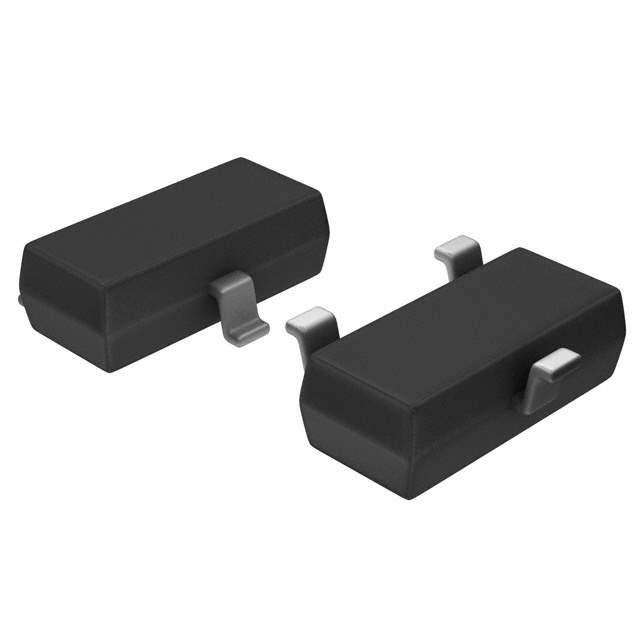

50V VCEO, 500mA collector ceiling, 200mW dissipation, SMT3 package, and 4.7k/4.7k built-in bias resistors
Quick Engineering Summary
| Field | Value |
|---|---|
| Manufacturer | Rohm Semiconductor |
| Category | Transistors (BJT) - Single, Pre - Biased |
| Package | SMT3 |
| Core function | TRANS PREBIAS NPN 50V 0. |
| Key electrical range | Collector Cut-off Current(Max): 500nA; Frequency - Transition: 200MHz; Maximum Current Collector: 500mA; Maximum Power Dissipation: 200mW |
| Reported stock | 42000 pcs reported — confirm on RFQ |
50V is useful, but 200mW is the real limiter
50V is the headline ceiling. It settles the collector-emitter voltage question for low-power control work and lets DTD143EKT146 sit on rails and switched nodes that would rule out a lower-voltage digital transistor.
The harder limit is 200mW maximum power dissipation in SMT3, because that number decides whether the part remains a small-signal switch or becomes a board-level heat problem. Set beside the 500mA maximum collector current, it reads as a warning not to treat the current figure as a comfortable operating point but as an absolute ceiling, especially when the package thermal path is still unspecified in the summary.
The 300mV max VCE(sat) at 2.5mA and 50mA is useful in its stated condition because it points to low saturation loss at modest load current, but it does not justify carrying the same expectation up to the 500mA limit. hFE is 47 at 50mA and 5V, enough to frame behavior around that test point and no further than that without more thermal and switching detail.
Wrong for adjustable bias, right for simple rail-side switching
Wrong for adjustable bias. If you need to choose your own base network, tune edge speed, or pull every bit of drive current from a GPIO, this is not the device to start with.
The reason is simple: DTD143EKT146 already fixes the network at 4.7k on R1 and 4.7k on R2, and that built-in choice is the whole value proposition. Where it fits is repetitive housekeeping work with fewer externals, such as level shifting, small load switching, and logic-driven control paths where an NPN pre-biased transistor in SMT3 is more useful than a bare BJT.
The 50V VCEO ceiling gives rail margin for industrial-style low-power nodes, while the 500nA maximum collector cut-off current keeps off-state leakage from becoming the first thing you notice. The 200MHz transition frequency is listed, but it is not the deciding number here; the fixed resistor network and the absence of switching curves will shape real edge behavior first.
Active status makes the buy decision easy
Buy it.
Active status, aligned lifecycle signals, listed stock of 42000, and reel packaging make the near-term decision straightforward for a running line. EU RoHS is compliant. The planning catch is the estimated 2028 EOL date, so don't treat DTD143EKT146 as a forever choice for very long platform lives.
The missing curves are what still block confidence
200mW is the decisive figure. The summary still leaves out thermal resistance, a derating curve, package drawing detail, reverse-recovery time, junction capacitance, and pinout.
View the Win-Source product page for DTD143EKT146.
Key Takeaways for Engineers & Buyers
- Keep DTD143EKT146 off loads that push toward the 500mA collector limit unless the 200mW package budget is already closed.
- Use the built-in 4.7k R1 and 4.7k R2 only where that bias network matches the drive source and turn-off behavior you want.
- Buy DTD143EKT146 on reel for the running line while 42000 pieces are available.