
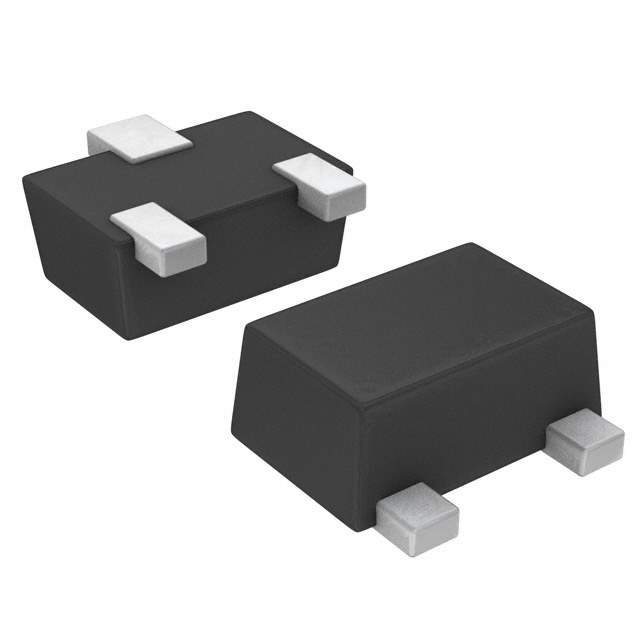
12 V, 500 mA, 150 mW, SOT-723 pre-biased NPN; power is the first limit to check
Quick Engineering Summary
| Field | Value |
|---|---|
| Manufacturer | Rohm Semiconductor |
| Category | RF Transistors (BJT) |
| Package | Tape & Reel (TR) |
| Core function | TRANS PREBIAS NPN 12V 0. |
| Key electrical range | Current - Collector (Ic) (Max): 500 mA; Current - Collector Cutoff (Max): 500nA; DC Current Gain (hFE) (Min) @ Ic, Vce: 115 @ 100mA, 2V; Frequency - Transition: 260 MHz |
| Reported stock | 8000 pcs reported — confirm on RFQ |
150 mW is the number that decides DTD543EMT2L
150 mW decides this part. DTD543EMT2L may list 500 mA collector current and 12 V collector-emitter breakdown, but both are ceilings, not a sign that the tiny SOT-723 body can sit comfortably anywhere near them at the same time.
The more useful clue is the saturation point: 300mV @ 5mA, 100mA. That anchors a defined low-drop state at 100mA with 5mA base drive, and because this is a pre-biased NPN with 4.7 kOhms on R1 and 4.7 kOhms on R2, the drive network is part of the device choice. The 12 V breakdown ceiling shuts out higher-voltage rails. The 500nA collector cutoff ceiling matters when off-state leakage is part of the budget. In practice, DTD543EMT2L fits low-power switching on low rails, where the resistor network and tiny footprint are the reason to use it.
Not for rail headroom or heat, but useful in dense logic switching
Wrong first: this part does not suit designs that need voltage margin, thermal slack, or freedom to choose a base network. A 12 V collector-emitter breakdown ceiling rules out the common habit of stretching a small transistor across whatever rail is nearby, and 150 mW tightens the dissipation budget quickly.
It does fit compact board-level switching where built-in bias resistors save parts and routing. The minimum hFE of 115 @ 100mA, 2V is solid at that test point, and the 300mV @ 5mA, 100mA saturation ceiling keeps low-current switching credible. The 260 MHz transition frequency is listed, but in most uses of a pre-biased NPN in VMT3, package limits, resistor values, and power ceiling will settle the choice before ft does.
The buy call is simple: reel planning matters
So the purchasing call is simple. Stock is 8000, standard package is 8,000, and packaging is Tape & Reel, which makes DTD543EMT2L a clean fit for a running SMT line when the build matches reel usage.
The listing still leaves a few design-closing holes
The weak point is missing detail, not lifecycle. DTD543EMT2L is Active, MSL 1 (Unlimited), EU RoHS compliant, and REACH Unaffected, so the commercial and handling side is straightforward.
The electrical close still has gaps. No thermal resistance figure appears here, so the 150 mW ceiling cannot be tied to ambient headroom from this page alone. No pinout or package drawing appears here either, even with SOT-723 and VMT3 named, so footprint and orientation still depend on the datasheet. Switching-time data is also absent, along with a capacitance figure, and that matters if DTD543EMT2L is pushed past slow logic-level switching into edge-sensitive paths.
View the Win-Source product page for DTD543EMT2L.
Key Takeaways for Engineers & Buyers
- Keep DTD543EMT2L off rails above 12 V; that number is a breakdown ceiling, not an operating target.
- Budget around 150 mW first, then 500 mA; the package is SOT-723 and the power limit is the tighter constraint.
- Buy DTD543EMT2L in reel quantities that match 8,000 standard pack and current stock of 8000.