
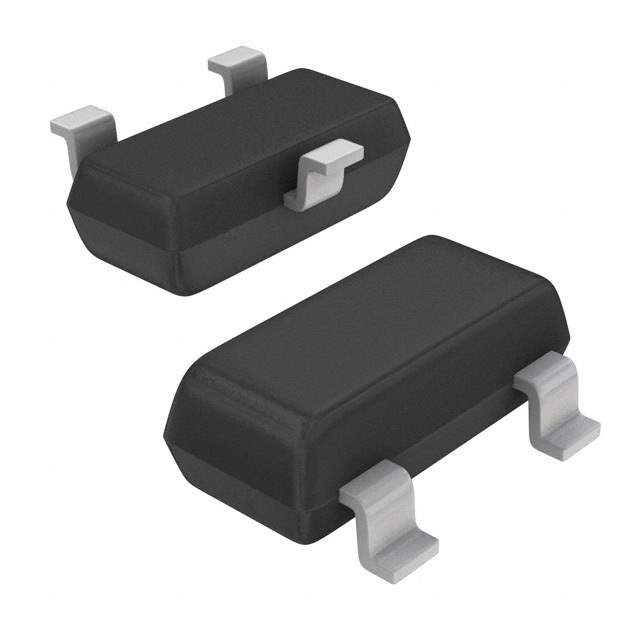
30V VCEO ceiling, 200mA collector limit, 150mW cap, EMT3 package, built-in 1k and 10k resistors
Quick Engineering Summary
| Field | Value |
|---|---|
| Manufacturer | Rohm Semiconductor |
| Category | Transistors (BJT) - Single, Pre - Biased |
| Package | EMT3 |
| Core function | TRANS PREBIAS NPN 30V 0. |
| Key electrical range | Collector Cut-off Current(Max): 500nA; Frequency - Transition: 260MHz; Maximum Current Collector: 200mA; Maximum Power Dissipation: 150mW |
| Reported stock | 1 pcs reported — confirm on RFQ |
Not for fresh platforms, still usable on a running line
Wrong for a clean-sheet program. Fine on an existing board that already expects a pre-biased NPN in EMT3 and stays within the listed limits.
DTD713ZETL carries the awkward combination of Active and Not For New Designs, so the practical call is sustaining only. That matters more than the device category, because lifecycle ambiguity can block approvals long before the 30V VCEO ceiling or the 200mA collector limit becomes the issue. EU RoHS compliance is clear, but it does nothing to settle the lifecycle conflict.
Can you actually buy DTD713ZETL today?
Can you get it now? Listed stock is 1 and packaging is Reel - TR, so this source alone does not cover immediate line demand.
The built-in resistor network is the real fit test
The weak point is flexibility. The strong point is integration.
This is not a general small-signal NPN you can bias any way you like; it is a pre-biased NPN with R1 fixed at 1k and R2 fixed at 10k. That works for simple logic-drive, pull-down, and switching jobs when those values already match the circuit, and it fails when base drive needs tuning, leakage shaping, or different turn-off behavior. If the existing schematic used discrete bias resistors with other values, this part changes the circuit rather than just the footprint.
The listed hFE minimum of 140 @ 100mA, 2V matters only after the resistor network already fits. The 260MHz transition frequency is listed too, but without switching waveforms or capacitance data, it does not settle a fast-edge decision on its own.
Three ceilings decide whether DTD713ZETL survives the job
The numbers create a tight box: voltage, current, and heat all close in quickly.
Start with 30V VCEO. That is a collector-emitter ceiling, not a suggested rail, so it rules out higher-voltage rails, inductive nodes with poorly controlled overshoot, and any design that treats breakdown as margin instead of failure. Get that wrong and field returns are part of the design.
Then there is the 200mA maximum collector current. Ceiling again. It places the device in signal-level switching and light load control, not in outputs that live near the current limit. The 150mW maximum power dissipation narrows the window further, because current capability on paper does not mean the EMT3 body can shed the resulting heat in the actual board stackup.
The saturation listing, 300mV @ 2.5mA, 50mA, is useful because it ties voltage drop to a stated drive and load condition. That gives a real dissipation clue for low-side switching around that point, but only around that point; it says nothing about other currents and does not justify leaning on the full 200mA collector ceiling.
Leakage is controlled at 500nA collector cut-off current max, which helps when the off-state matters. Small number. Still a limit, not a blanket promise across every temperature corner.
The missing thermal and switching data still matters
260MHz is listed, but that number alone does not answer the switching question.
DTD713ZETL would be easier to sign off with thermal resistance, a derating curve, pinout detail, and a package drawing in hand. Reverse-recovery time does not apply to this BJT, but switching waveforms or capacitance data would still determine whether the 260MHz figure means anything useful in the edge-rate budget. ECAD access is listed separately, not the actual mechanical or electrical detail.
View the Win-Source product page for DTD713ZETL.
Key Takeaways for Engineers & Buyers
- Hold DTD713ZETL for existing production only; the status conflict is the real program risk.
- Check the rail against the 30V VCEO ceiling before reusing DTD713ZETL on any higher-voltage node.
- Budget heat from the 150mW limit and the 300mV @ 2.5mA, 50mA saturation listing before committing the EMT3 footprint.