
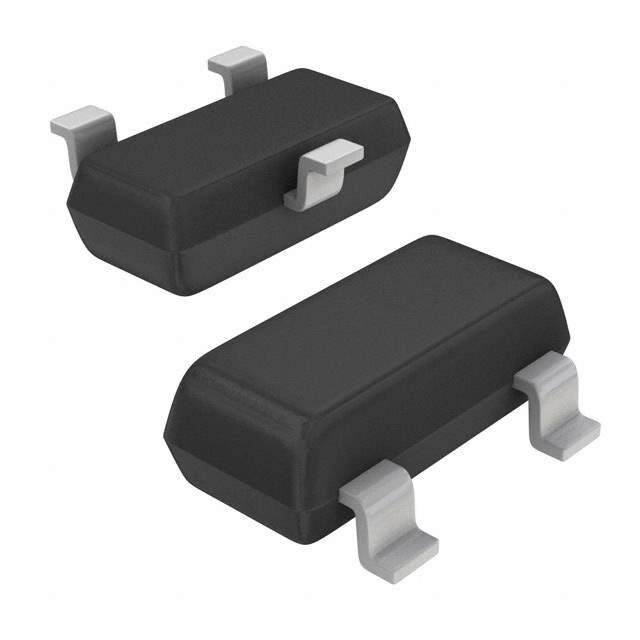
30V VCEO, 200mA collector ceiling, 150mW dissipation, EMT3 pre-biased NPN with 4.7k/4.7k resistors
Quick Engineering Summary
| Field | Value |
|---|---|
| Manufacturer | Rohm Semiconductor |
| Category | Transistors (BJT) - Single, Pre - Biased |
| Package | EMT3 |
| Core function | TRANS PREBIAS NPN 30V 0. |
| Key electrical range | Collector Cut-off Current(Max): 500nA; Frequency - Transition: 260MHz; Maximum Current Collector: 200mA; Maximum Power Dissipation: 150mW |
| Reported stock | 7395 pcs reported — confirm on RFQ |
30V is the first gate, but not the whole decision
30V is the hard rail ceiling on DTD743EETL. If the collector-emitter path can ever see more than 30V, stop.
That still leaves the harder part of the call. The other limits that matter are 200mA maximum collector current and 150mW maximum power dissipation, and they have to be read together because a small pre-biased NPN in EMT3 can run into the package power ceiling before the current ceiling becomes practically usable once saturation loss and ambient headroom enter the picture.
The listed 300mV max VCE(sat) at 2.5mA, 50mA helps, but only at that test point. It shows reasonably low loss there, not across the rest of the operating range. The listing also lacks the thermal detail that would settle the margin question cleanly: no thermal resistance and no derating curve.
Can you start a new BOM with it?
Can you put it on a new BOM? Not comfortably.
DTD743EETL shows an Active lifecycle field, but it also carries Not For New Designs. That conflict is the real story. For a running line, 7395 pieces on hand and reel packaging make it workable for scheduled builds. For a new platform, the conservative answer is no.
Use it where the BOM already exists, and secure the reel quantity needed for that build window instead of rolling it into a fresh release. EU RoHS is compliant, so compliance is not the blocker. Lifecycle ambiguity is.
7395 pieces help, but they don't answer the review
7395 pieces help near-term builds. They do not resolve the lifecycle conflict or the missing basics for electrical signoff: no pinout, no package drawing, no thermal resistance, and no derating curve.
Wrong for rail or load margin, right for compact bias-saving switching
Wrong for rail or load margin.
A 30V VCEO ceiling and 200mA collector ceiling keep DTD743EETL in the small-signal switching lane, not in loads that see rail spikes, startup surges, or sustained collector current near the top of the listing.
It fits better in dense board work that benefits from the built-in 4.7k base resistor and 4.7k emitter-base resistor, since those values remove external bias parts and help the EMT3 footprint earn its place. The 115 minimum hFE at 100mA, 2V shows the transistor is characterized in a meaningful load region. The 500nA collector cut-off current keeps off-state leakage from becoming the first problem in ordinary logic-driven switching. The 260MHz transition frequency is only a family-level speed hint; without switching curves or capacitance, it does not predict edge behavior in your circuit.
View the Win-Source product page for DTD743EETL.
Key Takeaways for Engineers & Buyers
- Freeze DTD743EETL to existing production unless the Not For New Designs flag is cleared internally.
- Keep collector stress below the 30V VCEO ceiling; that number does not settle switching behavior.
- Budget heat against the 150mW package ceiling before using the 200mA collector limit.