
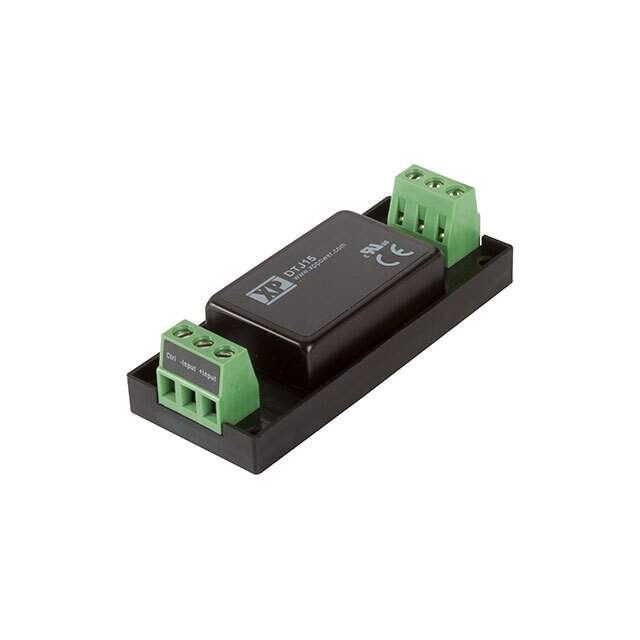
9V to 36V input, 12V output at 1.25A max, 15W, 3 kV isolation, chassis-mount enclosed box
Quick Engineering Summary
| Field | Value |
|---|---|
| Manufacturer | XP Power |
| Category | External/Internal (Off - Board) DC DC Converters |
| Package | Box |
| Core function | DC/DC CONVERTER 12V 15W |
| Key electrical range | Current - Output (Max): 1.25A; Number of Outputs: 1; Power (Watts): 15W; Temperature Range - Operating: -40°C ~ 100°C (With Derating) |
| Reported stock | 1 pcs reported — confirm on RFQ |
Why the lifecycle call is cautious, not negative
And that is the real verdict: DTJ1524S12 is usable for new work, but only with a supply plan attached. The lifecycle status is Unknown, not EOL or NRND, so the data does not force a redesign away from it. The immediate issue is availability: listed stock is 1, while the standard package is 6. For an existing production build, secure material first. For a fresh release, don't let this converter stand as the only qualified source on the BOM.
The fit is otherwise straightforward. It is an enclosed, chassis-mount, off-board DC/DC converter aimed at ITE (Commercial), with CB and UL approvals and EU RoHS compliance. That points to equipment-level power conversion inside commercial systems rather than a board-level power stage where footprint and solder profile would drive the choice.
36V is the rail ceiling that decides inclusion
36V is the input ceiling, and 9V is the floor. That pair decides whether DTJ1524S12 belongs in your power tree at all; it does not speak to transient survival outside that window.
The package and limits point to equipment power, not board power
The constraint is physical integration under a derated thermal envelope. DTJ1524S12 is a chassis-mount enclosed box at 3.00" L x 1.24" W x 0.77" H, so you are designing around a mounted converter module, not dropping a board-level brick into spare copper. That matters because the operating range is listed as -40°C to 100°C with derating, and the derating curve is not shown here. Without that curve, the temperature number is only a boundary statement, and it leaves open how much of the 15W rating remains available at the hot end once mounting and enclosure conditions are real rather than nominal.
The output side is clear, but only to a point. The listing gives 12V output, 1.25A maximum, and 15W. Those are load ceilings, not a promise that every ambient and mounting condition supports full output. The 87% efficiency helps the case for a compact enclosed converter, but it does not answer the thermal question that sets enclosure temperature rise and mounting margin.
The 3 kV isolation is the other number that changes placement. It supports use where input-to-output isolation is a design requirement, but isolation voltage alone does not settle creepage, clearance, or system safety construction. For ITE equipment under 62368-1, DTJ1524S12 looks directionally right. Outside that commercial equipment lane, the listing stops short.
The missing curves are what still block a clean release
Not ready yet.
The biggest gap is the derating curve behind the -40°C to 100°C operating range. That curve decides ambient headroom at 15W, and it is absent here. The listing also still needs the mechanical drawing or pinout, because chassis mount and box dimensions alone do not tell you connector orientation or mounting-hole placement.
Ripple and noise, plus line and load regulation, are also still missing. Those details decide whether DTJ1524S12 can feed sensitive downstream loads without extra filtering or local regulation.
View the Win-Source product page for DTJ1524S12.
Key Takeaways for Engineers & Buyers
- Lock the mechanical envelope early: 3.00" x 1.24" x 0.77" chassis-mount box.
- Hold input excursions inside 9V to 36V; those numbers decide whether DTJ1524S12 is even in bounds.
- Plan supply around stock of 1 and a standard package of 6.