
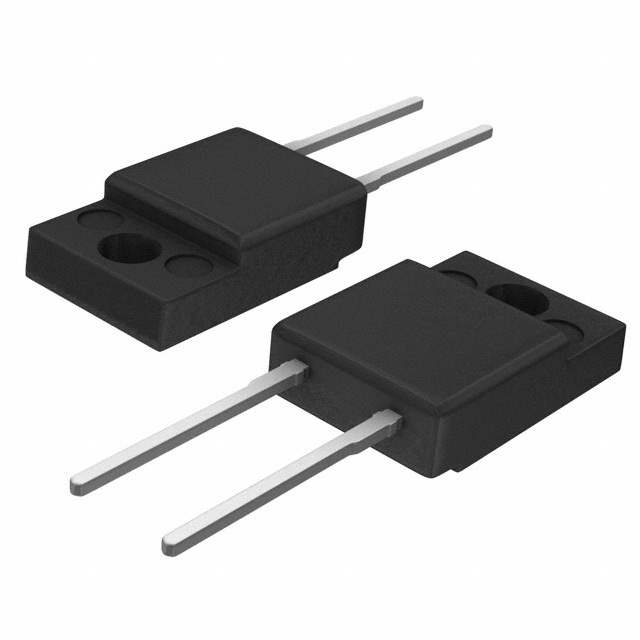
1500V reverse-voltage ceiling, 6A average rectified ceiling, TO-220FPAC through-hole, 175°C junction max
Quick Engineering Summary
| Field | Value |
|---|---|
| Manufacturer | STMicroelectronics |
| Category | Diodes, Rectifiers - Single |
| Package | TO-220FPAC |
| Core function | DIODE STD 1500V 6A TO220FPAC |
| Key electrical range | Current - Average Rectified (Io): 6A; Current - Reverse Leakage @ Vr: 100μA @ 1500V; Operating Temperature - Junction: 175°C (Max); Speed(Frequency): Standard Recovery >500ns, > 200mA (Io) |
| Reported stock | 200 pcs reported — confirm on RFQ |
Not for new design-in
Don't start here.
DTV1500SDFP has a direct lifecycle conflict: one field says Unknown, while another says Obsolete(EOL). Treat the EOL flag as decisive and keep the part out of fresh design work.
Use it only to keep a running line alive. The stock figure is 200 and the packaging is Tube/Rail, so the practical move is to reserve DTV1500SDFP for builds already qualified around this exact diode and keep it out of new assemblies. EU RoHS is listed, but compliance does not change the lifecycle risk.
The weak point is speed; the strong point is voltage
Speed is the limitation first. This is a Standard diode with 1μs reverse recovery time, and the speed field calls out Standard Recovery >500ns, > 200mA (Io). That rules out designs where reverse-recovery behavior is a first-order loss or noise term, because DTV1500SDFP is not positioned as a fast or ultrafast rectifier.
Voltage standoff is the reason it stays in the conversation. The reverse-voltage ceiling is 1500V (1.5kV), and that number decides whether the diode can sit on a high-voltage rectifier node at all. If that ceiling is wrong for the node, nothing else on the listing matters.
The 6A average rectified current is also a ceiling, not a normal operating point. It places the part in moderate-current through-hole power stages, but it says nothing about surge behavior, overload tolerance, or pulsed stress because no surge-current figure is listed here. Then there is the forward-drop pair: 1.75V @ 6A. That is the conduction-loss budget the listing gives you, and it will drive thermal decisions long before the 175°C junction maximum starts to sound reassuring.
That 175°C value is still only a junction ceiling. It tells you how hot the silicon may get, not what ambient the assembly can support continuously, and without thermal resistance or a derating curve, the real headroom remains open.
Wrong for fast switching, right for high-voltage rectification
Not for high-frequency switching stages. The 1μs trr and Standard recovery label settle that before package choice enters the discussion.
Its fit is narrower and more straightforward: a through-hole high-voltage rectifier position that needs a single standard diode, can live with TO-220FPAC, and is selected around a 1500V ceiling rather than speed. The 6A average rectified ceiling keeps it out of heavier current paths, while the 1.75V @ 6A figure makes clear that conduction loss is part of the selection, not a footnote. In practice, DTV1500SDFP belongs where voltage standoff is the first filter and switching softness is not the main criterion.
The missing thermal and mechanical details still matter
The constraint is incomplete closure on heat and fit.
You have TO-220FPAC and through-hole, but no pinout or package drawing, so footprint release still depends on the full datasheet.
The bigger gap is thermal and stress data. The listing does not give thermal resistance, derating curve, or surge current, and those are the numbers that decide startup survival, ambient tolerance, and how much margin the package really has once the 1.75V @ 6A drop is in the thermal path.
View the Win-Source product page for DTV1500SDFP.
Key Takeaways for Engineers & Buyers
- Block DTV1500SDFP from new BOM releases; the listing carries Obsolete(EOL).
- Check reverse-voltage headroom against the 1500V ceiling before using DTV1500SDFP on any high-line rectifier node.
- Budget conduction loss from the listed 1.75V at 6A pair; that number sets the thermal discussion, not the package name.