
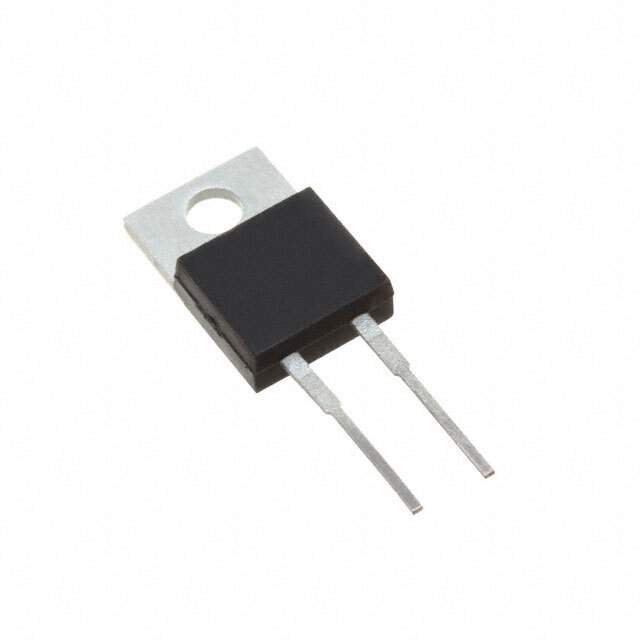
1500V reverse ceiling, 10A average rectified ceiling, TO-220AC through-hole, -55°C to 150°C junction
Quick Engineering Summary
| Field | Value |
|---|---|
| Manufacturer | Vishay |
| Category | Diodes, Rectifiers - Single |
| Package | TO-220AC |
| Core function | DIODE STANDARD 1500V 10A TO220AC |
| Key electrical range | Current - Average Rectified (Io): 10A; Current - Reverse Leakage @ Vr: 100μA @ 1500V; Operating Temperature - Junction: -55°C to 150°C; Speed(Frequency): Fast Recovery = 200mA (Io) |
| Reported stock | 2 pcs reported — confirm on RFQ |
1500V is the reason to use it
1500V is the decisive number here. Once a rail can swing toward that reverse limit, lower-voltage diodes are out before current or package even enter the discussion.
The rest of the listing narrows the use case. The 10A average rectified rating is a ceiling, not a promise in your assembly, and the 1.8V maximum at 6A says conduction loss will matter well before this becomes a casual drop-in on a cramped board. This is a high-voltage through-hole rectifier with real thermal consequences. Use DTV56L-E3/45 when reverse margin is the job.
The constraint is thermal headroom, not headline current
The constraint the numbers create is thermal headroom. Current is listed at 10A, but the forward-drop figure is only given as 1.8V maximum at 6A, so dissipation stays a budget question rather than a solved one.
That pair closes some decisions and leaves others open. It tells you this diode will not behave like a low-drop part at meaningful load. It does not tell you junction rise in your layout, because thermal resistance and derating are absent.
The -55°C to 150°C junction range is also a set of ceilings, not ambient permission. It tells you the silicon can span harsh temperature conditions if the package can move heat out. It does not tell you how much current DTV56L-E3/45 can really carry at your ambient, on your copper, with your mounting.
Wrong for compact fast-switch stages
Wrong for compact fast-switch stages. If board density, surface-mount assembly, or very fast commutation behavior drives the choice, this is not the first place to look.
It is through-hole in TO-220AC, packaged Tube/Rail, and its reverse recovery is listed at 135ns. Useful, yes. Not enough to turn it into a switching-loss story by itself.
Where it fits is a discrete single-rectifier position that can accept through-hole assembly and needs a standard diode with a 1500V reverse ceiling. The leakage figure, 100μA at 1500V, matters because it tells you what the part is allowed to draw at the top of its reverse rating; it does not tell you leakage at lower reverse bias, and it does not rescue a design already tight on standby loss.
2 pieces on hand is the real buying limit
2 pieces changes the conversation immediately. Whatever the broader supply picture says, DTV56L-E3/45 is not sitting here in a quantity that supports a fresh release, and the lifecycle picture is still muddy because one field says Unknown while another says Active.
That combination pushes the verdict toward sustaining use. If DTV56L-E3/45 is already on a running line, cover the next build and clear the lifecycle status with Vishay before it goes back onto an unrestricted AVL. For a new design, this record does not support confidence on continuity, even though EU RoHS compliance is clean.
Packaging matters too. Tube/Rail is normal for a through-hole TO-220AC device, but it also signals that this is not positioned here as a high-volume reel-fed assembly choice. Reserve the available stock for existing production rather than spreading it across prototype work.
The missing thermal picture still matters
The weak point is plain: the listing omits thermal resistance, derating curve, junction capacitance, and a package drawing or pinout. DTV56L-E3/45 gives you trr at 135ns, but those gaps still leave heatsinking, switching loss, and mechanical fit open.
View the Win-Source product page for DTV56L-E3/45.
Key Takeaways for Engineers & Buyers
- Hold DTV56L-E3/45 to rails that need the full 1500V reverse ceiling; don't spend TO-220AC board area on lower-voltage rails without a reason.
- Budget conduction loss from the listed 1.8V at 6A pair; that number decides whether the thermal path in TO-220AC is acceptable.
- Buy only to a build plan now: stock is 2 pieces and packaging is Tube/Rail.