
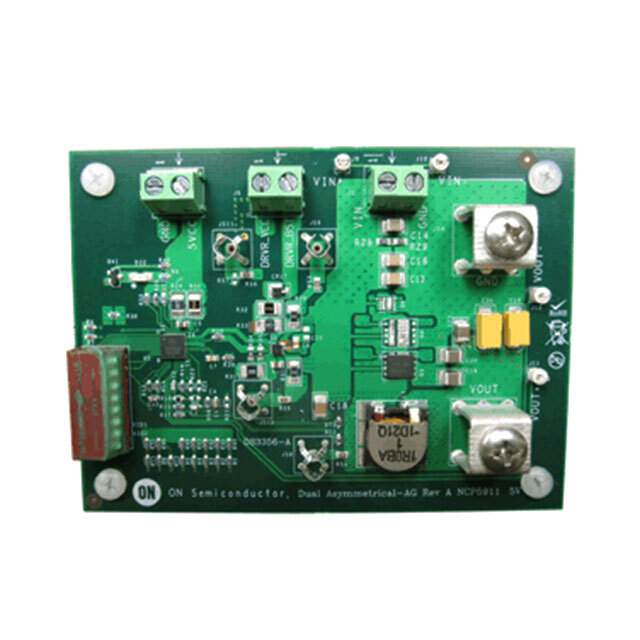
8 V to 19 V input, 0.8 V to 1.4 V output, 20 A, 330kHz buck evaluation board
Quick Engineering Summary
| Field | Value |
|---|---|
| Manufacturer | ON Semiconductor |
| Category | Evaluation Boards - DC/DC & AC/DC (Off - Line)SMPS |
| Package | Not listed for this part |
| Core function | EVAL BOARD FOR NCP5386B NCP5901B |
| Key electrical range | Frequency - Switching: 330kHz; Output Current: 20A; Outputs and Type: 1, Non-Isolated; Supply and Demand Status: Limited |
| Reported stock | 1 pcs reported — confirm on RFQ |
1 board available changes the buying call
1 unit is on hand. That alone shifts DUALASYMB12VGEVB into bench-tool territory rather than anything you would build a rollout around.
Active lifecycle and EU RoHS compliance still support new design-in for evaluation use. Move quickly if you need this exact board.
20A is the ceiling that decides whether this board is relevant
20A is the deciding figure. It puts DUALASYMB12VGEVB in low-voltage, high-current buck evaluation, not light-load housekeeping rails, and it should be read as a hard ceiling.
The rest of the envelope is narrow in a useful way. Input is 8 V to 19 V, so it fits intermediate rails and bench supplies in that span. Output is 0.8 V to 1.4 V with 1 non-isolated output, which points directly to core-rail work and rules out higher-voltage secondary rails without extra conversion. The 330kHz switching frequency also matters, because magnetics, ripple behavior, and transient tuning all sit around it, but this listing stops short of the waveforms or compensation detail that would show how forgiving the board is under fast load change.
So this is a lab vehicle, not a production building block
So the fit is specific. DUALASYMB12VGEVB belongs on a bench when you need to evaluate the NCP5386B and NCP5901B around a 0.8 V to 1.4 V rail at meaningful current, with an upstream source between 8 V and 19 V.
The fully populated board type helps because you are buying time, not bare PCB real estate. It does not belong in a BOM that expects long-run board-level continuity, because the product itself is an evaluation board in box packaging with contents listed only as Board(s). If the job is to prove control behavior, startup sequence, or rail interaction before a custom layout, it fits. If the job is to qualify a shippable power stage, this page stops short.
The weak point is documentation depth, not the electrical envelope
The weak point comes first: the listing does not say enough about how the board is built, even though the electrical envelope is clear.
You get topology, current ceiling, voltage spans, and switching frequency. You do not get the details that close a serious bench review. The missing items that matter are the schematic or pinout, the board drawing, and the thermal information. Without those, you cannot see connector assignment, copper strategy, or where heat leaves the board as you push toward 20A. The listing also omits switching waveforms and any efficiency or transient plots, and those are the first documents that tell you whether 330kHz on this platform behaves cleanly enough for the rail you care about.
One more gap is practical, not fatal. Storage condition is called out as dry storage cabinet and humidity protection package, but there is no MSL field. For an evaluation board that matters less than it would for a bare IC, yet handling expectations still remain unstated.
View the Win-Source product page for DUALASYMB12VGEVB.
Key Takeaways for Engineers & Buyers
- Treat 20A as the board ceiling; map your load step and copper heating before copying it into a design.
- Keep the input rail inside 8 V to 19 V; that range decides whether DUALASYMB12VGEVB is even the right bench platform.
- Buy the single available board now if this lab setup matters; stock is 1 and supply status is Limited.