
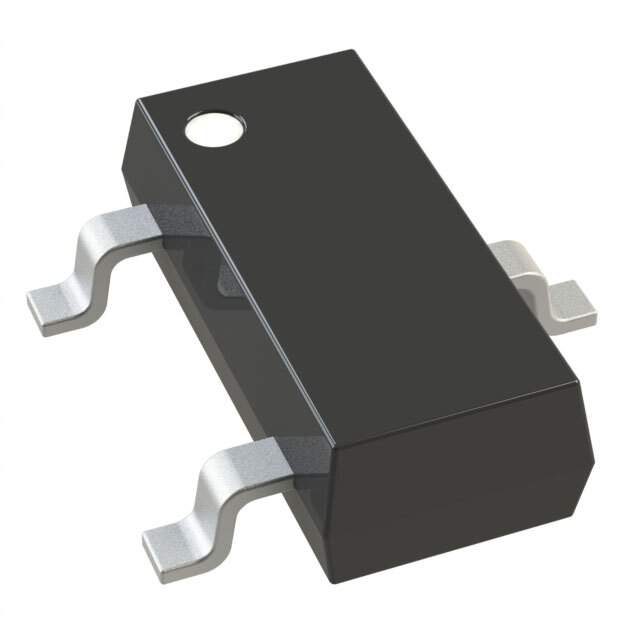
32V reverse standoff, 66V max clamp, 8A peak pulse, 350W peak pulse in SOT-23-3
Quick Engineering Summary
| Field | Value |
|---|---|
| Manufacturer | Diodes Incorporated |
| Category | TVS - Diodes |
| Package | Tape & Reel |
| Core function | TVS DIODE 32VWM 66VC SOT233 |
| Key electrical range | Capacitance @ Frequency: 30pF @ 1MHz (Max); Current - Peak Pulse (10/1000µs): 8A; Power - Peak Pulse: 350W; Power Line Protection: No |
| Reported stock | 610 pcs reported — confirm on RFQ |
Can you start a new design on DUP3105SOQ-7?
Can this part protect the line you actually have? Yes, when the rail and surge target fit its limits. The device is Active, AEC-Q101 is listed in the series field, and you get two bidirectional channels in SOT-23-3 for compact board-level protection on automotive-adjacent signal lines.
Voltage decides it. The 32V reverse standoff is a ceiling for normal bias, not a recommendation for every 32V net, and the 66V maximum clamping voltage is what the protected node may still see during the specified pulse event. If the downstream silicon cannot tolerate that clamp level, this is the wrong protector even when lifecycle and package fit.
The clamp ceiling is the real design gate
This is the gate.
The key numbers are linked: 66V maximum clamping voltage at 8A peak pulse on a 10/1000µs waveform, with 350W peak pulse also listed. Those are surge-event ceilings, and they decide whether the part keeps a transient inside the survival window of the IC behind it; they do not describe normal line voltage. The 35.6V minimum breakdown matters too, because conduction starts above the 32V reverse standoff ceiling, leaving a defined gap between normal bias and protection turn-on.
Not for power rails; useful on compact signal protection
Power-line protection is the wrong job. The listing says "Power Line Protection: No," and that rules out using it as a mains or supply-entry answer.
It fits dense SMT protection where board area is tight and two bidirectional channels help. The SOT-23-3 package and 30pF maximum capacitance at 1MHz point to lines that need transient protection without a larger TVS body, though that capacitance ceiling still has to work with the interface on the line. Automotive is named, and AEC-Q101 is listed, which is stronger than a generic TVS entry, but the 32V standoff and 66V clamp are still the hard boundaries.
610 pieces is the buying constraint
610 pieces are on hand. The standard package is 3,000 and the format is Tape & Reel.
What the listing still does not answer
30pF at 1MHz is useful, but it doesn't answer enough by itself. There is no pinout or package drawing here, so board escape and channel assignment are still open questions even though the case is named as TO-236-3, SC-59, SOT-23-3.
The electrical gaps are just as concrete. Reverse leakage is not listed, so standby loading on a high-impedance node remains unknown. Surge detail stops at the 10/1000µs condition tied to the 8A figure, and there is no derating curve or thermal resistance, so ambient headroom and repetitive-stress behavior are still unresolved. For interface-sensitive work, that missing capacitance-versus-bias picture matters as much as the headline 30pF number, because without it you can't judge how the part will load the line across its actual operating range.
View the Win-Source product page for DUP3105SOQ-7.
Key Takeaways for Engineers & Buyers
- Keep the protected line at or below 32V reverse standoff; that ceiling preserves normal operation.
- Check the downstream IC against 66V maximum clamp at 8A; that pair sets the surge survival limit.
- Buy on reel strategy: stock is 610 while the standard package is 3,000.