
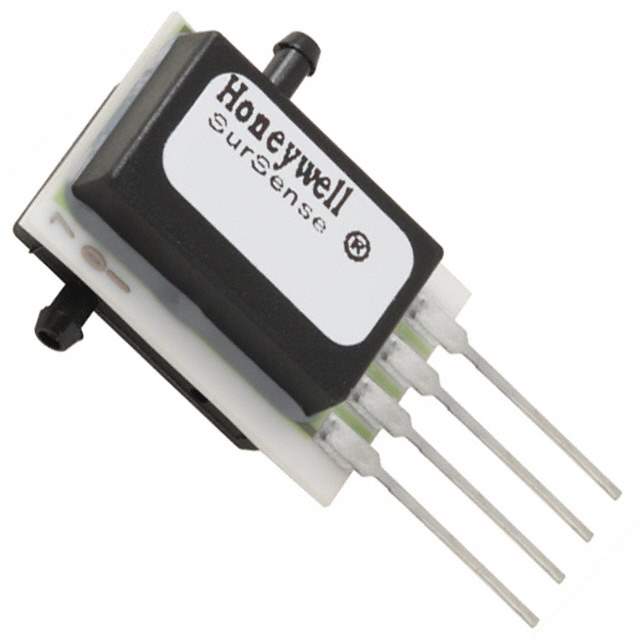
0.72PSI differential, 0 mV to 30 mV at 4.5V, 3V to 8V supply, 4-SIP module, -25°C to 85°C
Quick Engineering Summary
| Field | Value |
|---|---|
| Manufacturer | Honeywell |
| Category | Pressure Sensors, Transducers |
| Package | Tube |
| Core function | SENSOR 0. |
| Key electrical range | Output: 0 mV ~ 30 mV (4.5V); Output Type: Wheatstone Bridge; Temperature Range - Operating: -25°C ~ 85°C; Voltage - Supply: 3V ~ 8V |
| Reported stock | 1 pcs reported — confirm on RFQ |
Can you still buy DUXL20D for a real build?
Can I still build with it? Only if you are covering an existing production problem. DUXL20D is marked Discontinued in both lifecycle fields, the risk level is high, and listed stock is 1, so this is not a realistic starting point for a new build.
The compliance side is straightforward: EU RoHS is listed, and MSL 1 (Unlimited) removes one handling variable. Availability still decides the story. Secure the single unit only to keep a board alive while migration work moves forward.
Too low-range for general pressure work
Wrong for broad pressure ranges or direct high-pressure media. DUXL20D is a differential board-mount sensor centered on 0.72PSI (4.98kPa) operating pressure, with a 7.23PSI (49.83kPa) maximum pressure ceiling.
The weak point is output level, not package
The signal is small. The useful part is that the listing states exactly how small: 0 mV to 30 mV at 4.5V, from a Wheatstone bridge, with a 3V to 8V supply range.
That settles one decision quickly. DUXL20D fits a design that already expects a raw bridge sensor and has front-end gain and noise control ready for millivolt-level output. It does not fit a board that expects a conditioned voltage output or a digital interface, because nothing here says the sensor handles that conditioning for you.
The 3V to 8V supply range gives some rail flexibility, but it does not answer transfer behavior across that range. You know the output span at 4.5V; this page does not tell you how span or offset shift at 3V or 8V, and that matters when the excitation rail is not fixed.
What the listing still doesn’t settle
And that is where the page stops being enough. DUXL20D gives you enough to sort fit from misfit, but not enough to finish the analog design without the datasheet, because the missing details are the ones that drive interface choices and mechanical commitment.
The gaps are concrete: the pinout for the 4-SIP module, the package drawing, and the bridge electrical details that shape interface design, including offset behavior, span behavior versus supply, and any pressure transfer curve beyond the single 0 mV to 30 mV at 4.5V statement. For a low-range differential sensor, those are not side notes; they determine amplifier gain, connector orientation, and whether the mechanical porting lands cleanly on the board once layout is locked.
Mechanical fit is otherwise specific. The part is board mount, uses PC pins, and carries dual male 0.08" (2.03mm) tube barbed ports, so DUXL20D is aimed at tubing-based differential measurements on a PCB rather than remote-cabled sensing or manifold hardware with different port geometry.
The operating temperature range of -25°C to 85°C is a listed operating limit, not a blanket statement that accuracy stays at ±0.5% across every condition that matters to your design.
View the Win-Source product page for DUXL20D.
Key Takeaways for Engineers & Buyers
- Lock DUXL20D to sustaining builds only; stock is 1.
- Budget the signal chain for 0 mV to 30 mV output at 4.5V excitation.
- Match tubing to the dual 0.08" (2.03mm) barbed ports before layout release.