
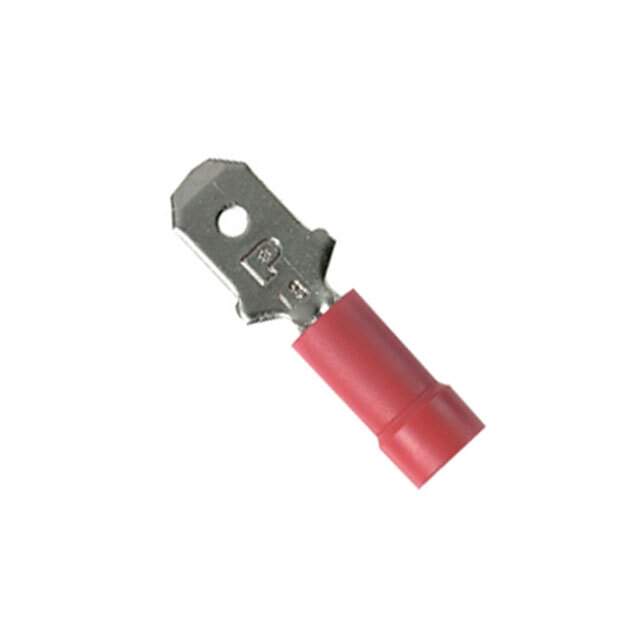
0.250" tab, 0.032" thickness, 18-22 AWG crimp, free-hanging male terminal
Quick Engineering Summary
| Field | Value |
|---|---|
| Manufacturer | Panduit Corp |
| Category | Terminals |
| Package | Bulk |
| Core function | CONN QC TAB 18-22AWG 0. |
| Key electrical range | Not listed for this part |
| Reported stock | 1 pcs reported — confirm on RFQ |
Still, this is a clean new-build choice
And that is the main call: this is a sound design-in when the job is a free-hanging male quick-connect tab rather than a board part or sealed connector system. The lifecycle is Active with no conflict, EU RoHS is compliant, and MSL is not applicable.
What decides the fit is mechanical, not electrical. It is a free-hanging, in-line crimp terminal in a standard male tab format, so it belongs in harnesses and lead sets where the mating side is already built around that geometry.
The wire range is narrow, and that is the point
The limitation comes first: the listed wire range is only 18-22 AWG, so this terminal will not cover a broader harness mix with one part. If the build moves outside that range, the crimp fit is out of bounds.
That same narrowness is also what makes the rest of the geometry useful. The 0.250" (6.35mm) tab width and 0.032" (0.81mm) tab thickness set mating compatibility, and if either one is wrong the failure starts as a mechanical mismatch long before anything else. The 0.980" (24.89mm) overall length and 0.154" (3.91mm) insulation diameter matter in tighter in-line runs, but they do not answer insertion force, retention, or current handling.
Wrong for boards; right for harness terminations
Not for PCB landings. Not for compact sealed interconnects either.
This is a free-hanging male crimp terminal, so it fits cable assemblies, appliance leads, and general wire-to-wire or wire-to-device quick-connect points where a 0.250" tab is already the mating standard.
Construction details line up with that role: copper contact material, nickel finish, a butted seam, and non-mating-end insulation. Those details describe how the terminal is built and handled as a discrete harness element, not as part of a high-density connector family with housing features doing the alignment work.
1 piece on hand is the real buying constraint
1 piece is not a build plan. The stock quantity is 1, the standard package is 100, and the package form is bulk, so the immediate constraint is line readiness rather than lifecycle risk.
There is also a second quantity signal in the record: 69 appears in a separate row quantity field while the stock quantity field shows 1. That mismatch does not change fit or function, but it does matter for near-term planning, especially if DV18-250MB-CY is headed for an active BOM and the release depends on what can actually be pulled.
Bulk packaging matters on the floor too. It points to loose pieces rather than reel or tape presentation, which affects kitting and crimp-station handling assumptions. Buy to the package logic you need, not to the idea that the on-hand count covers more than a sample or repair event.
The missing data is all performance data
0.250" is enough to match mating geometry, but not enough to sign off the connection. Current rating, insulation support details, and the drawing or pin-form dimensions are still needed to close crimp-tooling and mating-retention questions.
View the Win-Source product page for DV18-250MB-CY.
Key Takeaways for Engineers & Buyers
- Match the mating receptacle to the 0.250" tab width and 0.032" tab thickness.
- Keep DV18-250MB-CY on 18-22 AWG wire only; that range is the crimp fit limit listed here.
- Plan around bulk packaging and a standard package of 100, because current stock is 1.