
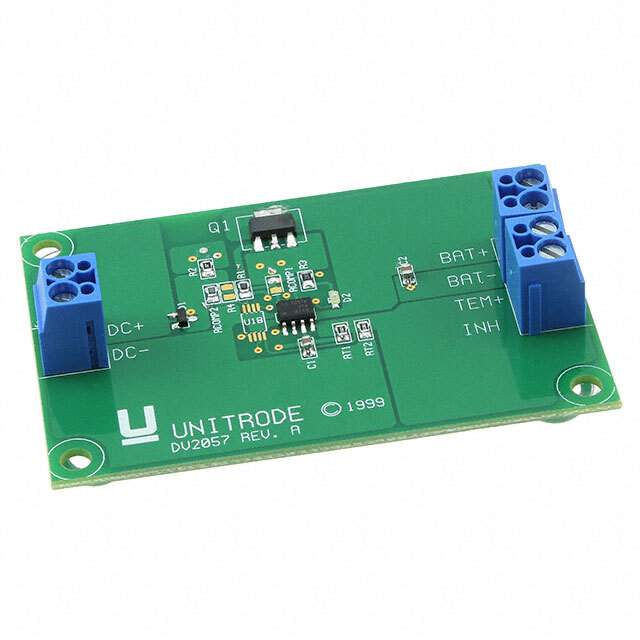
Discontinued battery charger eval board, bulk package, stock 1, MSL 1, built around BQ2057W
Quick Engineering Summary
| Field | Value |
|---|---|
| Manufacturer | Texas Instruments |
| Category | Evaluation and Demonstration Boards and Kits |
| Package | Bulk |
| Core function | EVAL BOARD FOR BQ2057W |
| Key electrical range | EVAL BOARD FOR BQ2057W |
| Reported stock | 1 pcs reported — confirm on RFQ |
Wrong for production hardware, usable for a bench stopgap
Wrong for any new product build, and really for any production plan at all. The board is listed as Discontinued and the available quantity is 1, so the design-in decision ends there.
Its useful role is much narrower: a bench setup around the BQ2057W, where an engineer needs the original evaluation hardware for comparison, bring-up, or a sustaining issue on an existing charger design. The category matters. This is an Evaluation and Demonstration Board and Kit, not a production component, so even with healthy lifecycle status it would belong in lab work first. RoHS is marked Not applicable, which is another reason to keep DV2057W out of a regulated production BOM.
New design-in is closed
New design-in is closed.
The deciding facts here are not electrical limits but supply facts: Standard Package is 1, Stock Quantity is 1, and Package is Bulk. That tells you nothing about charger performance, but it tells you plenty about procurement. This is a single-board event, not a repeatable supply position, so any plan that needs matched units across sites or a second buy later is already broken.
MSL 1 (Unlimited) removes a storage-handling concern. Nothing more. It does not offset discontinued status or turn DV2057W into a safe choice for hardware that must be purchased again.
The real constraint is missing board-level detail
The constraint is missing board-level detail.
The listing never tells you how the board is actually built or connected. You know DV2057W is an eval board for BQ2057W and that the contents are Board(s), but that still leaves the practical review unfinished.
What is missing is concrete: the schematic, connector and pinout information, the board drawing, and the test or operating setup for the charger function. Without that, you cannot tell how power enters the board, what battery connection it expects, or whether the measurement points line up with your lab method. For an evaluation board, those details decide whether bench reuse is quick or whether the board goes nowhere.
Buy it only to unblock one specific task
The weak point comes first: only 1 unit is listed, and the lifecycle status is Discontinued. The useful point is narrower but real. If you need this exact board to reproduce behavior around BQ2057W, the listing is at least clear about what it is and what comes in the box: Board(s), in bulk, as a battery charger evaluation platform.
That makes the buy decision extremely tight. Use DV2057W only when the task is equally tight: reproduce an old lab setup, compare against an existing board on a sustaining program, or replace missing evaluation hardware that a team already knows how to use. Do not treat it as a generic charger development shortcut, because the listing gives you no electrical ceilings, no board-level connection detail, and no path to reorder after this unit is gone.
The open-market fake-threat figure of 46 pct. is not, by itself, a reason to reject every channel. Paired with discontinued status and a quantity of 1, though, it does argue for a tightly scoped transaction tied to an immediate need rather than any attempt to standardize on DV2057W over time.
View the Win-Source product page for DV2057W.
Key Takeaways for Engineers & Buyers
- Do not release DV2057W into a new program; lifecycle is Discontinued.
- Treat the listed stock of 1 as a one-off lab catch, not a running line source.
- Check the BQ2057W board documentation for schematic, connectors, and test setup before relying on DV2057W.