
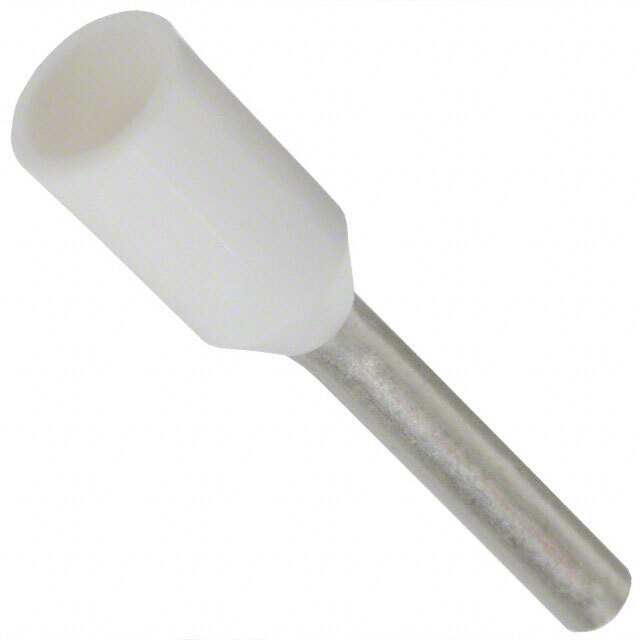
0.250" (6.35mm) female receptacle, 0.032" (0.81mm) tab thickness, 14-16 AWG crimp, free-hanging bulk part
Quick Engineering Summary
| Field | Value |
|---|---|
| Manufacturer | Panduit Corp |
| Category | Terminals - Quick Connects, Quick Disconnect Connectors |
| Package | Bulk |
| Core function | CONN QC RCPT 14-16AWG 0. |
| Key electrical range | Supply and Demand Status: Shortage |
| Reported stock | 2 pcs reported — confirm on RFQ |
Can you put DVF14-250-C on a new harness today?
Can you actually build with it today? Only if the print already calls for this exact quick-connect geometry. DVF14-250-C is Active, and EU RoHS status removes the usual compliance hesitation. Supply is the real stop sign: stock is 2 and the demand signal says Shortage.
That leaves DVF14-250-C as a clean sustaining choice for an existing harness and a cautious new design-in only when the mating tab is already fixed at 0.250" (6.35mm) wide and 0.032" (0.81mm) thick. If those dimensions are still fluid, don't anchor the design to a part you can't pull in volume right now.
The fit is decided by three mechanical numbers
Fit comes first.
This is a print-driven part. The 0.250" (6.35mm) tab width is not a preference; it decides whether the receptacle will mate at all. Get that wrong and the harness fails at first assembly, not in qualification. The 0.032" (0.81mm) tab thickness is the second hard limit, because a quick-connect that is right on width and wrong on thickness still gives you the wrong insertion feel and retention.
The 14-16 AWG wire gauge closes the crimp-side decision. It tells you where DVF14-250-C belongs in the harness and where it does not: branch circuits and lead sets built on 14 AWG or 16 AWG conductors, not lighter control wiring and not heavier feed conductors. The overall length of 0.810" (20.57mm) matters less electrically than physically; it decides whether the receptacle clears adjacent hardware in a dense free-hanging bundle, especially when the non-mating end insulation adds bulk where the wire exits.
Material choices help, but they don't rescue a bad fit. Brass with tin finish is ordinary and serviceable for a crimp quick-disconnect, yet the listing gives no retention force, no insertion force, and no mating-cycle figure, so DVF14-250-C should be treated as a standard harness terminal whose success depends first on tab geometry and conductor size.
Where DVF14-250-C belongs in a build
The constraint is simple: free-hanging, crimp-terminated, bulk-packed. That puts it in wire-to-tab harness work, not on a board and not in any assembly that needs a packaged reel or strip process. The category and mounting call that plainly.
It fits where technicians terminate 14-16 AWG leads onto standard 0.250" tabs in appliances, panels, or internal equipment wiring. The non-mating end insulation is useful when the wire exit needs some protection, but it does not describe the exposed mating interface, so don't read it as a fully insulated disconnect.
What the listing still doesn’t answer
The weak point is documentation depth. You still need the terminal drawing, the recommended crimp tooling, and the mating-tab retention or insertion data to close a release on DVF14-250-C. The listing also does not show insulation material details.
View the Win-Source product page for DVF14-250-C.
Key Takeaways for Engineers & Buyers
- Match the mating blade to 0.250" (6.35mm) width and 0.032" (0.81mm) thickness before releasing DVF14-250-C.
- Keep DVF14-250-C on 14-16 AWG conductors; the crimp range is the fit limit here.
- Cover only the non-mating end in the harness layout; insulation is not called out on the mating side.