
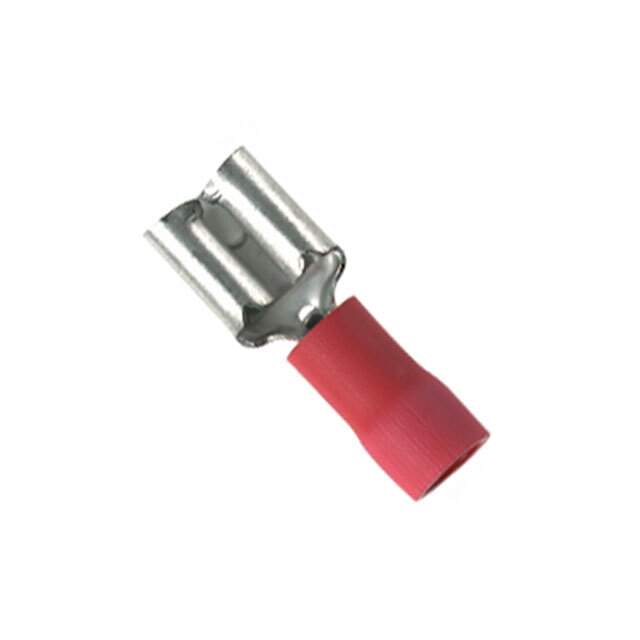
18-22 AWG crimp receptacle with 0.187" x 0.032" female tab fit and free-hanging insulation
Quick Engineering Summary
| Field | Value |
|---|---|
| Manufacturer | Panduit Corp |
| Category | Terminals |
| Package | Bulk |
| Core function | CONN QC RCPT 18-22AWG 0. |
| Key electrical range | Not listed for this part |
| Reported stock | 1 pcs reported — confirm on RFQ |
So yes, this is a clean new design-in call
And that is the whole case: the lifecycle signals agree on Active, with EU RoHS compliant, REACH unaffected, and MSL listed as Not Applicable.
Wrong for board work; right for harness-side quick disconnects
Not for PCB terminations, sealed connectors, or anything that needs a fixed mounting feature. This is a free-hanging female terminal with crimp termination, so it fits wire-to-tab hookups where serviceability matters more than connector density.
The mating side sets the boundary fast. A 0.187" tab width and 0.032" tab thickness define the interface, and those numbers do not say anything about retention force on some other blade size. On the wire side, 18-22 AWG is the conductor range; outside it, the crimp barrel fit fails before the brass contact material or tin finish matters. Non-mating end insulation helps on the wire side, but it does not make the mated system sealed or touch-safe.
0.187" is the number that decides the whole part
0.187" (4.75mm) is the gate. If the mating blade is not that width, the decision is over before finish, insulation, or brand preference enters the conversation.
The paired limit is 0.032" (0.81mm) tab thickness. Treat that as a ceiling for the mating tab. Get it wrong and the result is either a loose disconnect or an insertion problem, and no amount of crimp quality fixes a bad blade fit once the geometry is off.
The other hard boundary is wire size. The 18-22 AWG range closes the call on conductor fit, but it does not answer pull-out force, current handling, or temperature rise because those values are not listed here.
Everything else in the listing supports the same narrow use case without broadening it. Female gender, standard terminal type, brass contact material, and tin finish all point to a conventional quick-connect receptacle. The 0.760" (19.30mm) overall length and 0.137" (3.48mm) insulation diameter matter for harness packaging, especially when bundle space is already tight and the terminal has to fit the routing you have rather than the routing you wish you had, but they do not settle electrical qualification.
Short version: when blade geometry and wire gauge are already fixed, DVF18-187-MY is easy to place. When either one is still moving, it is not.
Can you actually buy it for production?
Can you get enough of it? That is the first buying question, and the numbers create the issue: stock quantity is 1 while the standard package is 1,000.
So the lifecycle status is not the problem. Availability is. That makes DVF18-187-MY workable for qualification samples or a controlled build, but not for an unrestricted release unless supply is lined up first.
The listing also leaves a few practical gaps. There is no mechanical drawing, no pinout equivalent for the receptacle geometry, and no stated mating-tab tolerances beyond width and thickness. The missing details that would close the review are crimp barrel dimensions and retention or insertion performance. Those are the items that prevent line-side surprises.
View the Win-Source product page for DVF18-187-MY.
Key Takeaways for Engineers & Buyers
- Match the mating blade to 0.187" width and 0.032" thickness before releasing DVF18-187-MY.
- Keep DVF18-187-MY on 18-22 AWG conductors only; that wire range is the fit limit here.
- Plan around stock quantity 1 versus standard package 1,000 if DVF18-187-MY is going onto a running BOM.