
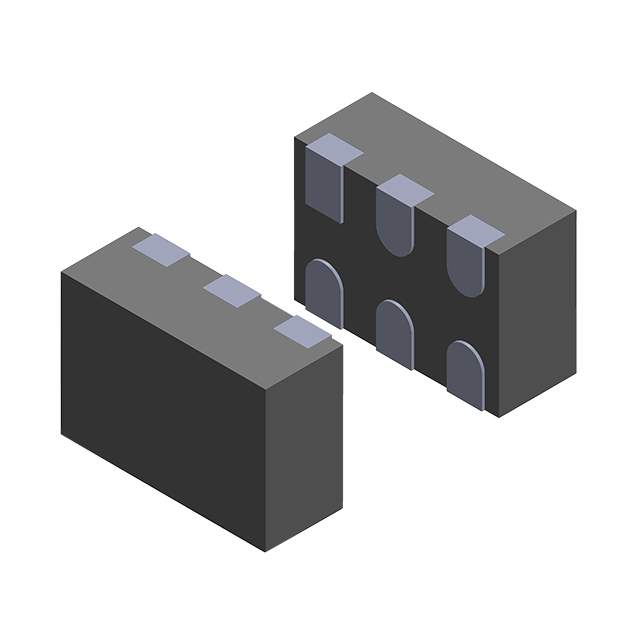
5V stand-off, 17V max clamp, 5A pulse, 0.85pF, 6-μQFN: useful limits for sustaining builds
Quick Engineering Summary
| Field | Value |
|---|---|
| Manufacturer | STMicroelectronics |
| Category | TVS - Diodes |
| Package | 6-μQFN (1.45x1.0) |
| Core function | TVS DIODE 5VWM 17VC 6UQFN |
| Key electrical range | Capacitance @ Frequency: 0.85pF @ 825MHz; Max Clamping Voltage: 17V; Minimum Breakdown Voltage: 6V; Peak Pulse Current(Ippm): 5A (8/20μs) |
| Reported stock | 1 pcs reported — confirm on RFQ |
17V is the number that decides reuse
17V is the ceiling that matters most. DVIULC6-2M6 is a 5V stand-off TVS with a 17V maximum clamping voltage and a 6V minimum breakdown voltage, so it belongs only on rails and signal nodes where that clamp ceiling still leaves the protected silicon inside its own absolute maximum window.
It is not a working rail target. The listed 5A peak pulse current is tied to 8/20μs, so it defines the surge condition the part was characterized for, not behavior under a different pulse shape or repeated hits. The conclusion is direct: DVIULC6-2M6 is sustaining-only. It is EOL, stock is 1, and EU RoHS does not change that.
The real constraint is rail margin, not package size
Rail margin is the constraint here. A 5V stand-off voltage says DVIULC6-2M6 can sit across a 5V-protected node without entering breakdown in normal use, while the 6V minimum breakdown voltage marks where protection action starts.
The other number worth keeping is 0.85pF at 825MHz. That low capacitance suits fast lines where added loading can hurt signal integrity early, and the steering rail-to-rail topology with 2 unidirectional channels fits paired signal paths better than a single bulk power-rail clamp. The small package helps density, but the electrical ceilings decide whether the interface survives.
Wrong for fresh platforms, still usable on dense 5V signal pairs
Wrong for fresh platforms first: DVIULC6-2M6 should not go into any new board spin because the lifecycle is EOL and the available quantity is 1.
It still fits a running design that already used this exact footprint and protection window. The 6-μQFN (1.45x1.0) package is tiny, SMD assembly is standard, and 0.85pF at 825MHz points to signal-line protection rather than a heavy power-entry suppressor. Power line protection is listed as Yes, but with only 5V stand-off and 5A at 8/20μs on the page, that reads as a narrow use case, not a blanket answer for exposed supply inputs. It is also the wrong choice when your review needs a published operating temperature, a stronger pulse-energy picture, or proof that the clamp level stays inside a very tight downstream abs-max limit.
The missing datasheet items are the real blocker now
And the gaps are specific: DVIULC6-2M6 needs a pinout or package drawing, reverse leakage, thermal resistance, and a derating or surge-energy view to judge ambient headroom and hit tolerance. None of that is on this page.
View the Win-Source product page for DVIULC6-2M6.
Key Takeaways for Engineers & Buyers
- Lock DVIULC6-2M6 to existing 5V-protected interfaces only; it is EOL.
- Check the 17V max clamp against the downstream absolute maximum before approving reuse.
- Reserve the single listed unit for failure analysis or line support, not prototype spins.