
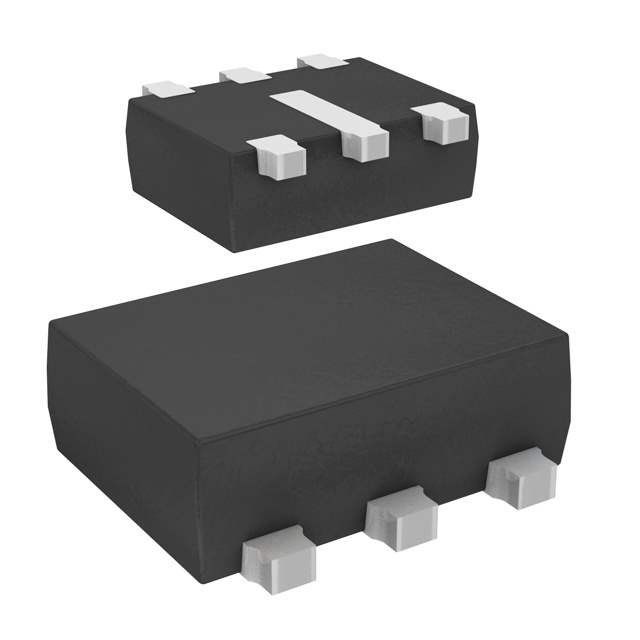
5V stand-off, 17V clamp, 5A pulse, 0.85pF, SOT-666 for 5V lines in running builds only
Quick Engineering Summary
| Field | Value |
|---|---|
| Manufacturer | STMicroelectronics |
| Category | TVS - Diodes |
| Package | SOT-666 |
| Core function | TVS DIODE 5VWM 17VC SOT666 |
| Key electrical range | Capacitance @ Frequency: 0.85pF @ 825MHz; Max Clamping Voltage: 17V; Minimum Breakdown Voltage: 6V; Peak Pulse Current(Ippm): 5A (8/20μs) |
| Reported stock | 22300 pcs reported — confirm on RFQ |
EOL is the problem, not the electrical fit
The weak point is obvious: DVIULC6-2P6 is EOL, so it is out for new design-in. The better news is that listed stock of 22300 gives existing production some breathing room when the device is already qualified and the line still has to ship.
Use it only as a sustaining part. Lifecycle signals line up cleanly, supply status is Limited, and packaging is Reel - TR, so the practical move is to buy against known demand inside a defined service window and start migration now. EU RoHS compliance and halogen-free status help keep an existing line compliant, but they do nothing to change the lifecycle call.
17V is the ceiling that decides the rail
17V is the maximum clamping voltage. That number decides quickly whether the protected node can tolerate the listed let-through during the specified surge event, and it should be read as a ceiling rather than a normal operating point.
The surrounding limits matter too. A 5V stand-off voltage keeps DVIULC6-2P6 on rails or signals that stay below that reverse standoff in normal use, while the 6V minimum breakdown voltage shows that conduction starts above the stand-off region, not at it. The 5A peak pulse current at 8/20μs is also a ceiling, useful for matching the part to that class of surge event, but it does not answer thermal repetition, long-pulse stress, or board-level survivability.
Wrong for high-capacitance-tolerant power clamps, right for fast lines
A bulky power clamp is not what this part does best. DVIULC6-2P6 is a steering rail-to-rail TVS with 2 unidirectional channels in SOT-666, and the listed 0.85pF at 825MHz points it toward interfaces where line loading matters far more than it does on rails that can tolerate a heavier protector.
That is the real fit argument. On computer peripherals, communications gear, and test equipment, low capacitance gives DVIULC6-2P6 a clear role when protection has to stay as unobtrusive as possible in the signal path, and the 5V stand-off keeps that role centered on 5V-class lines rather than higher-voltage rails. Package size helps as well: SOT-666 suits placements close to the connector when board area is tight and the protection element needs to sit where the surge enters.
The limits are just as important, and they are concrete. The listing gives no reverse-recovery behavior, no junction capacitance versus bias, and no dynamic clamp curve beyond the single 17V ceiling, so it cannot tell you how DVIULC6-2P6 will affect an eye diagram, shape overshoot, or behave outside that one pulse condition. For a running design, proven hardware may be enough. For a new layout, it isn't.
The missing datasheet items are the real stop sign
And that is the point from the section above. The gaps matter more than another pass through the headline specs.
The listing does not include a pinout or package drawing, so footprint confirmation still depends on the datasheet. It also leaves out thermal resistance, derating information, and peak pulse power, which keeps ambient headroom and repeated-stress margin unresolved. There is no surge waveform detail beyond 5A at 8/20μs, and no junction capacitance curve beyond 0.85pF at 825MHz. Those missing items decide whether DVIULC6-2P6 is simply on the schematic or actually safe on the board.
View the Win-Source product page for DVIULC6-2P6.
Key Takeaways for Engineers & Buyers
- Block DVIULC6-2P6 from new BOMs; lifecycle is EOL.
- Check the protected rail against the 5V stand-off and 17V maximum clamp before any last-time build.
- Plan reel usage early; packaging is TR and supply status is Limited.