
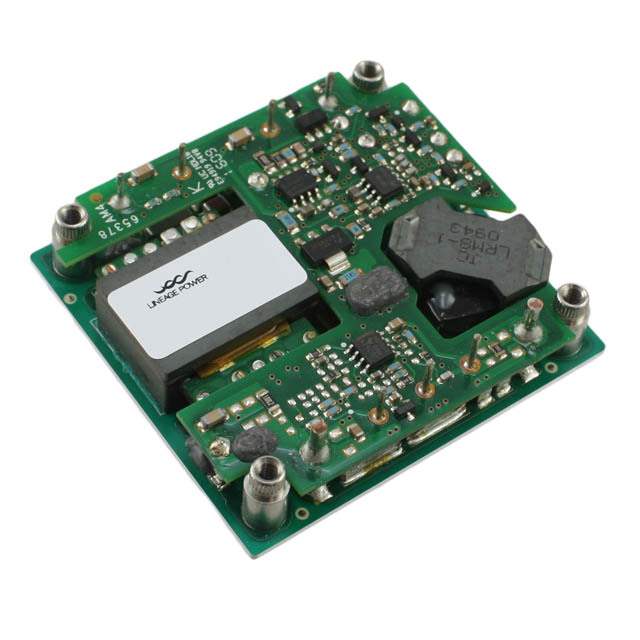
36V to 75V input, 25W, 5V and ±12V outputs, 9-DIP through-hole module, -40°C to 100°C operating range
Quick Engineering Summary
| Field | Value |
|---|---|
| Manufacturer | ABB Embedded Power |
| Category | HOT - SALES and EOL Components |
| Package | 9-DIP Module |
| Core function | DC DC CONVERTER 5V +/-12V 25W |
| Key electrical range | Current - Output (Maximum): 5A, 1A, 1A; Number of Outputs: 3; Power (W): 25W; Supply and Demand Status: Limited |
| Reported stock | 1 pcs reported — confirm on RFQ |
Still useful only if the line already depends on it
And that is really the whole call: keep it only for existing production, not for a fresh schematic. The lifecycle is EOL, the status is Obsolete, supply is Limited, and the listed stock is 1. That closes the new-design question fast.
There is no lifecycle conflict here; the signals agree. EU RoHS compliance helps if you must keep a running line alive, and MSL is Not Applicable, but neither changes the constraint. If this module is already qualified in your build, lock down the remaining need now and start migration work in parallel.
25W is the ceiling that keeps the rails honest
25W is the ceiling. With listed maximum output currents of 5A, 1A, and 1A, treat the 5V and ±12V rails as a shared output budget, not as three rails you can load to their maxima at the same time.
Wrong for compact refreshes, right for fixed 48V-class board power
Not for a compact redesign. The 9-DIP through-hole package and 2.80" L x 2.40" W x 0.50" H body make DW025ABK-M a board-level power block for equipment that already has room and assembly flow for a through-hole isolated converter, not for dense low-profile layouts trying to win back area.
Where it still fits is narrower. The 36V minimum input and 75V maximum input define a wide input window that suits systems built around a nominal telecom or industrial DC bus, while the three outputs — 5V, 12V, and -12V — point to mixed-signal or interface sections that still need both logic power and bipolar auxiliary rails from one isolated module. The 500V isolation rating matters as a boundary, but it does not answer creepage, clearance, or system safety on its own.
The operating range of -40°C to 100°C is useful, but it is still only a listed range. It does not show how much output headroom remains at the hot end because derating behavior is absent. Efficiency is 82%, so thermal loss is not trivial in a sealed box or crowded card cage. In practice, DW025ABK-M belongs in sustaining ITE hardware with an established mechanical envelope and a known input bus, and it does not belong in a new platform where footprint, thermal margin, or long-term availability are still open.
What is the buyer's first problem here?
Availability. With stock at 1, bulk packaging, and a manufacturer pack quantity of 30, DW025ABK-M is not something you can count on for a rolling build. Add the listed open-market fake threat of 46 pct., and spot buying becomes a quality risk as much as a sourcing problem.
Buy only against a specific sustaining demand, then quarantine any non-franchised intake for extra scrutiny. The missing datasheet items that still matter are the pinout, the mechanical drawing for drop-in confirmation, derating information, and thermal resistance to judge hot-case margin at 25W.
View the Win-Source product page for DW025ABK-M.
Key Takeaways for Engineers & Buyers
- Freeze DW025ABK-M to existing builds only; lifecycle is EOL and stock is 1.
- Check your rail set before reuse: outputs are 5V, 12V, and -12V with maximum currents of 5A, 1A, and 1A.
- Reserve board area early; the module body is 2.80" x 2.40" x 0.50" in a 9-DIP through-hole package.