
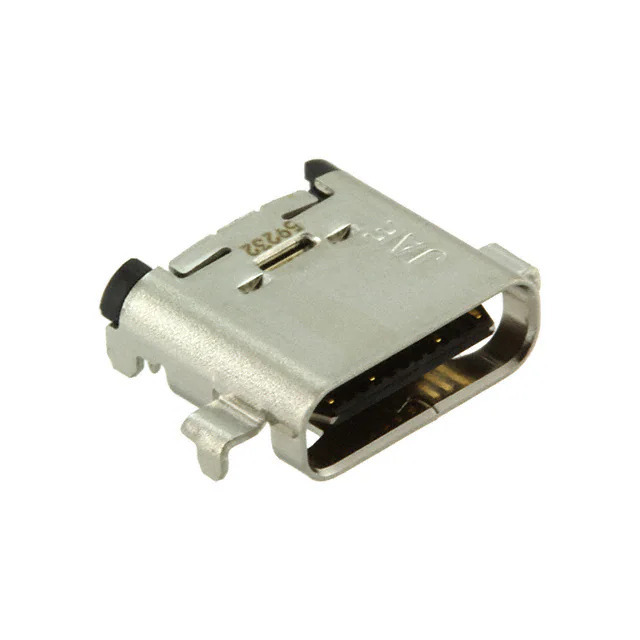
20V rated, 0.25A/1.25A ceilings, 24 contacts, horizontal mid-mount USB-C, -30°C to 80°C
Quick Engineering Summary
| Field | Value |
|---|---|
| Manufacturer | JAE Electronics |
| Category | USB, DVI, HDMI Connectors |
| Package | Tape & Reel |
| Core function | CONN RCPT USB3. |
| Key electrical range | Current Rating (Amps): 0.25A, 1.25A; Temperature Range - Operating: -30°C ~ 80°C; Voltage - Rated: 20V |
| Reported stock | 1 pcs reported — confirm on RFQ |
Can you start a new build on it?
Can I use it in a new build? Yes, with one supply check. Active status and EU RoHS compliance make DX07B024JJ2R1500 a valid design-in choice, but one stock field shows 1 while another shows 8484.
Not for high-power USB-C; fine for dense board-edge I/O
Not for high-power USB-C. The listed current ratings are 0.25A and 1.25A, and those numbers are ceilings, not a basis for assuming every contact can run at the higher figure across the whole connector.
That matters because this page does not show the contact-by-contact assignment behind those two ratings, so you cannot close current sharing, temperature rise, or cable-power expectations from the listing alone. If the design depends on the connector entry itself to carry the full power case, this is the wrong place to take comfort.
Where it does fit is a compact board-edge receptacle for a single USB-C port where mechanical format carries as much weight as the electrical limit. The listing calls out a 24-contact receptacle, horizontal mid mount, board-edge cutout, surface-mount, and through-hole right-angle mounting features together, which reads like a connector selected around enclosure height and shell retention rather than brute current.
The 20V rated voltage sets another clear boundary. It places the part in standard USB-C voltage territory, but it does not answer negotiation behavior, protection strategy, or any margin above that rating. The -30°C to 80°C operating range works for plenty of indoor and light-industrial hardware, yet it does not support a harsher ambient assumption. Good fit for dense data-and-power ports; poor fit for designs that need the connector listing to carry the whole power argument.
The mechanical life is decent, but the drawing is missing
Good enough mechanically.
The 10000 mating cycles make the connector credible for equipment that gets plugged and unplugged regularly, and the shielded stainless-steel shell supports the same use case. Pick and place plus tape and reel help on an automated SMT line, and MSL 1 (Unlimited) removes a common handling nuisance before assembly.
What is still missing is the actual mechanical definition: pinout, recommended land pattern, board cutout drawing, and full dimensional drawing. Those items decide whether the mid-mount geometry fits your stackup and whether the shell stakes and SMT pads land where your board can support them.
20V is the cleanest boundary in the listing
20V is the cleanest boundary in the listing. It is an explicit rated voltage ceiling for the connector, so if the port architecture expects more than that at the receptacle, DX07B024JJ2R1500 is out.
The harder issue is the mixed current entry: 0.25A and 1.25A. Those figures matter more than the gold finish because they determine whether the connector is being used as a signal-first interface with limited power on selected contacts, or whether the listing is being overread and current is headed to the wrong pins. The missing piece is the contact assignment behind those ratings, along with any temperature-rise or derating information tied to them.
View the Win-Source product page for DX07B024JJ2R1500.
Key Takeaways for Engineers & Buyers
- Treat 20V as the connector ceiling; do not use DX07B024JJ2R1500 to close a higher-voltage USB-C path.
- Map the 0.25A and 1.25A current ratings to the exact contact groups before release.
- Resolve the quantity split now: 1 in one stock field, 8484 in another.