
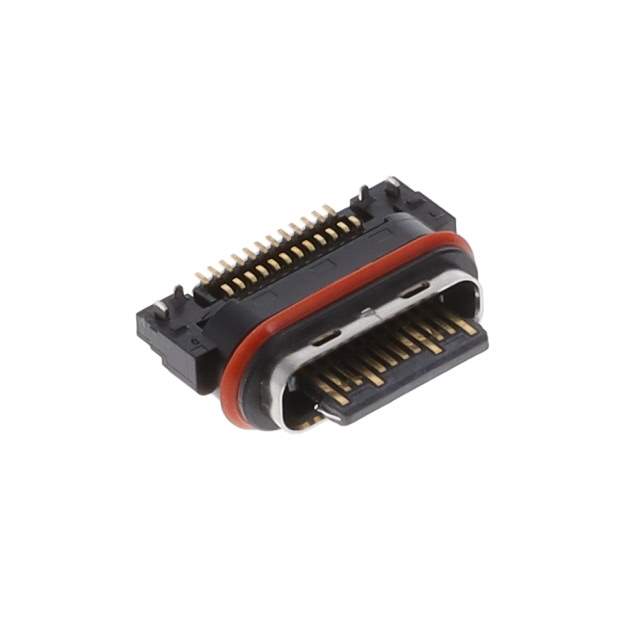
20VAC ceiling, 0.25A to 6.25A contact limits, 24 contacts, mid-mount USB-C, -30°C to 80°C
Quick Engineering Summary
| Field | Value |
|---|---|
| Manufacturer | JAE Electronics |
| Category | USB, DVI, HDMI Connectors |
| Package | Tape & Reel |
| Core function | CONN RCPT USB3. |
| Key electrical range | Current Rating (Amps): 0.25A, 1.25A, 5A, 6.25A; Temperature Range - Operating: -30°C ~ 80°C; Voltage - Rated: 20VAC |
| Reported stock | 3000 pcs reported — confirm on RFQ |
20VAC is the first gate, not the whole answer
20VAC is a ceiling. That rules out any connector interface expected to run above that rated voltage, and it does not qualify the part for anything beyond that limit.
After that, the fit turns on the mechanical and environmental details. This is a 24-contact USB-C receptacle, horizontal mid-mount, board-edge, surface-mount, right-angle, with IPX8 waterproofing and a board guide. The mix points to compact sealed equipment where connector placement and shell control matter as much as the electrical path. Active lifecycle supports new design-in, but the EU RoHS call is still conflicted, so release control needs that resolved before the part reaches a production BOM.
Those current numbers are ceilings by contact role
And this is where a quick read breaks down. The listing gives 0.25A, 1.25A, 5A, and 6.25A, but it does not say which contacts or conditions own each number, so the connector cannot be treated as a blanket 6.25A part.
That gap matters because current in a USB-C receptacle is never just a headline figure; it sets contact assignment, drives copper heating around the solder joints, and can cap the power path before the rest of the board does. The -30°C to 80°C operating range is also a limit, not ambient permission for every load case. Near the top of that range, the missing current-to-contact mapping and missing thermal detail become the real review blockers.
The 10000 mating-cycle figure answers a different question. It supports repeated user access better than a lightly used service port, but it still does not answer wear under contamination, sealing stress, or high-current hot-plug behavior.
Wrong for generic USB-C assumptions, right for sealed mid-mount ports
Not for a generic "any USB-C will do" port. The listing says USB-C and the description says USB3.1 Type-C, yet the specifications field says USB 2.0, so it should not be assigned to a SuperSpeed layout on naming alone.
Where it fits is a single-port sealed product that needs a receptacle, shielded shell, horizontal mid-mount geometry, and board-edge right-angle entry. IPX8 waterproofing, stainless steel shell material, UL94 V-0, and the board guide point to a connector chosen for enclosure integration and handling stability, not just pin count. Gold contact finish also suits repeated mating better than a one-time internal jumper use case.
The packaging details help frame production use. Tape and reel with a standard package of 1,000 suits line loading, and the listed stock of 3000 can cover builds without forcing an immediate split lot. JAE Electronics DX07W024JA2R1000 makes sense when enclosure and mount style are already driving the connector choice; it is a poor fit when the project still needs proof of USB 3.x lane support from the connector record itself.
The missing details are the ones that close layout
Two gaps matter most. Pinout is absent, and so is a mechanical drawing.
Without those, footprint and stack-up work cannot close. The record also lacks contact-specific current assignment and any sealing test detail beyond IPX8.
View the Win-Source product page for DX07W024JA2R1000.
Key Takeaways for Engineers & Buyers
- Match the 20VAC rating to your connector-side rail; don't treat it as permission for higher bus voltage.
- Map each contact group against the listed 0.25A, 1.25A, 5A, and 6.25A ceilings before assigning power and signal pins.
- Clear the EU RoHS conflict on DX07W024JA2R1000 before release to production.