
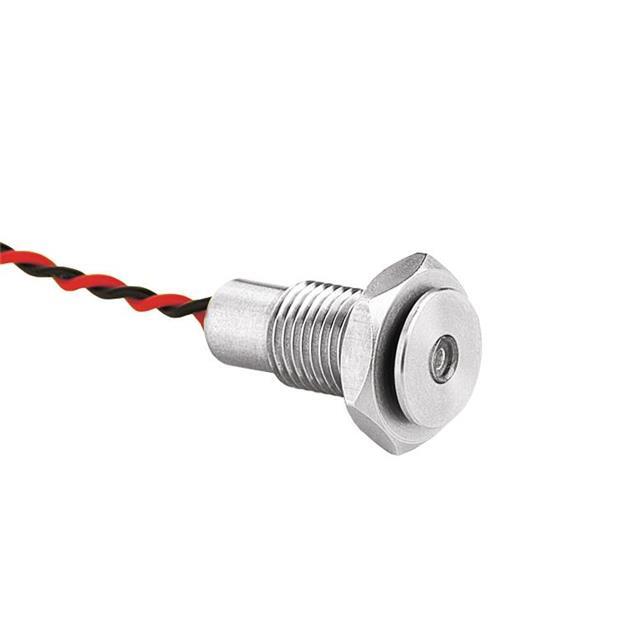
2V LED, 30mA ceiling, 8.00mm round panel cutout, IP66 front sealing, PC pins
Quick Engineering Summary
| Field | Value |
|---|---|
| Manufacturer | Bulgin |
| Category | Panel Indicators, Pilot Lights |
| Package | Bulk |
| Core function | LED PNL IND RED 5MM PC PIN |
| Key electrical range | Current: 30mA; Supply and Demand Status: Shortage; Voltage: 2V |
| Reported stock | 1 pcs reported — confirm on RFQ |
Shortage is the weak point; the part itself is usable
The weak point comes first: availability is tight. Stock is listed at 1 and the supply signal says Shortage, so this is not a part to drop into a fresh build and assume will keep flowing.
On the product side, the picture is cleaner. Lifecycle is Active with no conflict, and EU RoHS is covered in the listing. That makes DX1090/RD workable for new design-in when the panel hardware is already close to this geometry and sealing level, and when you can secure supply early against known demand instead of leaving it as an open-ended line item.
Wrong for bright status lamps, right for sealed small indicators
Not for a high-visibility annunciator. The listed 25mcd output is the number that rules DX1090/RD out anywhere the lamp has to fight distance, glare, or a bright enclosure face.
It fits better as a compact sealed panel indicator. The 5mm, T-1 3/4 lens and 0.315" (8.00mm) round cutout point to a small front-panel device, not a large beacon. The IP66 rating matters at the panel face, especially where washdown or dust exposure is part of the environment, but it says nothing about rear-side sealing. PC pin termination also keeps it in board-backed assemblies rather than free-wired panel builds unless the mechanical stack was designed around pins from the start.
The 30mA and 2V numbers are ceilings and drive limits
Keep it conservative.
The listing says the ratings are Vf (Typ) and If (Max), and that distinction matters. The 30mA figure is a current ceiling, not a target drive point, so it sets the upper bound of the indicator circuit and nothing more. The 2V figure is a typical forward drop for rail budgeting, but it does not settle tolerance, bin spread, or temperature behavior. Treat it like a fixed 2V load and current control is where the mistake shows up first.
What the listing still doesn't answer
And that leaves the release questions still open, because the missing details are the ones that decide whether the mechanical and electrical assumptions survive first article without rework.
There is no pinout or polarity drawing here, which is a basic gap for a PC pin indicator. There is no dimensional drawing beyond the 0.315" (8.00mm) cutout and 5mm lens size, so panel thickness fit, shoulder details, and rear clearance remain unresolved. There is no forward-current-versus-brightness curve, and without it the 25mcd figure is only a single point rather than enough information to judge how much visual margin remains when you back away from the 30mA ceiling. Temperature limits are also omitted, leaving ambient and storage decisions open.
View the Win-Source product page for DX1090/RD.
Key Takeaways for Engineers & Buyers
- Lock the 8.00mm round panel cutout before releasing the front-panel drawing.
- Treat 30mA as the current ceiling and size the indicator drive around the 2V LED drop.
- Place DX1090/RD only against committed demand; stock is 1 and status shows Shortage.