
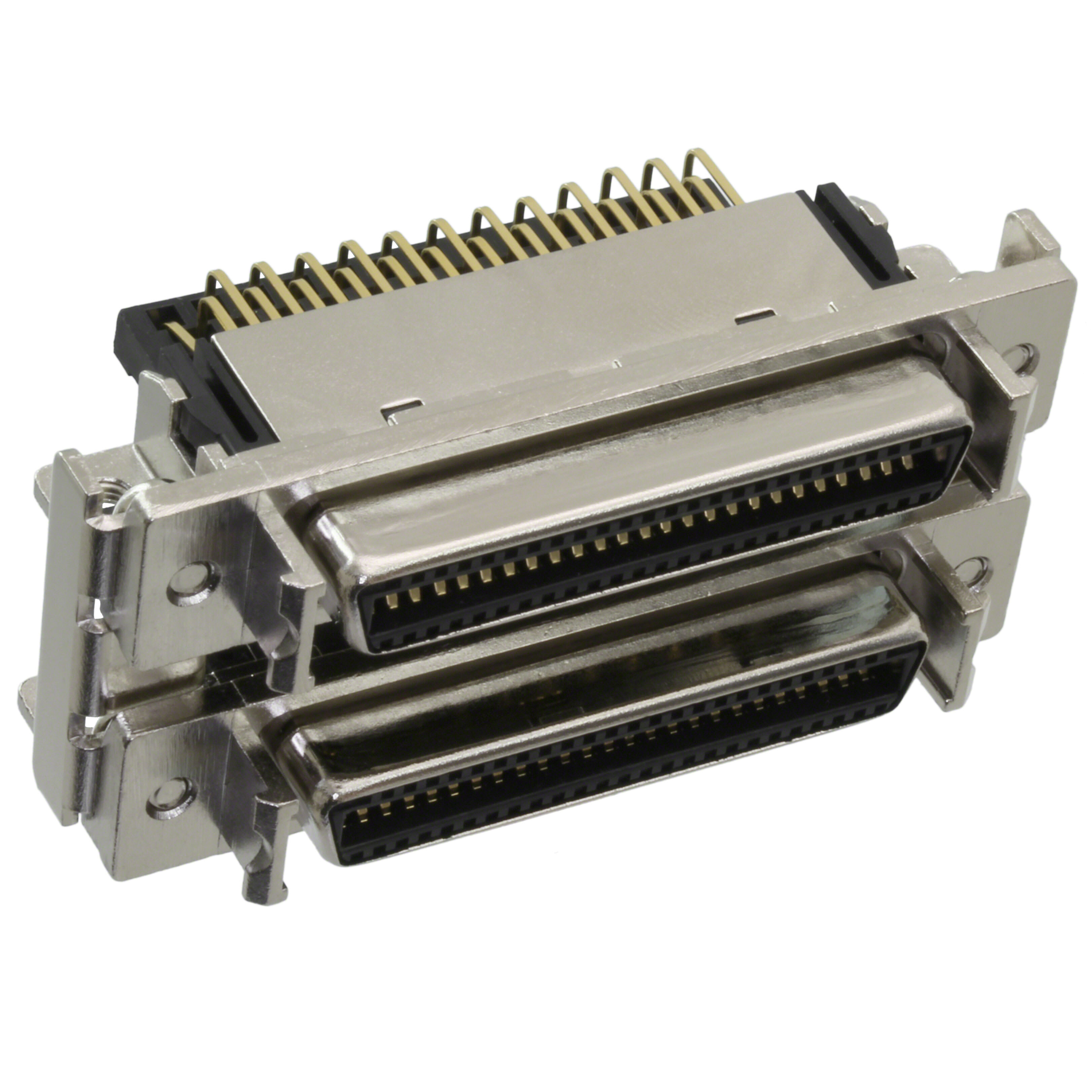
68 positions, 2 rows, right-angle panel mount, M2.6 screwlock: mechanical fit comes first.
Quick Engineering Summary
| Field | Value |
|---|---|
| Manufacturer | Hirose Electric Co Ltd |
| Category | D - Shaped Connectors - Centronics |
| Package | Tray |
| Core function | CONN PLUG 68POS |
| Key electrical range | Supply and Demand Status: Shortage |
| Reported stock | 38 pcs reported — confirm on RFQ |
Can you start a new build on this connector?
Can you actually buy it for a new build? Yes—if the interface is already fixed to a 68-position miniature high-density Centronics receptacle and near-term supply is covered. It is Active and EU RoHS compliant, but availability is the first constraint.
The fit is fixed by the shell, mount, and screwlock
This is a mechanical commitment.
It is a panel-mount, through-hole, right-angle receptacle with 68 positions in 2 rows, an outer-shroud contact style, and a mating-side female screwlock at M2.6. Those details decide whether it belongs in the product before plating or packaging enters the discussion, because they lock the board edge, panel cutout, cable exit direction, and mating hardware at the same time. Get one of them wrong and the result is blunt: the connector will not land in the enclosure or mate to the intended cable assembly.
The 68-position count settles one question and leaves another open. It places the part in a dense parallel-style interface where contact count is central, but it does not establish current per contact, voltage withstand, or hot-plug behavior because those limits are not listed here. The right-angle, through-hole construction also points to board-mounted I/O rather than free cable termination. If the product needs vertical entry, surface-mount assembly flow, or a connector without panel hardware, this geometry does not fit even when the position count does.
The contact finish is gold with 7.87µin (0.200µm) thickness. That says the finish system is not bare tin and gives some grounding for contact interface stability and mating durability, but it does not answer wear life because no mating-cycle figure is shown.
Shortage is the buying constraint, not status
38 pieces in stock.
That is the decisive number. The part shows shortage status, and package is tray. For samples, fixture builds, or a controlled sustaining release, that can work. For a program that expects repeated turns or line-side replenishment, it is thin. Put the shortage into the release decision now so a mechanically unique connector does not become the item that stalls the build after layout is frozen.
Tray packaging is not a defect, but it does shape handling. It suits manual loading and protected storage better than high-speed feeder assumptions. If the assembly flow was counting on tape-and-reel convenience, this part needs a different plan.
The missing numbers are the ones that close risk
The weak point is electrical detail. The strong point is that the mechanical identity is clear.
What is absent matters: no current rating, no voltage rating, no insulation resistance, and no contact resistance figure. On a 68-position connector, those are the numbers that set signal class, rail exposure, and real interface margin. There is also no drawing or pinout here, so footprint, keepout, and assignment review cannot be closed from this page alone.
It is easy to place this part in the right family and mounting scheme, but the dimensional drawing, pin numbering, and basic electrical ceilings still have to come from the datasheet before the interface is signed off.
View the Win-Source product page for DX10A-68S(50).
Key Takeaways for Engineers & Buyers
- Lock the enclosure and mating hardware to the M2.6 female screwlock before releasing DX10A-68S(50) on the BOM.
- Reserve tray handling for incoming and kitting; this part does not arrive in reel packaging.
- Cover the shortage now: 38 pieces on hand is fine for samples, not for a broad production release.