
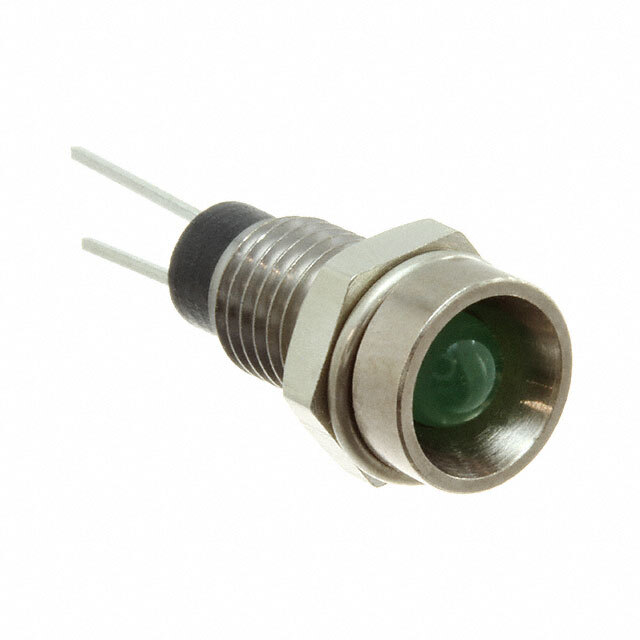
30mA ceiling, 2.1V listed, 4.00mm lens, 0.24" round cutout, PC pin termination
Quick Engineering Summary
| Field | Value |
|---|---|
| Manufacturer | Bulgin |
| Category | Panel Indicators, Pilot Lights |
| Package | Not listed for this part |
| Core function | LED PNL IND GREEN 4MM PC PIN |
| Key electrical range | Current: 30mA; Voltage: 2.1V |
| Reported stock | 1 pcs reported — confirm on RFQ |
Not for uncertain programs
Wrong for fluid builds or unfixed panel holes. It starts to make sense only when you already need a green LED panel indicator with PC pins, a 4.00mm lens, and a 0.24" (6.10mm) round cutout.
Use is cautious, not clean, because lifecycle says Unknown while Part Status says Active. EU RoHS does not resolve that conflict.
The weak point is brightness, not current
2.5mcd is modest. That sets the tone before any other spec does: this is a nearby status lamp, not something you expect to read across a bright enclosure face.
The stronger part of the listing is mechanical. A 4.00mm diameter, round domed lens, and a 0.24" (6.10mm) round panel cutout tell you fast whether it drops into an existing front panel or forces a tooling change.
The 30mA figure is a ceiling, not a drive target. The listed 2.1V helps only as a rough rail-budget input; it does not give the forward-voltage curve needed to judge resistor choice across tolerance and temperature.
Fit is mechanical first, electrical second
Fit comes first.
DX1116/GN suits boards that terminate directly to a panel indicator through PC pins and already have room for a round, domed 4.00mm green lens at a 0.24" (6.10mm) panel hole. That makes it a practical option for compact front panels and low-information annunciation where color and presence matter more than luminous intensity.
Bulk packaging points the same way. It fits bench assembly, service stock, or lower-volume builds better than a feed-format decision already locked down for automation.
The no-go cases are just as plain. If the panel is cut for another diameter, if the assembly needs another termination, or if visibility is the first requirement, DX1116/GN loses its convenience quickly. The electrical listing stays thin, and that matters more than it first appears, because 30mA only marks the maximum current while 2.1V is only a single listed voltage point, leaving the real design call dependent on missing forward-current behavior, thermal limits, and mounting detail once enclosure temperature rises.
Can you actually buy against a running line?
Can you get it now?
One source shows 1 in stock, while another quantity field shows 12, so DX1116/GN does not belong in an unconstrained build plan without a direct availability check.
Place it where demand is known and small, or where the BOM can wait for confirmation. The lifecycle conflict adds another brake: Active in one field and Unknown in another is enough to slow a fresh release before the quantity question is settled.
The missing details are the real hold-up
30mA is the ceiling.
What is missing matters more. The listing gives no pinout, no drawing, no thermal resistance, and no forward-voltage curve beyond the single 2.1V figure.
Those gaps split cleanly between fit and behavior. The drawing and pinout decide whether the PC pins and panel hardware land correctly in the assembly, while thermal resistance and forward-drop behavior decide how much current margin remains below the 30mA ceiling as ambient temperature rises.
View the Win-Source product page for DX1116/GN.
Key Takeaways for Engineers & Buyers
- Match the panel to the 0.24" (6.10mm) round cutout before releasing DX1116/GN.
- Hold LED current at or below the listed 30mA ceiling; it is not a default drive point.
- Do not count on immediate line fill from the shown stock of 1; place DX1116/GN only against confirmed need.