
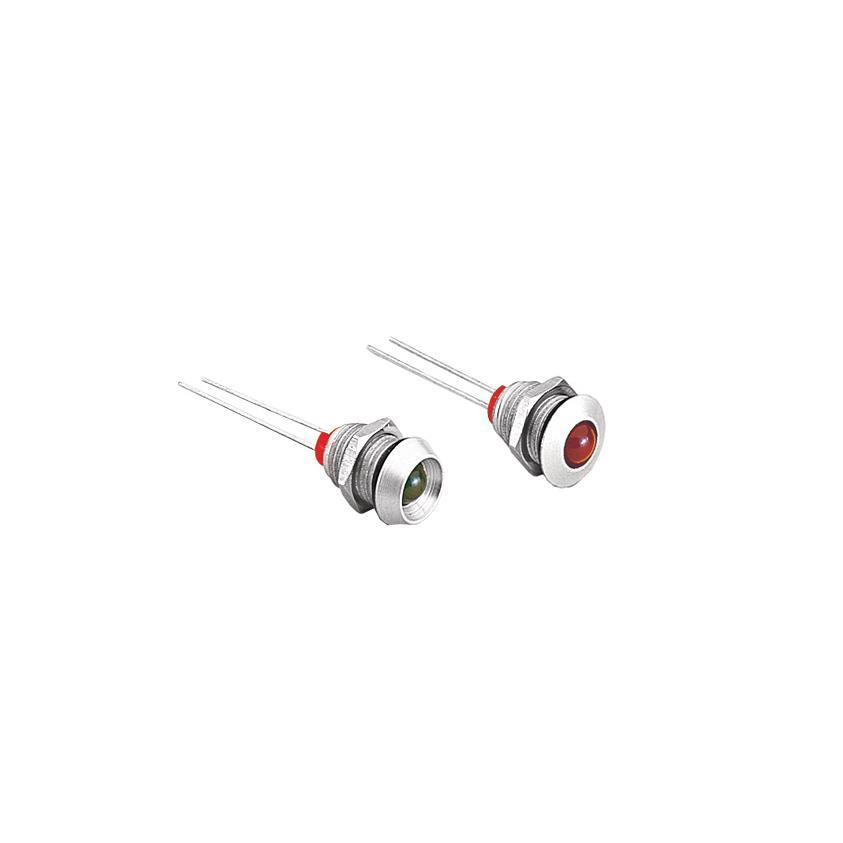
30mA ceiling, 2V typical drop, 4.00mm lens, 0.24" (6.10mm) round cutout, PC pin panel indicator
Quick Engineering Summary
| Field | Value |
|---|---|
| Manufacturer | Bulgin |
| Category | Panel Indicators, Pilot Lights |
| Package | Bulk |
| Core function | LED PNL IND RED 4MM PC PIN |
| Key electrical range | Current: 30mA; Supply and Demand Status: Shortage; Voltage: 2V |
| Reported stock | 100 pcs reported — confirm on RFQ |
Availability, not lifecycle, is the real constraint
Supply is the constraint. The part is listed Active and EU RoHS compliant, but the same record shows Shortage, stock at 100, and Bulk packaging. That supports prototypes or a controlled build, not an easy running line.
View the Win-Source product page for DX1116/RD.
30mA is a ceiling, and 2V does not finish the resistor choice
30mA is the decisive figure. For DX1116/RD, it is a current ceiling, not a normal operating point.
The paired number is 2V typical, listed as Vf (Typ) beside If (Max). That is enough to start a resistor budget, but not enough to close it, because the listing does not show forward-voltage spread over production or temperature, and it does not show what the indicator dissipates at your chosen current. Brightness consistency is where that shows up first. The 2.5mcd output also keeps expectations in check: this is a basic status lamp, not a panel indicator meant to fight strong ambient light across an enclosure.
Use DX1116/RD where the panel mechanics are already settled
Good fit here.
DX1116/RD makes sense in straightforward board-fed panel indication where a red LED, PC Pin termination, and a fixed round hole are already built into the enclosure plan. The mechanical call is the real one: a 4.00mm diameter lens with a round, domed top and a 0.24" (6.10mm) round panel cutout. If your front panel is already tooled for that hole, the case is easy. If not, the electrical story is too ordinary to justify changing the panel for this indicator alone.
The low 2.5mcd output narrows the use case further. It suits nearby human viewing on equipment that only needs a simple on, fault, or armed indication. It does not support applications where viewing angle, daylight readability, or lens behavior under ambient light decides the interface, because those details are missing here. The red lamp color fits conventional status coding, but nothing in the listing argues for a high-visibility role.
Packaging and termination point the same way. Bulk packaging works for bench builds and steady assembly flow, while PC Pin suggests board-mounted wiring discipline rather than free-lead panel lamp replacement. If the product depends on field-swap convenience, sealed mounting details, or harness-first assembly, this listing does not make that case.
The missing details are mechanical and optical, not lifecycle
And that is where the page stops being enough. DX1116/RD still needs a proper drawing and pinout before release, because panel indicators live or die on lead spacing, body retention, and stack-up around the cutout.
The optical gaps matter too: no viewing angle, no peak wavelength, and no lens transparency detail are listed. On the electrical side, the forward-drop curve is absent as well; only 2V typical is shown. Those missing items decide whether the indicator reads correctly on the actual panel and whether the resistor choice stays safe across build variation.
View the Win-Source product page for DX1116/RD.
Key Takeaways for Engineers & Buyers
- Match the panel to the 0.24" (6.10mm) round cutout before releasing DX1116/RD.
- Treat 30mA as the current ceiling and size the series resistor around the listed 2V typical drop.
- Cover the Shortage flag now; the listed stock is 100 and DX1116/RD ships in Bulk.