
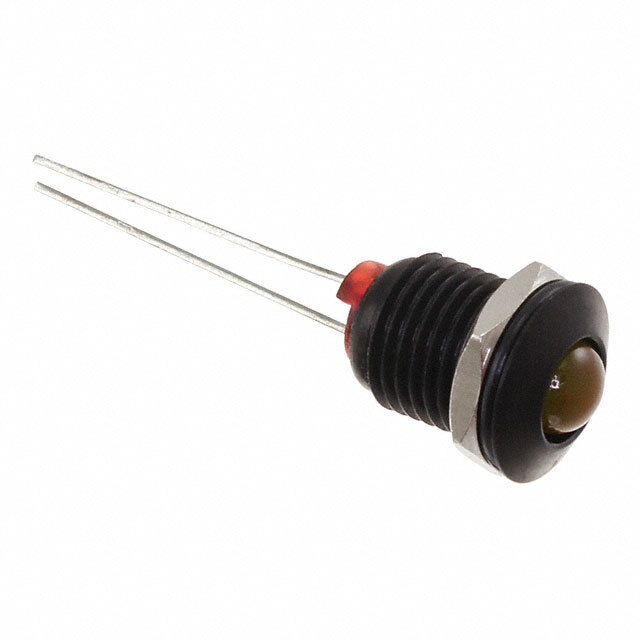
30mA ceiling, 2V listed, 4.00mm lens, 0.24" (6.10mm) round cutout, PC pin panel indicator
Quick Engineering Summary
| Field | Value |
|---|---|
| Manufacturer | Bulgin |
| Category | Panel Indicators, Pilot Lights |
| Package | Bulk |
| Core function | LED PNL IND RED 4MM PC PIN |
| Key electrical range | Current: 30mA; Supply and Demand Status: Shortage; Voltage: 2V |
| Reported stock | 1 pcs reported — confirm on RFQ |
Not for a fresh panel layout unless the hole is already fixed
This is the wrong pick when the panel hardware is still moving, because the fit is already defined by a 0.24" (6.10mm) round cutout. If the enclosure, overlay, or light pipe geometry is still in flux, this listing does not give you enough detail to work around that.
Where it does fit, the picture is simpler: a red LED panel indicator with a 4.00mm diameter domed lens and PC pin termination. That points to board-backed front panels rather than loose wiring. Lifecycle is Active and EU RoHS is compliant, so it can go into a new design, but only when the panel hole and mounting approach are already settled.
Can you actually buy DX1119/RD for a build?
Can you get it in quantity? Right now, no. Stock is 1 and the supply status is Shortage.
That changes the decision more than the lens shape or LED color. Treat DX1119/RD as something you can support in small quantity or qualify into a controlled build, not a part for broad release. The package is Bulk, which is workable for bench use and service stock, but this listing gives no feeder or line-side handling detail. Reserve the on-hand piece for fit check or failure analysis, then hold the BOM until supply improves.
The electrical limits are thin, and that matters
The constraint is incomplete electrical context. The listing gives enough to avoid a gross mistake, but not enough to finish the drive design with confidence.
The page shows 30mA current and 2V voltage, and the ratings field says Vf (Typ), If (Max). Read that literally: 30mA is a ceiling, not a normal operating point. It sets the upper bound for drive current, but says nothing about the current that gives acceptable brightness, heat, or life in the finished product.
The 2V figure is typical forward voltage, not a guaranteed target for the rail. It tells you the part belongs on low-voltage indicator rails, yet it does not close resistor selection across tolerance, temperature, or lot spread, which is exactly where a quick listing stops being enough and a real design decision starts getting expensive.
Add the listed 2.5mcd intensity and the practical question comes into focus: this is a low-brightness red indicator unless the optical stack is forgiving. The listing also leaves out viewing angle and lens transparency, so you cannot tell how well it holds visibility off-axis.
Mechanically, DX1119/RD is easier to place than it is electrically. You know it is an LED panel indicator with PC pins, and you know the current ceiling. You do not know the forward-drop spread, the brightness conditions, or the thermal behavior that decide whether it is merely visible on a bench or still readable in the finished panel.
What the datasheet still has to settle
And the missing items are concrete: pinout, panel-mount drawing, and the conditions behind the 2.5mcd and 2V figures. Viewing angle is also absent here, which is a real gap for a domed 4.00mm indicator.
Without those, DX1119/RD is a known mechanical candidate and an unknown optical result.
View the Win-Source product page for DX1119/RD.
Key Takeaways for Engineers & Buyers
- Match the panel to the 0.24" (6.10mm) round cutout before releasing DX1119/RD.
- Treat 30mA as the current ceiling; set the drive around the actual indicator brightness you need.
- Cover the shortage now: available stock is 1 and DX1119/RD is supplied in Bulk.