
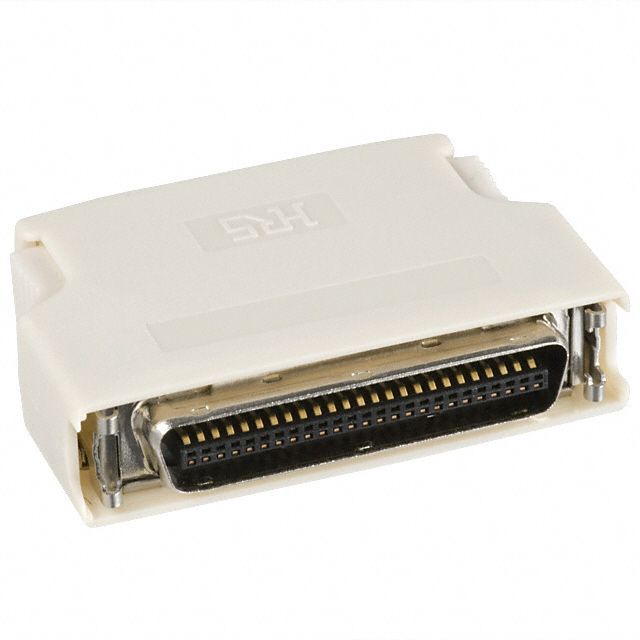
50 positions, 2 rows, panel-mount through-hole receptacle with M2.6 shell and latchblocks; shortage is the constraint.
Quick Engineering Summary
| Field | Value |
|---|---|
| Manufacturer | Hirose Electric Co Ltd |
| Category | D - Shaped Connectors - Centronics |
| Package | Tray |
| Core function | CONN RECEPT 50POS STRT |
| Key electrical range | Supply and Demand Status: Shortage |
| Reported stock | 22 pcs reported — confirm on RFQ |
50 positions decide the interface, not the plating
50 positions settles the first decision on DX20-50S(50). This is a fixed 50-way Centronics interface in a 2-row receptacle format, and nothing in the listing points to flexibility beyond that.
The mechanical description narrows the fit further. Panel mount and through hole place it on a board that also meets an enclosure wall, while the straight receptacle body, outer shroud contacts, and housing/shell with M2.6 plus latchblocks point to a retained cable-side mate rather than a free-floating board-edge connection. The gold finish and 7.87µin (0.200µm) thickness matter for contact expectations, but they do not overcome a mismatch in shell, latch, or panel geometry.
Active status helps, but shortage is the buying problem
Buy it carefully.
DX20-50S(50) is Active, so the lifecycle question is clear for new work and existing production. There is no status conflict to work around. EU RoHS is also straightforward here, and no exemption detail is shown.
The real constraint is supply. Stock is 22, package is Tray, and the supply-and-demand flag is Shortage. That combination changes how this connector fits a program: acceptable for a controlled build, much harder to justify for a broad release where it is the only approved front-panel interface and every missed tray can stall the line, especially when the mechanical interface is already locked to a 50-position, 2-row Centronics receptacle with panel-mount through-hole construction.
Use it only after build quantity and pull timing are known, then reserve material against that plan instead of assuming an active lifecycle will turn into easy near-term coverage.
Tray packing matters operationally too. It suits manual handling and protected connector bodies better than loose handling, but it does nothing to change the shortage signal.
So the fit is narrow and very physical
So the fit stays narrow. DX20-50S(50) belongs in equipment with a real panel, a through-hole board, and a mating scheme built around latchblocks and an M2.6 shell, not in cable-terminated assemblies, blind footprint swaps, or designs that have not frozen enclosure mechanics.
22 pieces won't answer the missing mechanical details
22 pieces may cover samples or a small build, but they do not answer the open mechanical questions in the listing. For DX20-50S(50), the missing items are the pinout, the dimensional drawing, and the exact panel-cutout guidance. Those details decide whether the shell, latchblocks, and through-hole tails land where the board and enclosure expect them to.
One more gap matters because this is a connector, not a passive bracket: no current rating or voltage rating is shown here. Without those ceilings, DX20-50S(50) can be placed mechanically but not fully signed off for the electrical load on the interface.
View the Win-Source product page for DX20-50S(50).
Key Takeaways for Engineers & Buyers
- Lock the panel cutout to the 50-position, 2-row Centronics interface before releasing DX20-50S(50) on a new BOM.
- Reserve stock early; DX20-50S(50) shows 22 on hand and a shortage signal.
- Check the mating hardware around the M2.6 shell and latchblocks before committing DX20-50S(50) to the enclosure.