
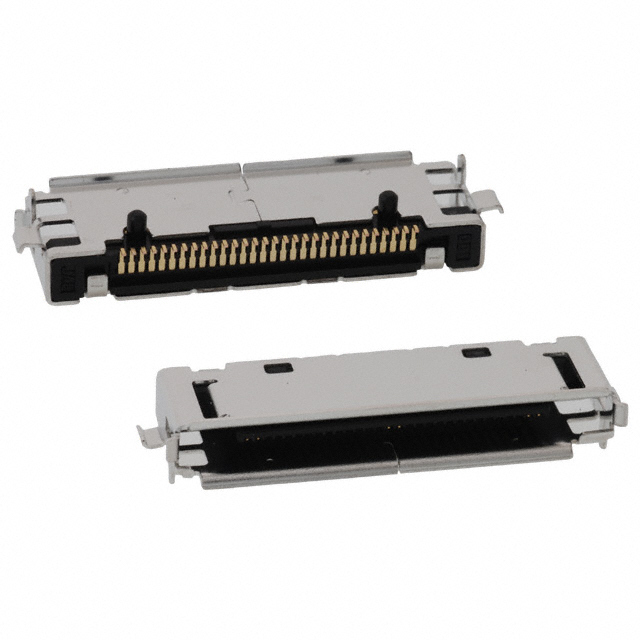
80-position, 2-row panel-mount through-hole receptacle with M2.6 shell hardware; shortage is the real constraint.
Quick Engineering Summary
| Field | Value |
|---|---|
| Manufacturer | Hirose Electric Co Ltd |
| Category | D - Shaped Connectors - Centronics |
| Package | Tray |
| Core function | CONN RECEPT 80POS STRT |
| Key electrical range | Supply and Demand Status: Shortage |
| Reported stock | 13 pcs reported — confirm on RFQ |
Still a valid design-in, if the shortage is manageable
And that is the real call: lifecycle does not block it, supply does. It is Active with no lifecycle conflict, and EU RoHS is straightforward. New designs work when the interface is already fixed to this 80-position Centronics form; otherwise, the shortage signal and 13 pieces on hand make it a bad late-stage surprise.
The weak point is supply; the fit is mechanically specific
Shortage comes first, because it can stop a build even when the part itself is healthy. After that, the listing is mechanically clear enough to place DX20-80S(50) in the right kind of product: a panel-mounted I/O connection that wants a straight, through-hole receptacle with shell hardware and latch retention, not a cable-end improvisation or a board-only internal link.
The 80 positions and 2 rows decide mating compatibility, not electrical headroom. Get either wrong and nothing else matters. Panel Mount, Through Hole, and Solder place this connector in assemblies that can tolerate board drilling and front-panel alignment work; if the program is pushing toward denser SMT-only assembly, DX20-80S(50) is fighting the manufacturing flow before qualification starts.
7.87µin (0.200µm) gold is a wear and contact clue
7.87µin (0.200µm) is the number that changes a decision. It is the listed contact finish thickness, and it tells you the contact system is specified at a defined gold plating level rather than leaving finish vague. That helps when you are screening for mating durability and contact stability, but it does not close the question by itself because the listing does not pair it with mating-cycle data or contact resistance.
The other hard mechanical limit is the shell hardware callout: Housing/Shell (M2.6); Latchblocks. Treat that as an interface constraint, not a convenience feature. If your panel cutout, fastening scheme, or service access assumes different hardware, DX20-80S(50) will force a redraw. This is not generic.
What the listing still does not tell you
The constraint is closure, not lifecycle. DX20-80S(50) gives enough to place the connector family, mounting style, position count, and retention hardware, but not enough to close the mechanical and reliability questions that usually decide whether a connector survives first article without rework, especially when the front-panel drawing and PCB hole pattern both depend on details the listing does not show.
The missing items that matter are the mating connector definition, the pinout or contact numbering drawing, and the panel or board footprint dimensions. Without those, you cannot finish the front-panel drawing or the PCB hole pattern with confidence. Contact current rating is also absent, so the 80-position count does not tell you how much signal or power each contact can actually carry in service.
Insertion and withdrawal force would also matter, along with durability or mating-cycle data. Gold finish thickness is useful, but without those companion figures it is only part of the story. For DX20-80S(50), the datasheet needs to close the mechanical drawing and contact loading questions before release.
View the Win-Source product page for DX20-80S(50).
Key Takeaways for Engineers & Buyers
- Lock the mating interface to 80 positions and 2 rows before releasing DX20-80S(50) to layout.
- Reserve stock early; DX20-80S(50) shows 13 pieces with a shortage flag.
- Confirm the panel hardware around the M2.6 shell and latchblocks before freezing the front-panel drawing.