
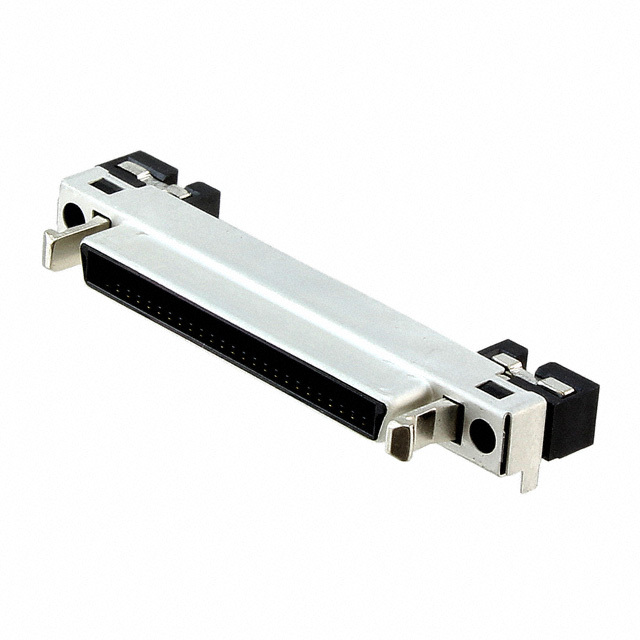
100-position, 2-row panel-mount through-hole receptacle with M2.6 screwlock and 7.87µin gold finish
Quick Engineering Summary
| Field | Value |
|---|---|
| Manufacturer | Hirose Electric Co Ltd |
| Category | D - Shaped Connectors - Centronics |
| Package | Tray |
| Core function | CONN RECEPT 100POS STRT |
| Key electrical range | Supply and Demand Status: Shortage |
| Reported stock | 19 pcs reported — confirm on RFQ |
Active part, but buy timing is the catch
Good for new work.
DX20A-100S(50) is Active with no lifecycle conflict. The issue is availability: stock is 19 and the supply signal is Shortage. EU RoHS is listed, so if this connector is on your release path, place it early and keep the BOM tied to this exact mechanical interface.
The mechanical interface decides this connector
The weak point is obvious: there is no electrical rating here at all. The strong point is the mechanical definition, and for a connector like this, that is enough to settle first-pass fit.
You get 100 positions across 2 rows in a Miniature High Density (HD) Centronics receptacle, straight, panel mount, through hole, with solder termination. That combination points to cabled or board-backed I/O where the panel takes insertion load and the PCB accepts the tails. Get it wrong and the failure is immediate: the panel cutout, hole pattern, and mating scheme will not line up, even if the rest of the assembly looks close.
The flange feature matters more than the gold callout at the start. Mating-side female screwlock with M2.6 fixes the hardware choice and the retention method, and it rules out designs that expect a friction-only mate or a different screw size. The 7.87µin (0.200µm) gold finish is useful, but it does not establish contact resistance, durability, or current handling on its own. Use DX20A-100S(50) when the enclosure, mating connector, and assembly flow already want this exact Centronics form factor; skip it when the interface family is still open.
100 positions is the number that sets scope
100 positions is the decisive figure here. It fixes cable count and mating density, and it keeps DX20A-100S(50) out of designs that need a lower signal count or a smaller D-shaped shell.
This is a defined external interface, not a casual board-to-board link. Outer shroud contacts, receptacle form, and straight panel-mount through-hole construction point to a connector that wants a chassis edge and a matching plug brought to it. It does not belong in a layout that needs surface mount assembly, blind mechanical tolerance, or a free choice of retention hardware.
What the listing still does not answer
Wrong for any release that still needs electrical or dimensional closure. Right for a program that already knows it needs this exact 100-position Centronics receptacle and is checking whether the listing is complete enough to proceed.
The missing items are concrete and blocking: no current rating, no voltage rating, no contact resistance, and no insulation resistance. There is also no drawing or pinout here, so the panel cutout, hole pattern, and mating geometry still have to come from the datasheet. For DX20A-100S(50), those gaps matter more than another line about finish or package because they separate a connector you can name on a BOM from one you can release into hardware.
View the Win-Source product page for DX20A-100S(50).
Key Takeaways for Engineers & Buyers
- Lock the mating hardware to M2.6 on the female screwlock side before releasing the panel drawing.
- Reserve DX20A-100S(50) for 100-position, 2-row Centronics interfaces; don't stretch it into adjacent D-sub footprints.
- Place the buy early: stock is 19 and supply status is Shortage.