
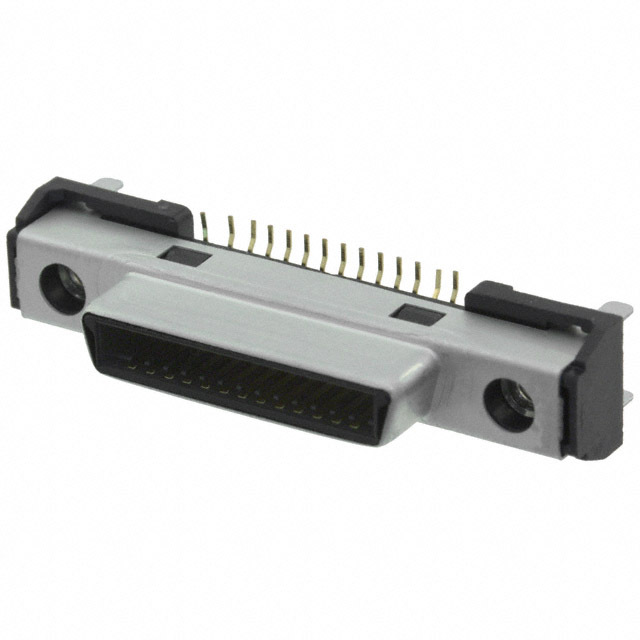
100 positions, 180° round-cable exit, shielded two-piece backshell, tray pack
Quick Engineering Summary
| Field | Value |
|---|---|
| Manufacturer | Hirose Electric Co Ltd |
| Category | D - Sub, D - Shaped Connectors - Backshells, Hoods |
| Package | Tray |
| Core function | IDC CONN 100POS PLUG |
| Key electrical range | Supply and Demand Status: Shortage |
| Reported stock | 1 pcs reported — confirm on RFQ |
Not for side-exit or loose cable dress
Wrong use cases come first: any harness that has to break sideways, any non-round cable, or any assembly that does not need shielding. The 180° cable exit sends the cable straight out of the connector, and that one choice sets enclosure clearance and bend management before finer mechanical details even matter.
Where it does fit is much narrower: a 100-position D-Sub build that needs a two piece backshell and cover, strain relief hardware, and a shielded metal shell. Active lifecycle supports new design-in, and EU RoHS is clear, but neither changes a bad cable path.
The useful limits here are mechanical, not electrical
And that is really the whole point. The numbers that matter on DX30M-100-CV2 are 100 positions and 180°. The 100-position callout closes compatibility at the connector family size level, but it says nothing about pinout, contact loading, or mating hardware beyond tying the hood to a very specific body size.
The 180° exit is a hard limit. Get it wrong and the cable dress fights the panel, the hood, or both. Round cable is another boundary; if the cable is flat or otherwise non-round, this listing gives no basis to assume the strain relief will clamp it correctly. Shielded and metal construction point to a screened cable termination path, but the listing still stops short of the dimensions that decide whether that shield termination is clean or awkward.
100 positions makes this a very specific hood
100 positions makes this either exactly right or immediately wrong. In a dense D-Sub assembly, the hood is not a generic accessory; it has to match connector size, cable form, and exit direction at the same time, and this one is locked to a 100-position plug with a straight cable departure.
The construction says plenty about intended use. A metal shell with stainless steel and a plastic cover points to a backshell trying to do two jobs at once: maintain shielding continuity and give the cable a controlled mechanical clamp. The listed strain relief hardware matters more than the word plug in the description, because failures on parts like DX30M-100-CV2 usually start at the cable entry when clamp geometry and the actual cable do not agree.
It belongs in panel or box builds where the harness can leave straight back, where a round shielded cable is already chosen, and where the connector position count is fixed at 100. It does not belong in a harness program still undecided on cable shape or exit direction. There are also concrete review gaps: no drawing, no compatible shell-size detail beyond 100 positions, no pinout or connector-side mechanical reference, and no dimensional range for the strain relief. Those details decide whether the hood closes properly on the real cable, not just on the part number.
Can you keep a running line on it?
First question: can you get it? Stock is 1 and demand is marked Shortage. If DX30M-100-CV2 is already on a running line, secure the needed quantity now; if it is for a fresh build, don't release the BOM until supply is lined up.
View the Win-Source product page for DX30M-100-CV2.
Key Takeaways for Engineers & Buyers
- Match DX30M-100-CV2 only to a 100-position build; this hood closes nothing about other shell sizes.
- Route for a 180° cable exit or stop here; DX30M-100-CV2 is not the part for side-exit dress.
- Book supply early: stock is 1 and demand is flagged Shortage.