
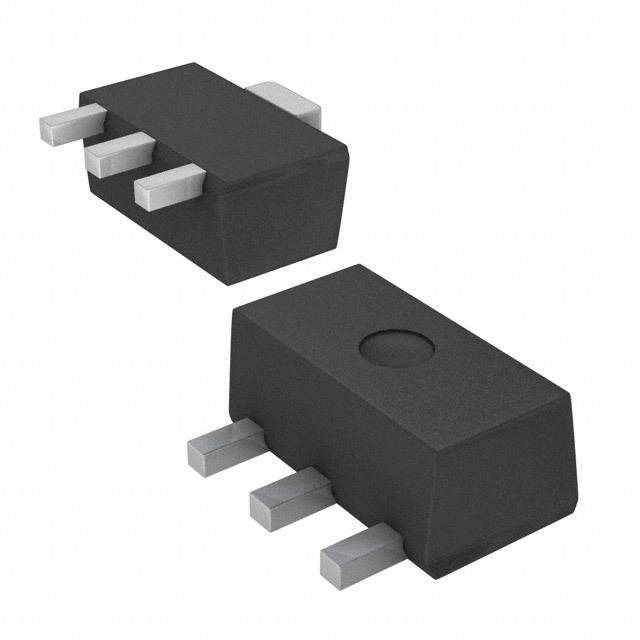
40V VCEO, 200mA collector ceiling, 1W dissipation limit, SOT-89-3, -55°C to 150°C (TJ)
Quick Engineering Summary
| Field | Value |
|---|---|
| Manufacturer | Diodes Incorporated |
| Category | Transistors (BJT) - Single |
| Package | SOT-89-3 |
| Core function | TRANS NPN 40V 0. |
| Key electrical range | Frequency - Transition: 300MHz; Maximum Current Collector: 200mA; Maximum Power Dissipation: 1W; Supply and Demand Status: Sufficient |
| Reported stock | 47480 pcs reported — confirm on RFQ |
The constraint is heat, not voltage
Heat sets the limit first. The 1W rating is a ceiling, not a place to operate continuously, while Active status and EU RoHS compliance keep the sourcing and compliance picture straightforward.
40V closes the rail question, not the switching one
40V is the collector-emitter breakdown ceiling, so it answers one narrow question: whether the device fits rails below that limit. It does not answer surge margin, avalanche behavior, or how much abuse it tolerates when an inductive node kicks back.
The other hard ceiling is 200mA maximum collector current. That keeps it in small-signal stages, level shifting, and modest low-side switching, and out of designs that expect the current rating to cover pulse handling or startup stress. Don't stretch it.
Then there is the listed 300mV max VCE(sat) at 5mA, 50mA. That helps because it ties conduction loss to a stated test point instead of leaving you to guess, yet it still does not show how DXT3904-13 behaves across the rest of the load line, where dissipation usually decides whether the SOT-89-3 package stays comfortable or becomes the hot spot on the board.
So the real fit is board-level signal and modest load switching
So the fit is fairly specific. DXT3904-13 belongs on dense SMT boards that want an NPN in SOT-89-3 with more thermal room than the smallest signal packages usually offer, while still staying in the small-transistor class set by the 200mA collector ceiling.
The 300MHz transition frequency says it is not a slow device, but that figure alone does not qualify it for RF gain blocks or fast switching edges where storage time and capacitance decide the waveform. The listed hFE minimum of 100 at 10mA, 1V shows the device is not starved for gain at that test point; it does not predict base-drive needs everywhere else. Use DXT3904-13 where the rail is comfortably under 40V, the load stays within 200mA, and the thermal budget respects the 1W maximum. Leave high-pulse, inductive, or waveform-sensitive jobs for a transistor with those missing behaviors spelled out.
Can you keep a running line on it?
Can you get it on the line without friction? Yes, if reel packaging matches your build. Stock is listed at 47480 and packaging is Reel - TR, so DXT3904-13 lines up with automated placement rather than hand-load replenishment.
The practical constraint is simpler than that 51 pct. open-market fake-threat figure: buy through the authorized channel you already trust and keep the reel format in the BOM notes, because a running line stalls faster on packaging mismatch than on medium popularity.
What the listing still does not tell you
1W is decisive, and it still does not finish the thermal argument. The listing gives maximum power dissipation and a junction operating range of -55°C to 150°C (TJ), but it does not give thermal resistance or a derating curve, so you cannot turn those ceilings into ambient headroom or copper-area expectations.
The switching picture is incomplete too. DXT3904-13 has a 300MHz transition frequency, yet there is no junction capacitance, no switching-time data, and no collector cutoff current figure in the specifications shown here. Those are the numbers that separate a transistor that merely fits the voltage and current ceilings from one that behaves cleanly in a real edge-rate or leakage-sensitive circuit.
One more gap matters at layout time: the listing names SOT-89-3 and TO-243AA, but it does not carry the pinout or package drawing. That is where footprint orientation and pad geometry get closed, and without it you still do not have enough to release the land pattern.
View the Win-Source product page for DXT3904-13.
Key Takeaways for Engineers & Buyers
- Keep VCEO below the 40V ceiling; this closes rail fit, not transient behavior.
- Budget heat against the 1W maximum and the 300mV @ 5mA, 50mA saturation limit.
- Buy on reel if DXT3904-13 fits the line; packaging is TR and stock shows 47480.