
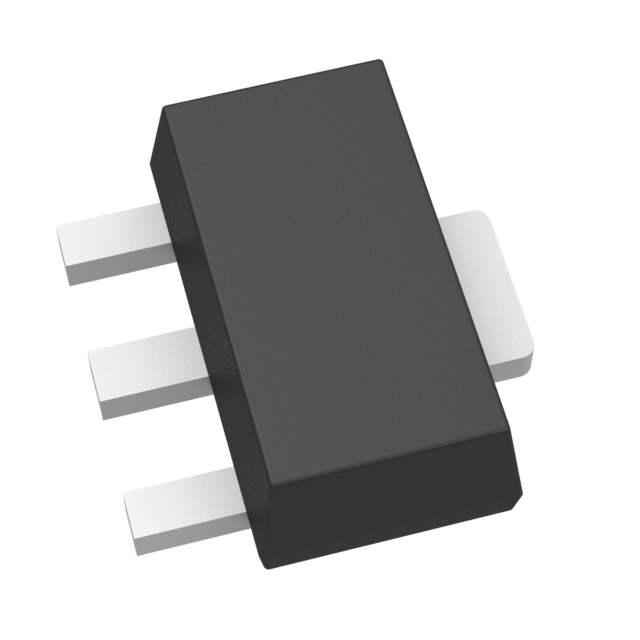
150V VCEO ceiling, 600mA collector limit, 1W dissipation ceiling, SOT-89-3 package, -55°C to 150°C TJ
Quick Engineering Summary
| Field | Value |
|---|---|
| Manufacturer | Diodes Incorporated |
| Category | Transistors (BJT) - Single |
| Package | SOT-89-3 |
| Core function | TRANS PNP 150V 0. |
| Key electrical range | Collector Cut-off Current(Max): 50nA (ICBO); Frequency - Transition: 300MHz; Maximum Current Collector: 600mA; Maximum Power Dissipation: 1W |
| Reported stock | 11180 pcs reported — confirm on RFQ |
Can you start a new design with DXT5401-13?
Can you use it in a new design without backing into an end-of-life corner? Yes, if the job is a PNP BJT selected on voltage first. DXT5401-13 is listed Active with no lifecycle conflict, so it is not boxed into sustaining-only use.
The real draw is the 150V VCEO ceiling in a SOT-89-3 body, which puts it into high-side small-signal and bias work where lower-voltage PNPs are out before layout starts. EU RoHS compliance also removes one routine approval snag.
That still does not settle the operating point. The 600mA collector current and 1W power figures are ceilings, and whether the part fits comes down to voltage stress and heat.
The current rating is not the first limit here
Voltage comes first.
The 150V collector-emitter breakdown rating decides whether this transistor belongs in offline-adjacent bias chains, startup paths, or other high-voltage transistor duties at all. Miss that ceiling and the rest of the part stops mattering.
The 600mA maximum collector current is separate, and it does not overrule the 1W maximum power dissipation. Read those together and current becomes a thermal-budget question, not a blanket green light. The listed 500mV max VCE(sat) at 5mA, 50mA gives one anchor point: saturation loss is bounded there, and only there. The 60 minimum hFE at 10mA, 5V is enough to set base-drive assumptions around a guaranteed floor rather than a typical curve.
This belongs in compact high-voltage transistor work
150V is the decisive figure. It pushes DXT5401-13 toward compact board-level jobs where a PNP device has to survive a much taller rail than the usual low-voltage signal transistor, while the SOT-89-3 package keeps it in dense layouts rather than through-hole service work.
The fit narrows once the other limits are read together. A 1W dissipation ceiling in SOT-89-3 says heat will shut the door before the headline 600mA number does in many real circuits, especially if the plan is to use DXT5401-13 as a hard-driven switch for long on-time loads.
The 300MHz transition frequency says the transistor is not inherently slow, but that number alone does not make it an RF choice; without capacitance data or switching behavior, the safer read is a high-voltage general-purpose BJT rather than a frequency-led selection.
The operating temperature range of -55°C to 150°C is a junction limit, so it marks the silicon ceiling, not the ambient a finished board can claim. If the design lives on collector voltage margin and modest current, DXT5401-13 fits. If it lives on sustained load current and easy thermal headroom, this package is where the case weakens.
11180 pieces help, but the real buy issue is supply status
11180 pieces are on hand, and that supports immediate builds if your line already buys reel. The bigger issue is the listed supply-and-demand status: Limited.
For DXT5401-13, that matters more than the open-market threat figure because the practical risk is continuity. The question is whether one approved transistor keeps flowing through repeat orders without forcing an AVL scramble, and that matters more than a healthy-looking stock number on a single day.
Treat it as available, not abundant. If DXT5401-13 is going into a fresh release, size the opening buy around the reel flow you actually need instead of assuming spot replenishment stays easy. The packaging is Reel - TR, so the part lines up naturally with SMT production rather than hand-load service stock.
The listing also leaves out details that matter on the bench: no pinout, no package drawing, no thermal resistance, and no derating curve. Those omissions affect land pattern confidence, orientation risk, and how much of the 1W ceiling remains usable once board conditions and ambient stop being friendly.
View the Win-Source product page for DXT5401-13.
Key Takeaways for Engineers & Buyers
- Keep DXT5401-13 on rails that need the full 150V collector-emitter ceiling, not low-voltage small-signal slots.
- Budget heat from the 1W dissipation ceiling before leaning on the 600mA collector limit in SOT-89-3.
- Buy on reel for builds that can use 11180 pieces; the supply-and-demand status is listed as Limited.