
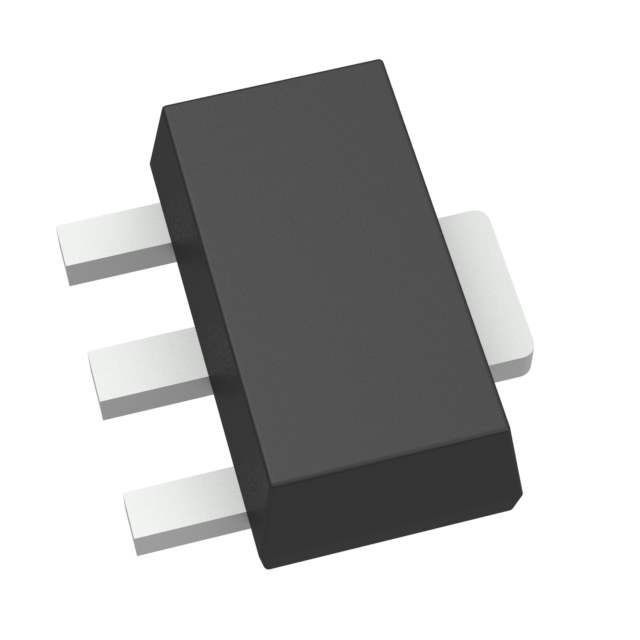
160V VCEO, 600mA collector ceiling, 1W dissipation, SOT-89-3, -55°C to 150°C junction
Quick Engineering Summary
| Field | Value |
|---|---|
| Manufacturer | Diodes Incorporated |
| Category | Transistors (BJT) - Single |
| Package | SOT-89-3 |
| Core function | TRANS NPN 160V 0. |
| Key electrical range | Collector Cut-off Current(Max): 50nA (ICBO); Frequency - Transition: 300MHz; Maximum Current Collector: 600mA; Maximum Power Dissipation: 1W |
| Reported stock | 90000 pcs reported — confirm on RFQ |
160V is the reason to pick it
160V sets the case for this device. That collector-emitter breakdown ceiling is what puts DXT5551-13 into high-side startup, bias, clamp, and small-signal level-shift work instead of the much larger pool of low-voltage transistor jobs where a lower voltage class would do the same work.
The rest of the listing supports that read. The 600mA maximum collector current is a ceiling, not a sign that the SOT-89-3 package will be comfortable there in every layout, and the 1W maximum power dissipation makes clear that thermal budget closes the decision before anyone should treat this as a casual high-current switch. It is active and EU RoHS compliant, so the lifecycle picture is clean for new design-in.
Use it where voltage margin matters more than current
Not a power transistor.
This part fits boards that need an NPN to stand off 160V in a compact SMD footprint, then carry modest current with defined saturation behavior. The listed 200mV at 5mA, 50mA gives one concrete switching point: at that test condition, saturation loss is controlled enough for low-current switching and bias functions, but it does not say what happens near the 600mA collector ceiling.
The 80 minimum hFE at 10mA, 5V points the same way. It sets a floor for gain in small-signal use, not a blanket answer for forced-beta switching across the full current range. If the design lives on low current and high voltage, DXT5551-13 belongs on the short list. If the job is sustained load current in a hot corner, package limits and missing thermal detail take over.
The constraint is thermal, not just electrical
Thermal headroom is the constraint here. The numbers invite a familiar mistake: 600mA and 1W appear together, but they do not settle the same question. The 600mA maximum collector current is only a current ceiling, while the 1W maximum power dissipation can end the design first, especially in SOT-89-3 where board copper and heat path decide whether the transistor stays controlled or drifts toward trouble.
The temperature range helps, but only partway. The listing gives a -55°C to 150°C junction operating range, so DXT5551-13 is not ruled out for wide-temperature equipment, yet that junction limit still depends on a real thermal path to mean much on the board. The 300MHz transition frequency matters in fast small-signal stages, but it does nothing for a switching design already boxed in by dissipation.
Supply is the other practical constraint. Packaging is reel - TR, stock is 90000, and supply-and-demand status is Limited. That points to buying for the build in view rather than assuming easy buffer later, because active lifecycle status and available stock are not the same thing.
What the listing still doesn't answer
What do you need first to place the order with confidence?
For DXT5551-13, the missing items are the ones that decide whether the listed ceilings are usable on a real board: thermal resistance, derating curve, pinout, and package drawing. Without thermal resistance and the derating curve, the 1W figure is only a headline ceiling. Without pinout and the package drawing, layout cannot be closed even though the package name is SOT-89-3.
There is also no switching detail beyond transition frequency. Reverse-recovery time does not apply here, but switching waveforms and capacitance data still matter if the transistor is being pushed into fast edge handling or high-voltage signal shaping, because those are the details that separate a part that merely survives on paper from one that behaves predictably across the actual operating range.
The ECAD note says contact us to download. That is not the same as having the mechanical and electrical detail in hand when footprint work, thermal checks, and release timing all depend on specifics.
View the Win-Source product page for DXT5551-13.
Key Takeaways for Engineers & Buyers
- Treat 160V VCEO as the rail ceiling; don't use DXT5551-13 where normal operation sits against it.
- Budget heat from the 200mV @ 5mA, 50mA saturation limit and the 1W package ceiling before committing copper.
- Place reel demand early if this stays on the BOM; stock shows 90000 while supply status is Limited.