
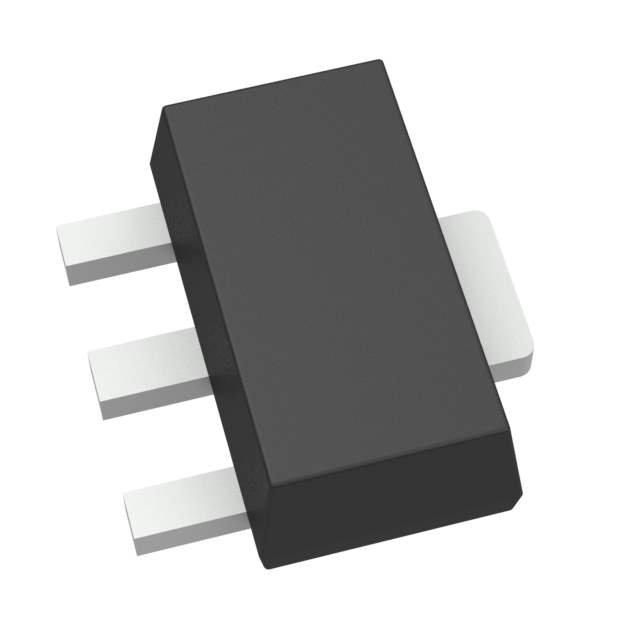
60V VCEO, 3A collector ceiling, 1W dissipation limit, SOT-89-3 package, -55°C to 150°C TJ
Quick Engineering Summary
| Field | Value |
|---|---|
| Manufacturer | Diodes Incorporated |
| Category | Transistors (BJT) - Single |
| Package | SOT-89-3 |
| Core function | TRANS NPN 60V 3A SOT-89-3 |
| Key electrical range | Collector Cut-off Current(Max): 100nA (ICBO); Frequency - Transition: 200MHz; Maximum Current Collector: 3A; Maximum Power Dissipation: 1W |
| Reported stock | 66835 pcs reported — confirm on RFQ |
The weak point is thermal headroom, not availability
The weak point comes first: SOT-89-3 with a listed maximum power dissipation of 1W puts a hard limit on how much current this part can really carry on a board, even though the headline collector current is 3A. That 3A figure is a ceiling, not a promise that any layout can hold junction temperature inside limits, and the -55°C to 150°C operating range is a junction range rather than ambient permission to run hard.
The stronger case is everything around that limit. A 60V VCEO ceiling gives useful rail margin for low-voltage to mid-voltage switching stages, and the listed Max VCE(sat) of 600mV @ 300mA, 3A frames the part as something to judge in saturated use, where conduction loss lands in the thermal budget immediately. The minimum hFE of 100 @ 500mA, 2V helps at moderate current, but it does not change the main constraint: heat is the first thing to solve here, not gain.
Availability is the easy part. DXT651-13 is Active, EU RoHS compliant, stocked at 66835, and offered on reel, so the commercial picture supports new design-in. The engineering fit is narrower: use it where 60V matters, board area is tight, and dissipation stays honest.
And that 600mV number decides the switching role
And that is still the number to watch. The 600mV @ 300mA, 3A VCE(sat) entry is a ceiling, not a typical drop, so it bounds worst-case saturated conduction but leaves linear-region behavior, switching speed under load, and board-copper needs unresolved.
Wrong for linear burn; right for compact saturated stages
Wrong for linear pass duty. With only 1W listed and no thermal resistance in view, DXT651-13 is a poor place to hold sustained voltage and current at the same time.
It suits compact board-mounted switching and driver work better, where an NPN in SOT-89-3 is attractive, the rail stays inside the 60V collector-emitter ceiling, and load current is managed against the 3A collector limit without treating 3A as a normal operating point. The 200MHz transition frequency says it is not a slow, purely low-frequency device, but that number alone does not settle switching loss or storage behavior in a real converter or clamp stage.
The missing items are the ones that finish the decision
The constraint is incomplete thermal and package detail. The 1W limit in SOT-89-3 only becomes actionable when thermal resistance, a derating curve, and a package drawing are in hand, because those are what tell you how the package sheds heat on a real land pattern.
Pinout is also missing, and safe pulse information such as surge or secondary-breakdown context is not listed, so inductive or fault-exposed switching still needs the full datasheet before layout is frozen. ECAD is listed only as contact access.
View the Win-Source product page for DXT651-13.
Key Takeaways for Engineers & Buyers
- Treat 3A collector current as a ceiling and check whether 1W in SOT-89-3 closes your thermal budget.
- Use the 600mV @ 300mA, 3A VCE(sat) limit to bound conduction loss in saturated switching service.
- Reserve DXT651-13 on reel if the line is continuous; listed stock is 66835.