
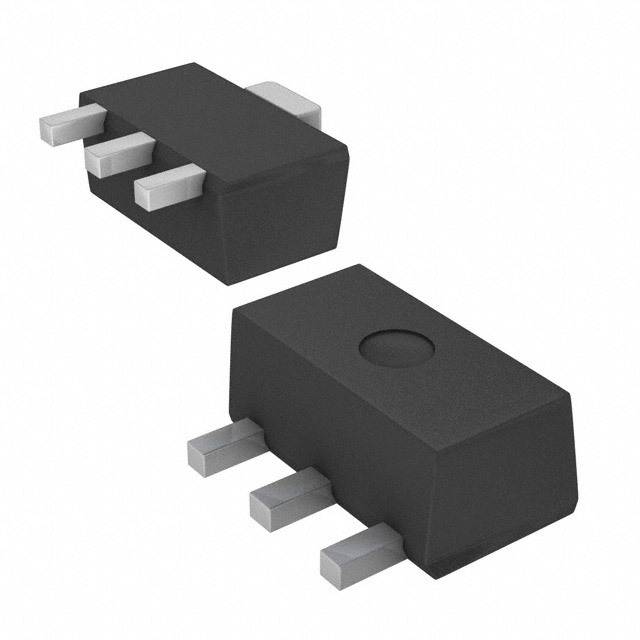
300V VCEO ceiling, 500mA collector limit, 1W dissipation cap, SOT-89-3, -55°C to 150°C junction
Quick Engineering Summary
| Field | Value |
|---|---|
| Manufacturer | Diodes Incorporated |
| Category | Transistors (BJT) - Single |
| Package | SOT-89-3 |
| Core function | TRANS PNP 300V 0. |
| Key electrical range | Collector Cut-off Current(Max): 250nA (ICBO); Frequency - Transition: 50MHz; Maximum Current Collector: 500mA; Maximum Power Dissipation: 1W |
| Reported stock | 134230 pcs reported — confirm on RFQ |
Not for power switching; useful in high-voltage small-signal rails
If your first problem is moving current with margin, this is the wrong part. The 500mA maximum collector current and 1W maximum power dissipation are ceilings, and the listing gives no thermal resistance or derating curve to show how much ambient headroom is actually available in SOT-89-3.
It fits better in a compact high-voltage PNP position where a 300V VCEO ceiling matters more than brute current handling. That points to startup, bias, level-shift, and linear support roles on elevated rails, especially when through-hole parts are off the table and SMD assembly matters. Active lifecycle and EU RoHS status support new design-in, and DXTA92-13 reads as a current production part rather than a sustaining-only buy.
The weak point is gain; the strong point is voltage
The weak point comes first: hFE is only 25 at 1mA, 10V, and that is the minimum listed figure. That does not close base-drive sizing across the rest of the operating range, and it rules out any casual assumption that DXTA92-13 behaves like a high-gain small-signal transistor once collector current moves away from that test point.
The strong point is the 300V collector-emitter breakdown ceiling. Get that wrong and the transistor is in the wrong socket. The 500mV maximum VCE(sat) at 2mA, 20mA also helps frame conduction loss at a defined test condition, but only there. It does not tell you saturation behavior at higher collector current, and it does not rescue a design already boxed in by the 1W dissipation cap.
300V is the deciding number
300V is the deciding number. The rest of the listing sets the boundaries: 500mA collector current is a limit, 1W is a limit, and the package is SOT-89-3. Use it on high-voltage control and bias nodes, not as a general-purpose load switch.
The real constraint is incomplete thermal and switching detail
Incomplete thermal and switching detail is the real constraint. The listing is enough to shortlist the device, but not enough to close a release for any design that cares about heat or switching speed, because it gives 1W maximum power dissipation, 50MHz transition frequency, and a -55°C to 150°C junction operating range without the details that decide whether those ceilings hold on your board, with your pulse shape, at your ambient.
Thermal data is the first gap. There is no thermal resistance figure and no derating curve, so the 1W ceiling cannot be translated into board-level temperature rise from this page alone. In a SOT-89-3 transistor, that is not housekeeping; it is the difference between a compact high-voltage stage that runs warm, runs hot, or fails qual when copper area shrinks.
The switching picture is thin too. A 50MHz transition frequency is useful as a family-level hint, but it does not replace charge storage behavior, capacitance, or switching waveforms when the part is driven hard or pulled out of saturation. The listing also omits a pinout and package drawing, which matters because DXTA92-13 will often land in dense high-voltage layouts where pad orientation and creepage decisions get made early.
Use the reel format already offered and plan around the supply signal, not the stock count alone: packaging is Reel - TR, stock is 134230, and supply and demand is marked Limited. That's the commercial constraint here. For a running build, reserve the reel quantity you need before layout freeze so the sourcing plan stays aligned with the electrical choice.
View the Win-Source product page for DXTA92-13.
Key Takeaways for Engineers & Buyers
- Keep DXTA92-13 in high-voltage PNP stages that need the 300V VCEO ceiling, not low-voltage power switching.
- Budget around the 1W dissipation ceiling and 500mV VCE(sat) max at 2mA, 20mA before committing board copper.
- Book reel demand early; stock shows 134230, but supply status is Limited.