
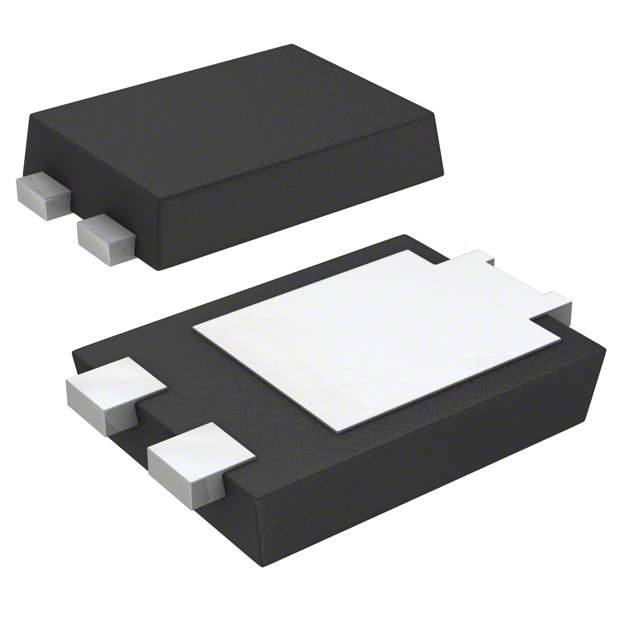
20 V, 8 A, 3 W, PowerDI™ 5, -55°C to 150°C TJ: rail and heat limits decide the fit.
Quick Engineering Summary
| Field | Value |
|---|---|
| Manufacturer | Diodes Incorporated |
| Category | RF Transistors (BJT) |
| Package | Tape & Reel |
| Core function | TRANS PNP 20V 8A POWERDI 5 |
| Key electrical range | Current - Collector (Ic) (Max): 8 A; Current - Collector Cutoff (Max): 50nA (ICBO); DC Current Gain (hFE) (Min) @ Ic, Vce: 300 @ 100mA, 2V; Frequency - Transition: 176MHz |
| Reported stock | 17559 pcs reported — confirm on RFQ |
Can you safely start a new build on this part?
Can I put this into a new design and move on? Yes—if the rail and thermal limits already fit.
DXTP19020DP5-13 is an Active PNP device, so the lifecycle case for new design-in is straightforward. The catch is the electrical envelope: a 20 V collector-emitter breakdown ceiling and 3 W maximum dissipation narrow the fit quickly in a small SMD package. If your design stays comfortably inside those limits and wants a PNP in PowerDI™ 5, this is a reasonable current-production choice. EU RoHS is compliant, REACH is unaffected, and MSL 1 helps on the assembly side.
20 V is the first number that rules parts in or out
20 V is the hard stop, and it sets the tone before the rest of the numbers matter.
This part belongs on low-voltage rails only. That collector-emitter breakdown figure is a ceiling, not a normal operating target, and it leaves no room for unmanaged transients.
The next limit is 3 W maximum. Paired with the 8 A collector rating and the listed 275mV Vce saturation at 800mA, 8A, it shifts the real design question away from headline current and toward whether the conduction-loss budget stays inside what the package can actually shed under your conditions. The 300 minimum hFE at 100mA, 2V is useful, but only at that test point; it does not settle base-drive behavior at heavier load.
The buy-side constraint is packaging, not lifecycle
5,000 pieces. That is the standard package.
With 17559 in stock, the signal is reel-based production use, not casual bench demand. If DXTP19020DP5-13 is headed for a line, plan the build lot around reel consumption.
What the listing still doesn't tell you
The weak point is the missing detail, not lifecycle or stock.
Several specifics that matter near the limits are absent here. There is no thermal resistance figure such as RθJC, so the 3 W maximum cannot be turned into ambient headroom or copper dependence from this page alone. There is no pinout or package drawing, so footprint review and orientation checks still depend on the datasheet. Safe-operating-area information is also missing, and for a part framed by 20 V and 8 A, that gap matters because separate current and voltage ceilings do not tell you which combinations are survivable in switching or linear stress.
Switching detail is thin as well. The 176MHz transition frequency tells you the transistor is not slow, but it does not replace turn-on, turn-off, or storage-time data when you need to predict edge behavior, loss, or saturation cleanup in a real circuit.
View the Win-Source product page for DXTP19020DP5-13.
Key Takeaways for Engineers & Buyers
- Keep VCE below the 20 V breakdown ceiling; this part does not close higher-rail decisions.
- Budget dissipation against the 3 W maximum before leaning on the 8 A collector rating.
- Buy in reel quantities that match the 5,000 standard package if DXTP19020DP5-13 is going onto a running line.