
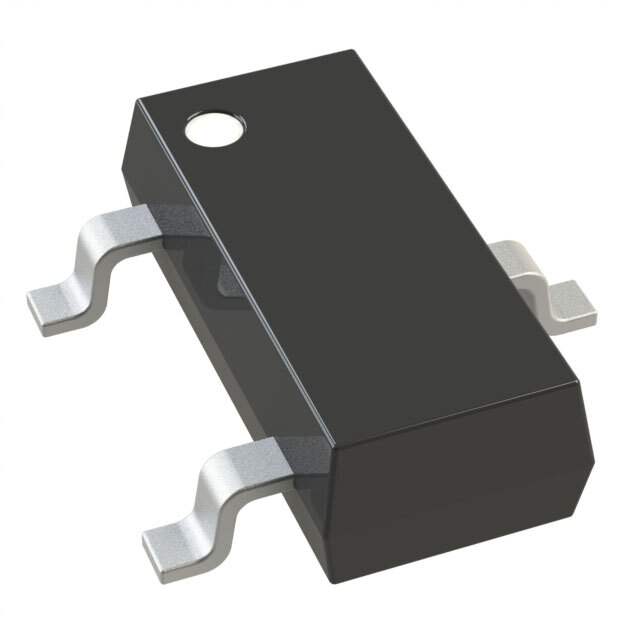
24V nominal zener, 300mW ceiling, SOT-23-3 package, -65°C to 150°C operating range
Quick Engineering Summary
| Field | Value |
|---|---|
| Manufacturer | Diodes Incorporated |
| Category | Diodes - Zener - Arrays |
| Package | SOT-23-3 |
| Core function | DIODE ZENER ARRAY 24V SOT-23-3 |
| Key electrical range | Maximum Power Dissipation: 300mW; Supply and Demand Status: Balance; Temperature Range - Operating: -65°C to 150°C; Tolerance: ±5% |
| Reported stock | 61000 pcs reported — confirm on RFQ |
300mW is the limit that decides this part
300mW is the limit that decides this part. In a dual zener array, that ceiling matters more than the 24V nominal marking because it determines whether the clamp survives the expected fault energy or just runs hot in a tiny SOT-23-3 body.
The 24V zener value with ±5% tolerance settles one question and leaves another open. It places the clamp region around 24V, so this fits moderate-voltage rails and signal protection points, not low-voltage logic nets. What it does not show is how sharply it clamps under current: the listing gives 80 Ohm maximum Zzt, but no reverse leakage figure and no current condition beyond that impedance. Active status and EU RoHS support new design-in, provided the circuit stays inside the power ceiling and the missing curves come from the datasheet.
Can you keep DZ23C24-7-F on a running line?
Can you actually buy it in production quantity? Yes. Stock is 61000, and packaging is Reel - TR, so it lines up with automated SMT builds instead of creating a repack or hand-load exception.
Supply is only part of the fit. The category is zener arrays, the configuration is 1 Pair Common Cathode, and the package is SOT-23-3. That is a specific electrical and mechanical choice: two zener elements sharing a common cathode node in a compact footprint. If the schematic needs separate discrete zeners, a different common node, or more surge headroom than a 300mW ceiling usually allows, the fit breaks before inventory does.
The operating range of -65°C to 150°C is a limit, not proof that every board can use the full span, and without a derating curve or thermal resistance it does not answer the ambient power question in a dense layout. For an active build, buy the reel and lock the common-cathode topology before BOM release, because that topology choice is harder to unwind than stock availability.
The weak point is missing behavior under stress
The weak point comes first: behavior under stress is still missing. The strong point is basic fit. This is a 24V zener array in SOT-23-3 with a common cathode, so it suits compact clamp and reference roles where board area is tight and the topology matches.
The listing leaves out the details that usually close the review. Reverse leakage is absent. Forward voltage at a stated If is absent. There is no surge current figure, no thermal resistance, and no pinout here. Those are decision-making numbers on a protection part; they set leakage on a quiet node, fault survivability, and whether the footprint and routing are right the first time. The ECAD note says contact us to download, but the electrical gaps still need the datasheet.
Use it where 24V clamping matters more than precision
Good fit.
It makes sense on moderate-voltage rails, interface lines, and compact protection networks where a 24V nominal clamp and common-cathode pair simplify routing. The 80 Ohm maximum Zzt says the zener behavior is not infinitely stiff, so treat it as a practical clamp element rather than a precision reference expected to hold tightly under changing current.
It does not belong on low-voltage rails that cannot tolerate a 24V clamp region, and it is a poor choice when the design depends on quantified leakage, surge handling, or exact thermal headroom, because those numbers are not listed here.
View the Win-Source product page for DZ23C24-7-F.
Key Takeaways for Engineers & Buyers
- Treat 300mW as the dissipation ceiling; pull the thermal path from the datasheet before loading both junctions.
- Use the 24V nominal zener value with ±5% tolerance to check clamp window and rail margin.
- Buy on reel if the line is automated; stock is 61000 and packaging is TR.