
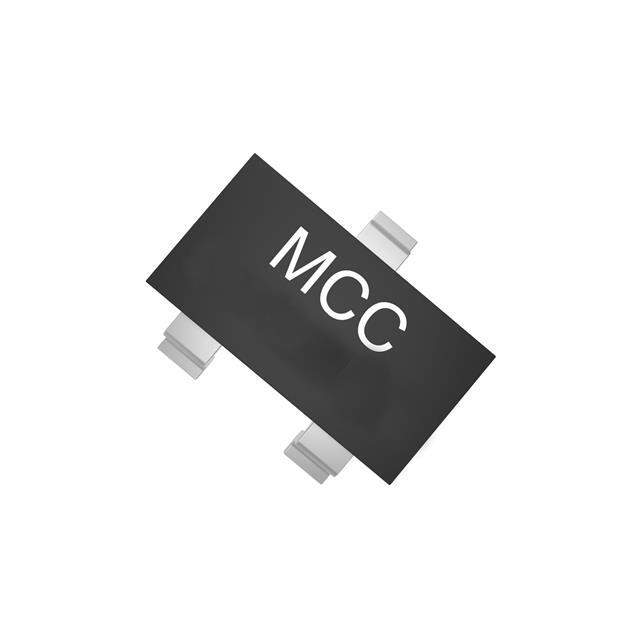
3.9V nominal, 300mW maximum, SOT-23 common-cathode zener pair; fit is clear, thermal detail is not.
Quick Engineering Summary
| Field | Value |
|---|---|
| Manufacturer | Micro Commercial Co |
| Category | Diodes - Zener - Arrays |
| Package | SOT-23 |
| Core function | DIODE ZENER ARRAY 3. |
| Key electrical range | Current - Reverse Leakage @ Vr: 10μA @ 1V; Maximum Power Dissipation: 300mW; Supply and Demand Status: Balance; Tolerance: ±5% |
| Reported stock | 2 pcs reported — confirm on RFQ |
Thin stock is the weak point; the part itself is usable
The weak point comes first: stock is listed at 2, so this is not a part to count on for immediate build depth. Past that, the case is straightforward. Lifecycle is Active with no conflict, and EU RoHS is listed as compliant.
What makes the fit real is the combination of 3.9V nominal zener voltage, 1 Pair Common Cathode configuration, and SOT-23 packaging. That points to a specific job, not a vague one. It suits compact dual-rail clamping or reference duty where the shared cathode is exactly what the topology calls for, and it belongs in new work only when that common-cathode arrangement is intentional from the start.
The ceilings are modest, and they decide the use case
This is modest.
The 300mW maximum power dissipation is a ceiling, not a working point, and it rules out designs that expect a SOT-23 array to absorb sustained fault energy. The 95 Ohm maximum impedance pushes in the same direction: if clamp behavior depends on a stiff zener characteristic, confidence starts to thin there. Add the ±5% tolerance on the 3.9V nominal Vz, and the part lands in loose rail limiting and simple reference duty rather than precision threshold setting.
The leakage figure is still useful. 10μA @ 1V says off-state reverse leakage is small at that stated condition, but the listing does not show how leakage behaves across the rest of the reverse range. That leaves DZ23C3V9-TP well suited to protecting or biasing small-signal nodes, not to carrying the burden of accuracy or surge handling by itself.
Will it fit the line build as well as the schematic?
Will purchasing be able to buy it the way the line needs it?
That is the first practical question. Packaging is Reel - TR with 3k pcs per package, so it fits an SMT flow that already consumes SOT-23 on reel. If the build is prototype-heavy, hand-loaded, or dependent on tiny spot buys, the friction is packaging and availability, not the silicon. Stock is listed at 2.
The category keeps the electrical fit narrow in a useful way. This is a zener array, not a general single zener, and the common-cathode configuration means the board has to want that shared node. In practice, it makes sense in dense interface protection, low-power rail clamps, or compact bias networks where two matched zener elements in one SOT-23 save area and routing. It is the wrong choice when the design needs independent diode placement, more dissipation margin, or a package with more thermal mass.
The missing data is exactly what would finish the call
And that is exactly where the listing stops short. For a final electrical signoff, the missing items are the ones that decide whether the part survives the real board rather than just fitting the symbol and footprint.
There is no operating temperature range, so ambient fit remains open. There is no forward-voltage figure at any If, which matters if the array can be driven forward in a fault path. There is no thermal resistance or derating curve, so the 300mW ceiling cannot be turned into board-level temperature headroom. Pinout and package drawing are also absent here, even though the package text names SOT-23 and TO-236-3, SC-59, SOT-23-3.
Those gaps are concrete, and they matter more than another line of marketing fit. Without thermal resistance, forward-voltage data, operating temperature range, and pinout detail, the part is still a plausible design-in candidate, but the last step from plausible to signed off is not in this listing.
View the Win-Source product page for DZ23C3V9-TP.
Key Takeaways for Engineers & Buyers
- Treat 300mW as the dissipation ceiling; the listing gives no thermal resistance to turn that into ambient headroom.
- Use DZ23C3V9-TP only where a 1 Pair Common Cathode array matches the clamp topology.
- Plan for reel intake: packaging is TR at 3k pcs, while current stock is listed at 2.