
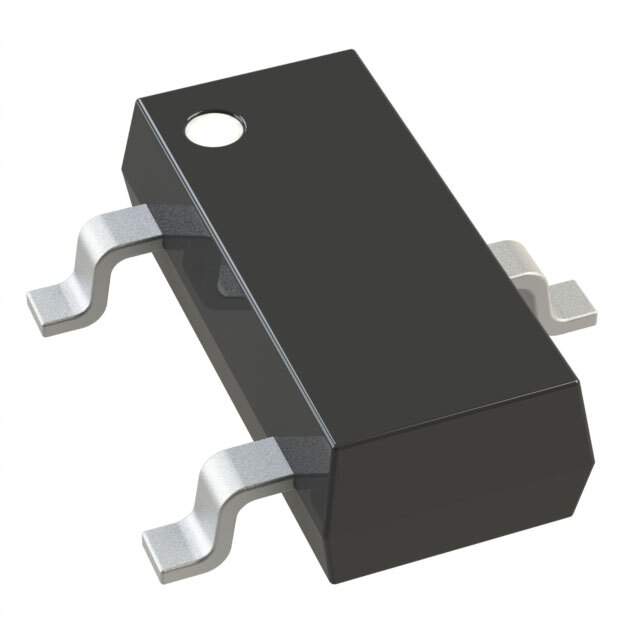
5.6V nominal zener array, 300mW ceiling, SOT-23-3 package, -65°C to 150°C operating range
Quick Engineering Summary
| Field | Value |
|---|---|
| Manufacturer | Diodes Incorporated |
| Category | Diodes - Zener - Arrays |
| Package | SOT-23-3 |
| Core function | DIODE ZENER ARRAY 5. |
| Key electrical range | Maximum Power Dissipation: 300mW; Supply and Demand Status: Sufficient; Temperature Range - Operating: -65°C to 150°C; Tolerance: ±5% |
| Reported stock | 3019 pcs reported — confirm on RFQ |
Not for precision references; fine for compact 5.6V clamps
This is the wrong part when a rail needs a tightly held reference voltage or the protection network needs substantial energy headroom. The listed ±5% tolerance leaves visible spread around the 5.6V nominal point, and the 300mW maximum power dissipation is a ceiling, not a place to leave a hot clamp continuously.
It fits small board-level protection or bias limiting that wants two zeners in a 1 Pair Common Cathode arrangement inside SOT-23-3. Active lifecycle, EU RoHS, and reel packaging make it a practical choice for new design-in and existing production when the circuit actually wants this topology rather than a single discrete zener or a tighter reference device.
The package is small; the power ceiling stays small
And that package choice is the first real constraint. SOT-23-3 settles the footprint quickly, but not the thermal picture, because the listing gives 300mW as a maximum power dissipation ceiling and stops there. That puts this array in low-power clamp duty; it does not answer ambient headroom, copper dependence, or how much abuse a surge event can survive.
The 5.6V nominal zener rating sets the rail class you can clamp around, while the 40 Ohm maximum impedance says regulation will shift under current rather than behave like a stiff reference. Get that wrong and the node you expected to stay neatly limited will wander more than the schematic suggests. The -65°C to 150°C operating range is broad enough for harsh ambient exposure, but it remains only an operating range listing, not a statement about long-duration dissipation at the top end.
What the listed numbers settle, and what they don't
Buy it for clamps.
The number that shapes the decision most is still 300mW. In a zener array this small, that ceiling decides whether the device belongs on a light signal or bias node or becomes the wrong choice for anything expected to absorb repeated energy dumping, and that distinction matters more than the package convenience because thermal margin disappears fast once both diodes in the common-cathode pair are asked to do real work.
The second number that matters is 5.6V nominal with ±5% tolerance. That is usually acceptable when the zener is there to catch excursions or set a loose threshold, but it does not settle a precision threshold decision by itself. If the downstream circuit trips close to the clamp point, the tolerance band becomes the design problem.
Then there is the 1 Pair Common Cathode configuration. That works well when two lines need a shared node relationship in a compact footprint, and it is awkward when the protection scheme expects isolated single diodes or a different common-node orientation. In SOT-23-3, the topology either fits cleanly or it pushes routing into compromises.
What the listing does not settle is just as concrete: no forward voltage at forward current, no reverse leakage at a stated Vr, and no surge figure. Without those numbers, this page cannot support a conduction-loss estimate or a fault-survival estimate, and those are the details that separate a harmless protector from a warm field return.
3019 pieces is enough to act, not enough to forget
3019 pieces is the decisive stock figure. That supports immediate builds and controlled replenishment, especially with Reel - TR packaging already aligned to SMT placement.
What still blocks a full signoff is the missing electrical and mechanical detail: no reverse leakage value at Vr, no forward-voltage figure at If, no thermal resistance, and no pinout detail here. Those gaps decide clamp current, heat flow, and layout certainty.
View the Win-Source product page for DZ23C5V6-7-F.
Key Takeaways for Engineers & Buyers
- Keep DZ23C5V6-7-F on rails and nodes that need a 5.6V nominal clamp, not a tighter trim than ±5%.
- Budget dissipation against the 300mW ceiling before using both diodes in the common-cathode pair.
- Load reel stock against the current 3019 quantity if this part is for an active running line.