
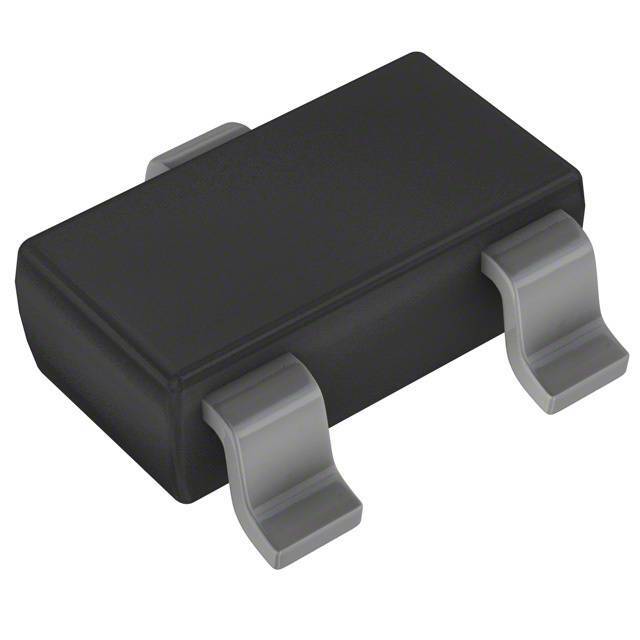
6.2V nominal, 300mW ceiling, SOT-23-3, -65°C to 150°C range, common-cathode pair
Quick Engineering Summary
| Field | Value |
|---|---|
| Manufacturer | Diodes Incorporated |
| Category | Diodes - Zener - Arrays |
| Package | SOT-23-3 |
| Core function | DIODE ZENER ARRAY 6. |
| Key electrical range | Maximum Power Dissipation: 300mW; Supply and Demand Status: Sufficient; Temperature Range - Operating: -65°C to 150°C; Tolerance: ±5% |
| Reported stock | 30000 pcs reported — confirm on RFQ |
The 300mW ceiling is the real design limit
The constraint is dissipation. DZ23C6V2-7-F gives you a 6.2V nominal Zener in a 1 pair common cathode array, but the listed 300mW maximum power dissipation is the ceiling that decides whether it belongs on a light protection or reference node rather than on a rail that can sit in clamp for long stretches.
The ±15% tolerance settles one question and leaves another open. It tells you the clamp or reference point is not precision-tight, but it does not show how voltage moves with current because the reverse leakage field is blank and no Vz test current appears here. The 10 Ohm maximum Zzt matters for dynamic behavior, yet without the current condition behind that impedance, you still need the datasheet before treating it as a predictable shunt element.
Not for heavy surge work; fine for compact dual-node clamps
Heavy surge work is the wrong job for this part. There is no IFSM, no forward-voltage figure at If, and no thermal resistance in the listing, so any design that expects the array to absorb repeated energy hits is working without the numbers that decide survival.
It fits much better in dense board-level protection or bias networks that need two 6.2V Zener elements in a common-cathode arrangement inside SOT-23-3. That topology helps when two lines return to the same node and board area is tight. The -65°C to 150°C operating range is broad enough for harsh ambient exposure, but it does not change the 300mW ceiling.
The weak point is missing behavior data
The weak point comes first: the listing stops before the numbers that close a clamp design. The strong point is simpler. DZ23C6V2-7-F is clearly identified as a common-cathode Zener array with 6.2V nominal Vz, ±15% tolerance, and SOT-23-3 packaging.
What is missing matters more than another attribute. Reverse leakage is absent. Forward voltage at If is absent. Thermal resistance is absent. A pinout or package drawing is also absent here, and with a three-pin common-cathode array that omission can still stall layout because the topology is known but the pad-to-function mapping is not.
Buy it for current builds, but watch the program horizon
And that is where the commercial picture gets more specific. The status is Active, stock is listed at 30000, packaging is Reel - TR, and supply-and-demand is marked sufficient, so the part is a reasonable buy for current production and for new work that does not need an unusually long service life.
The caution is the Estimated EOL Date of 2026. That does not cancel the Active status, but it does change how far out you should commit this device into a platform expected to run unchanged for years after that point. If the design window is short or the board is already in sustaining production, the combination of Active status and reel packaging is workable. If the program horizon runs past 2026 with little appetite for a midlife component touch, make that call now, before DZ23C6V2-7-F becomes the small line item that forces a requalification.
EU RoHS is compliant, and halogen free is marked compliant as well.
View the Win-Source product page for DZ23C6V2-7-F.
Key Takeaways for Engineers & Buyers
- Keep DZ23C6V2-7-F on low-energy clamp and reference duties; 300mW is the dissipation ceiling.
- Match the common-cathode topology before layout; this is a 1 pair common cathode array in SOT-23-3.
- For long programs, review the 2026 Estimated EOL Date before freezing DZ23C6V2-7-F into the BOM.