
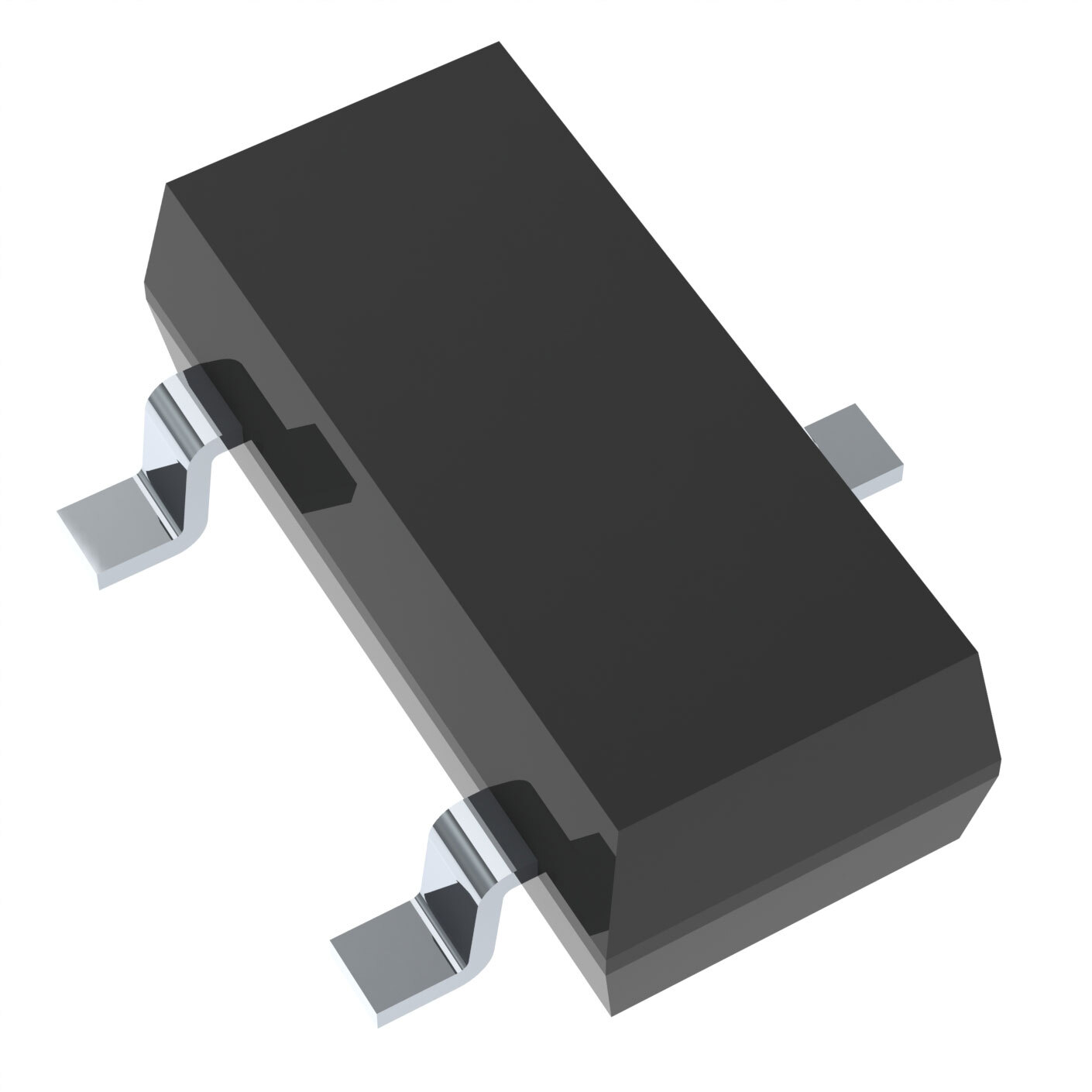
7.5 V nominal, 300 mW max, SOT-23 common-cathode Zener pair with ±5% tolerance
Quick Engineering Summary
| Field | Value |
|---|---|
| Manufacturer | Micro Commercial Co |
| Category | Diodes - Zener - Arrays |
| Package | TO-236-3, SC-59, SOT-23-3 |
| Core function | DIODE ZENER ARRAY 7. |
| Key electrical range | Current - Reverse Leakage @ Vr: 100 nA @ 5 V; Power - Max: 300 mW; Supply and Demand Status: Limited; Tolerance: ±5% |
| Reported stock | 1 pcs reported — confirm on RFQ |
300 mW is the first limit that matters
300 mW is the ceiling that decides whether this device belongs in the clamp network at all. In SOT-23, that points to small-signal protection and reference duty, while pulse handling, ambient headroom, and board temperature remain open because those limits are not listed.
Wrong for heavy surge work, right for compact rail clamping
Heavy surge work is the wrong job for this part. A 300 mW maximum power rating in SOT-23 points away from sustained high-energy suppression, and the listing gives no surge current figure to support that use.
It fits better in dense board-level clamping around a 7.5 V nominal node when a common-cathode pair suits the topology. The ±5% tolerance bounds the clamp target, but not tightly enough to treat it as a precision reference without checking the rest of the error stack. Reverse leakage of 100 nA @ 5 V is low enough to matter in high-impedance sensing or bias networks, where leakage can shift a threshold long before power does.
The buying problem is availability, not lifecycle
Availability is the constraint the numbers create. Active lifecycle helps, but it does not keep a line moving when stock quantity is 1.
Tape & Reel packaging fits production handling, yet the practical read on DZ23C7V5-TP is straightforward: don't release it into a build that needs continuity unless material is already in hand. For a prototype or a controlled sustaining build, that may be enough. For a fresh production start, it isn't.
View the Win-Source product page for DZ23C7V5-TP.
The missing datasheet items are the real review blockers
The weak point is what the listing leaves out, not the headline electrical data. DZ23C7V5-TP gives you 7.5 V nominal, ±5%, 7 Ohms maximum Zzt, and 100 nA @ 5 V leakage, which is enough to place it in the right class of circuit, but not enough to finish the stress check.
Thermal detail is the first gap. Power - Max is 300 mW, but there is no thermal resistance or derating curve, and that is what decides how much ambient margin the board really has once copper area, airflow, and local heating stop being assumptions and start being limits. Surge behavior is the next gap: no non-repetitive surge or similar overload figure is listed, so transient survivability is still open.
Forward conduction detail is also missing. The forward-voltage field is blank, which matters if the array can be driven into forward bias during fault conditions. Operating temperature is blank as well, so qual screening and environment fit remain unresolved.
Usable, yes. Finished, no.
View the Win-Source product page for DZ23C7V5-TP.
Key Takeaways for Engineers & Buyers
- Treat 300 mW as the dissipation ceiling, not the working point.
- Use the 1 pair common cathode topology only where the shared node is intentional.
- Secure stock early; listed quantity is 1 and supply status is Limited.