
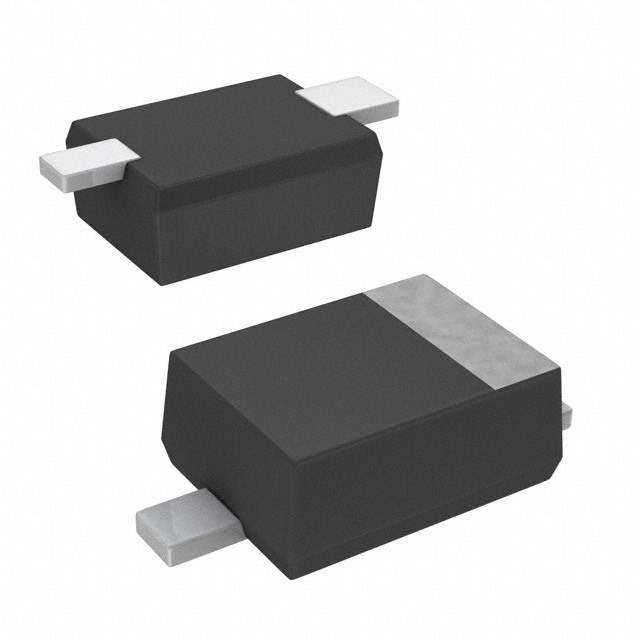
2.7V zener, 200mW ceiling, SMini2-F5-B package, SMD mounting, with conflicting lifecycle signals
Quick Engineering Summary
| Field | Value |
|---|---|
| Manufacturer | Panasonic |
| Category | Diodes - Zener - Single |
| Package | SMini2-F5-B |
| Core function | DIODE ZENER 2. |
| Key electrical range | Current - Reverse Leakage @ Vr: 120μA @ 1V; Maximum Power Dissipation: 200mW; Supply and Demand Status: Balance; Tolerance: ±5% |
| Reported stock | 18000 pcs reported — confirm on RFQ |
Sustaining part, not a fresh start
Existing production only.
Active status appears alongside a conflicting 停止提供 lifecycle signal, so the conservative call is to keep DZ2J02700L in sustaining use and out of new sockets. EU RoHS is compliant.
The 200mW ceiling is the real design limit
The constraint is power, not nominal voltage. The 2.7V zener rating tells you the neighborhood, but it does not answer how hard the device can be driven during faults, and the listed 200mW maximum power dissipation sets a firm ceiling while the absence of a derating curve or thermal resistance leaves ambient headroom unresolved.
The other number that shapes the decision is 110 Ohm maximum Zzt. That is high enough to expect regulation behavior to shift with current, so this is not the right pick when a rail needs a stiff shunt characteristic. The ±5% tolerance is usually acceptable for simple protection rails and much less comfortable for a tight reference point.
That pushes it toward light-duty local clamps
And that package choice reinforces it. SMini2-F5-B in SMD form points this device toward dense board-level protection and bias networks, where a small zener catches a node or sets a rough threshold rather than absorbing repeated heavy energy.
The forward figure matters too: 1V at 10mA is a listed maximum in forward conduction, so if the circuit can drive the diode the wrong way, that drop belongs in the dissipation budget. Reverse leakage of 120μCA at 1V is also a ceiling, not a promise of precision behavior near the knee, so don't put it where standby current or threshold sharpness decides the product.
Wrong for precision rails, workable for BOM continuity
Wrong for precision references, thermally stressed clamps, and any review that needs surge confidence. The listing does not carry IFSM, thermal resistance, or a derating curve, which leaves too much unsaid for those jobs.
It is more believable in a compact consumer board where 2.7V nominal, ±5%, and a 200mW ceiling are enough to protect a local node and nothing more dramatic.
For buying, the practical constraint is package discipline under lifecycle ambiguity. There are 18000 in stock, packed Reel - TR with 3k pcs per package, so it can keep a running line supplied if the BOM already names it. Secure the reels needed for that line, then stop short of expanding DZ2J02700L into new assemblies.
The missing datasheet items are concrete ones: reverse-recovery time, junction capacitance, thermal resistance, and a package drawing or pinout reference. Those gaps matter because this part sits right on the boundary where small-signal zener behavior, heat flow, and footprint details decide whether the clamp is merely adequate or quietly troublesome in production.
View the Win-Source product page for DZ2J02700L.
Key Takeaways for Engineers & Buyers
- Hold DZ2J02700L to 2.7V nominal zener use; the listing gives no wider operating curve.
- Budget around the 200mW ceiling and 1V at 10mA forward condition before assigning clamp duty.
- Buy in reel multiples of 3k pcs if DZ2J02700L must stay on an existing BOM.