
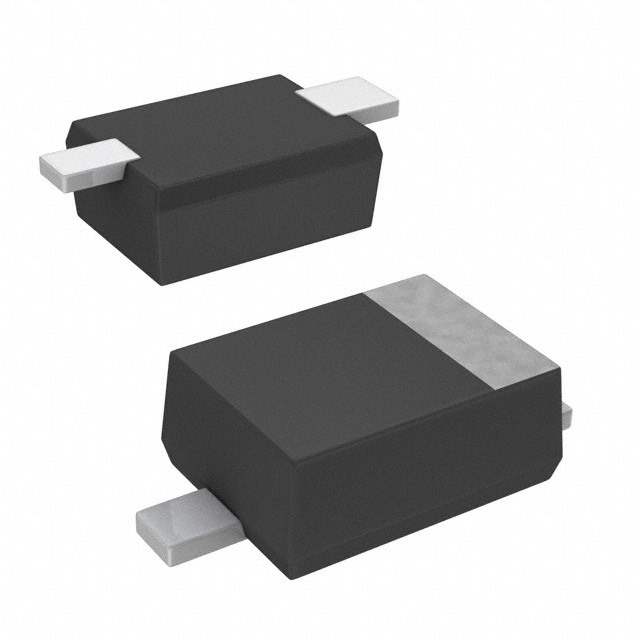
4.7V nominal, 200mW ceiling, SMini2-F5-B package, and a lifecycle conflict that changes the call
Quick Engineering Summary
| Field | Value |
|---|---|
| Manufacturer | Panasonic |
| Category | Diodes - Zener - Single |
| Package | SMini2-F5-B |
| Core function | DIODE ZENER 4. |
| Key electrical range | Current - Reverse Leakage @ Vr: 2μA @ 1V; Maximum Power Dissipation: 200mW; Supply and Demand Status: Balance; Tolerance: ±5% |
| Reported stock | 15000 pcs reported — confirm on RFQ |
Use it to sustain, not to start
Not for new designs.
Active status appears alongside a conflicting 停止提供 lifecycle signal. That is enough to rule out a comfortable new design-in. For an existing build, the part still fits if the package and electrical ceilings already match the board. EU RoHS is listed.
200mW is the number that really limits this Zener
200mW sets the ceiling first.
A 4.7V nominal Zener sounds straightforward, but DZ2J04700L is constrained by dissipation before nominal clamp value because the listing gives 200mW maximum power dissipation and no thermal resistance or derating curve to show how much ambient headroom the package really has.
The 4.7V Vz with ±5% tolerance answers the nominal regulation target and the spread you must accept, but it does not show how sharply the part reaches that region because only 80 Ohm maximum Zzt is listed. The 1V maximum forward drop at 10mA is a ceiling, not a normal operating point, and it matters if the diode can ever be driven forward by fault or polarity reversal because that condition adds heat to the same 200mW budget.
The weak point is documentation depth, not basic fit
The weak point is what is missing, not the basic device type.
DZ2J04700L is plainly a small SMD single Zener in SMini2-F5-B, sold on reel, so it fits compact board-level clamp or reference duties where a 4.7V nominal device and 200mW ceiling already frame the job.
It does not fit a design where surge handling, thermal margin, or dynamic behavior decide reliability. The listing gives 2µA at 1V for reverse leakage, but that only covers leakage at that stated condition; it does not close behavior near the Zener region or say anything about pulse survival. If your circuit depends on low drift under load or on absorbing repetitive transients, this page can’t clear it.
What would close the open questions
What does a buyer need to know first? Whether DZ2J04700L can stay on a running line without a package or qualification surprise.
There is usable stock at 15000, with reel packaging and 3k pcs per package, so the immediate move is simple: buy to reel multiples if this part is already released on your BOM. The real holdback is not quantity but missing detail. The listing does not include a package drawing or pinout confirmation, and with a small outline like SMini2-F5-B that is not clerical; it is the kind of omission that turns a footprint mismatch into scrap.
The other gaps are the ones that decide stress margin. There is no derating curve, no thermal resistance, no surge or overload figure such as IFSM, and no junction capacitance. For a Zener, those omissions separate a harmless rail clamp from a field return that shows up only after the board sees hot ambient, repetitive faults, or a fast edge the simple 4.7V label never described.
View the Win-Source product page for DZ2J04700L.
Key Takeaways for Engineers & Buyers
- Treat 200mW as the dissipation ceiling; don’t size DZ2J04700L from the 4.7V nominal alone.
- Match the footprint to SMini2-F5-B before release; the listing names the package but not the drawing.
- If the line is already built on DZ2J04700L, cover reel demand in 3k pcs increments against the 15000 stock.