
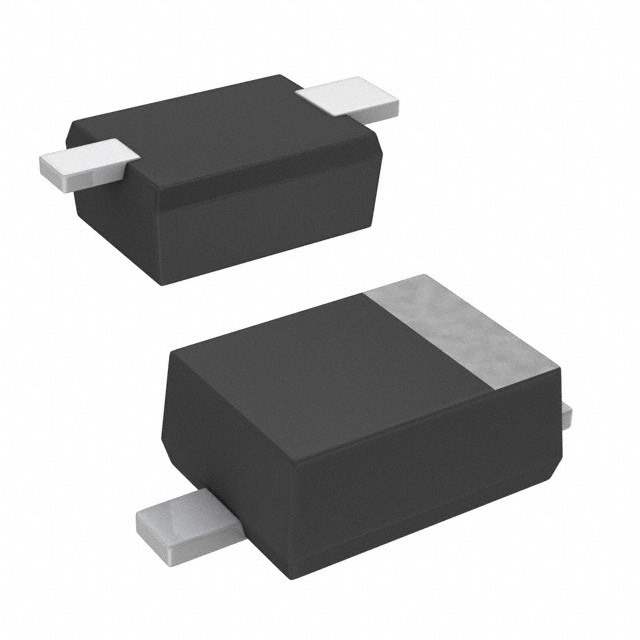
11V zener, 200mW ceiling, SMini2-F5-B package, ±2.5% tolerance, with lifecycle conflict in play
Quick Engineering Summary
| Field | Value |
|---|---|
| Manufacturer | Panasonic |
| Category | Diodes - Zener - Single |
| Package | SMini2-F5-B |
| Core function | DIODE ZENER 11V 200MW SMINI2 |
| Key electrical range | Current - Reverse Leakage @ Vr: 50nA @ 8V; Maximum Power Dissipation: 200mW; Supply and Demand Status: Limited; Tolerance: ±2.5% |
| Reported stock | 9000 pcs reported — confirm on RFQ |
200mW is the number that decides this call
200mW is the ceiling that makes the decision. It keeps DZ2J110M0L in signal-level clamping, reference, and light regulation work, not in jobs that have to burn off real fault energy. The 11V zener value tells you the rail neighborhood, but the 200mW limit is what decides whether the part survives what that neighborhood can throw at it.
Lifecycle is the other reason to stay conservative. One status says Active, another says 停止提供, so this is not where a fresh platform starts unless a later migration or second-source exercise is already part of the plan. For an existing production build, 9000 in stock, reel packaging, and EU RoHS make it workable.
30 Ohm sets how stiff the clamp really is
30 Ohm is the listed maximum zener impedance. That matters more than the nominal 11V by itself, because an 11V zener with 30 Ohm maximum Zzt is not a precision shunt regulator by default. It is a small clamp whose voltage moves with current, and that movement can shift a threshold or open up an overvoltage window more than expected.
The 50nA @ 8V reverse leakage is useful, but only as a low-current clue. It helps in bias networks where off-state leakage matters, yet it does not answer behavior near breakdown because no curve around Vz is listed.
The constraint is energy handling, not board area
Energy handling is the constraint here, not footprint. The package is small, the mounting is SMD (SMT), and the supplier package is SMini2-F5-B, with SC-90 and SOD-323F also named. That points the device toward dense digital and mixed-signal boards where an 11V zener has to fit into very little space, not toward spots where the diode must absorb repeated surge energy or run hot for long periods.
Small is fine. Small and stressed is where returns start.
The forward figure, 1V @ 10mA, is also a ceiling in the forward direction rather than a normal operating point. It shows what the diode may drop if it is driven forward at 10mA, and it is a reminder that a polarity mistake or transient can push dissipation into a package with only 200mW maximum available. That budget is tight even before ambient headroom enters the picture.
In practice, DZ2J110M0L fits rail clamps, bias protection, and compact reference points where ±2.5% is acceptable and very low dynamic impedance is not required. It is the wrong choice for a precision reference chain, a surge-heavy input, or any design whose thermal answer depends on a derating curve that is not listed.
Buy for the running line, not for comfort
Wrong for a carefree new release. Usable for an existing production line that already knows why it wants this exact 11V part.
The real buying constraint is not package or reel format. It is the mismatch between Active and 停止提供, plus a supply-and-demand status of Limited. If the device is already qualified in your build, secure the 9000 on hand and keep orders aligned to Reel - TR and 3k pcs so receiving stays simple.
The missing curves are the real hold-up
The weak point is the missing detail. No reverse-recovery time, junction capacitance, thermal resistance, derating curve, pinout, or package drawing is listed here, and for DZ2J110M0L the derating curve and thermal resistance matter first because 200mW only becomes usable after the ambient penalty is clear.
View the Win-Source product page for DZ2J110M0L.
Key Takeaways for Engineers & Buyers
- Hold DZ2J110M0L to 11V nominal and ±2.5% tolerance when setting clamp window.
- Budget around the 200mW ceiling; don't treat it as continuous margin.
- Buy in reel multiples of 3k pcs if DZ2J110M0L stays on the running BOM.