
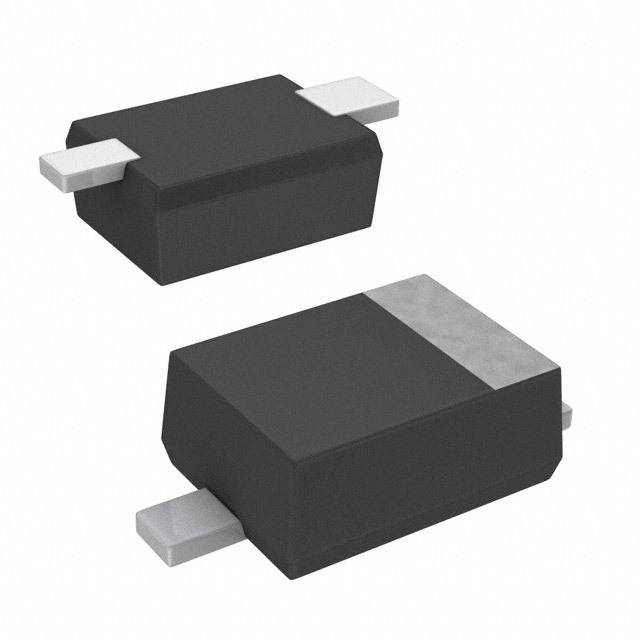
13V zener, 200mW ceiling, SMini2-F5-B package, ±2.5% tolerance; lifecycle conflict is the real constraint.
Quick Engineering Summary
| Field | Value |
|---|---|
| Manufacturer | Panasonic |
| Category | Diodes - Zener - Single |
| Package | SMini2-F5-B |
| Core function | DIODE ZENER 13V 200MW SMINI2 |
| Key electrical range | Current - Reverse Leakage @ Vr: 50nA @ 10V; Maximum Power Dissipation: 200mW; Supply and Demand Status: Sufficient; Tolerance: ±2.5% |
| Reported stock | 13380 pcs reported — confirm on RFQ |
Still usable, but only with a sustaining mindset
And that leaves a narrow conclusion: keep DZ2J130M0L in existing production, not in a fresh design-in. The conflict between Active and 停止提供 outweighs the stock count, though EU RoHS compliance does remove one routine compliance objection.
200mW is the limit that sets the part's job
200mW is the ceiling, and it defines the job before anything else does.
That number keeps DZ2J130M0L in small-signal clamp and reference work, not in roles that must absorb repeated energy with little thermal headroom. The 13V zener value settles rail selection, but not transient-energy capability. ±2.5% is tight enough to matter when the clamp threshold sits inside the tolerance stack, while 35 Ohm maximum Zzt says regulation will shift with current and load conditions the listing does not spell out. The forward figure, 1V @ 10mA, is also a limit in forward conduction; it bounds accidental forward-bias behavior, but it does not make this zener a general-purpose signal diode.
Wrong for power clamps; right for compact board-level protection
Not for surge-heavy protection.
This listing gives no surge current, no derating curve, and no thermal resistance, so DZ2J130M0L is the wrong pick when the protection scheme depends on absorbing fault energy instead of simply setting a voltage ceiling. That matters more here than the nominal zener value, because a part can match the rail and still fail the job if the energy picture is undefined.
Where it does fit is dense SMT board work that needs a single 13V zener in a very small body. The package callout is SMini2-F5-B, with SC-90 and SOD-323F also named, so footprint discipline matters immediately if this part is going into an existing land pattern or a second-source-qualified board. Reel - TR packaging and SMD mounting make it a normal choice for automated placement, and the 50nA @ 10V reverse leakage ceiling is low enough to stay out of the way in bias networks where leakage can skew a high-impedance node.
That low-leakage behavior does not rescue it for heavier clamp duty. If the design needs a zener that spends real time near its dissipation ceiling, the missing thermal and surge data leave too much unanswered.
The stock is real; the lifecycle signal is the catch
The weak point is obvious: lifecycle is not clean. The strong point is that 13380 pieces are listed, with sufficient supply status and reel packaging that suits a running SMT line.
Treat that stock as continuity, not expansion. If DZ2J130M0L is already on a released BOM, pull what you need for the current build window and avoid spreading it into new assemblies until the lifecycle contradiction is resolved.
The missing datasheet items are the ones that decide risk
Some gaps are decisive.
The missing items are surge current, thermal resistance, and the package drawing with pinout. Without them, DZ2J130M0L cannot be cleared for fault-energy work, board thermal review, or footprint release from this page alone.
Reverse-recovery time is also absent, though for a single zener that is usually less urgent than IFSM and thermal data.
View the Win-Source product page for DZ2J130M0L.
Key Takeaways for Engineers & Buyers
- Treat 200mW as the dissipation ceiling and size the clamp duty around that limit.
- Hold DZ2J130M0L to rails that need a 13V nominal zener with ±2.5% tolerance, not a looser clamp.
- If the line is live, secure reel quantity against the lifecycle conflict while 13380 pieces are available.