
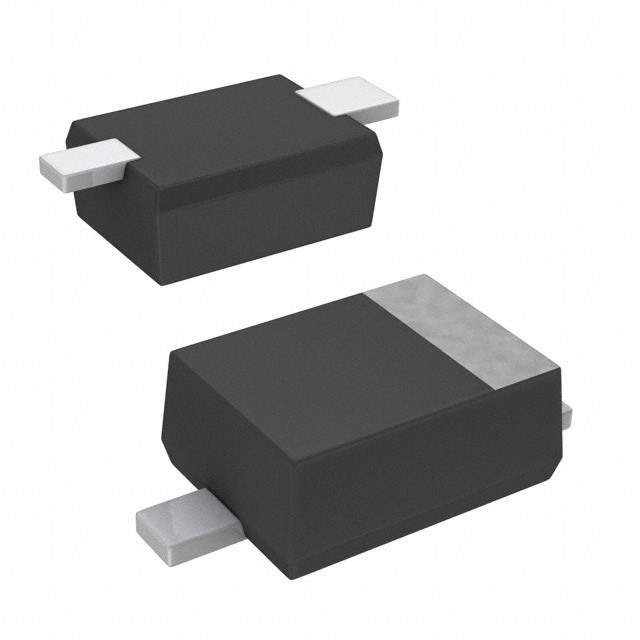
14 V nominal zener, 200 mW ceiling, SC-90/SOD-323F SMD package, ±5% tolerance
Quick Engineering Summary
| Field | Value |
|---|---|
| Manufacturer | Panasonic |
| Category | Diodes - Zener - Single |
| Package | SMini2-F5-B |
| Core function | DIODE ZENER 14V 200MW SMINI2 |
| Key electrical range | Current - Reverse Leakage @ Vr: 50nA @ 10V; Power - Max: 200mW; Supply and Demand Status: Limited; Tolerance: ±5% |
| Reported stock | 1 pcs reported — confirm on RFQ |
The lifecycle story is weak, so keep it off new BOMs
The weak point comes first: DZ2J14000L does not carry a clean lifecycle signal. One field says Active, another says 停止提供, and the estimated EOL field says Obsolete / End of life. That conflict alone is enough to stop a fresh design-in before stock even enters the discussion.
On paper, the electrical profile is straightforward: 14 V nominal zener voltage, ±5% tolerance, and a 200 mW maximum power rating in an SC-90, SOD-323F body. EU RoHS compliance clears one paperwork hurdle, but it does nothing to fix the continuity problem. This is a sustaining part, not a comfortable choice for a new program.
Wrong for heavy clamp duty; fine for light 14 V housekeeping
Wrong job first: don't put this part where surge energy or steady dissipation is the main task. The 200 mW maximum power rating is a hard ceiling, and in a small SMD package that rules out casual use as a general rail clamp when a fault can persist.
It fits better in low-power 14 V zener duty on dense boards that already want SC-90 or SOD-323F assembly. The 14 V nominal zener voltage sets the rail neighborhood, but it does not say how much abuse the node can absorb. The ±5% tolerance tells you how much threshold spread the downstream circuit has to live with before margins tighten.
Two secondary numbers deserve more attention than they usually get. The 40 Ohm maximum impedance puts a ceiling on how stiff the zener behavior is, so any circuit that depends on a sharply held clamp point should read that as a warning. The 50 nA reverse leakage at 10 V is low enough to keep the part credible in high-impedance sensing or bias networks, but only at that stated condition, and it leaves leakage at other reverse voltages or temperatures unresolved.
The 1 V maximum forward drop at 10 mA also matters. It sets a forward-mode ceiling at a stated current rather than a target operating point, and it reminds you that accidental forward conduction still consumes dissipation budget if the node can be driven with the wrong polarity.
And the buy problem is simpler than the circuit problem
And that makes the supply call easier than the electrical one. Stock is 1, packaging is reel, and supply status is Limited. Use DZ2J14000L only to support existing production, and reserve what remains for exact-need builds.
1 missing thermal number blocks the real stress call
1 omission does more damage than another paragraph of generic diode language. DZ2J14000L is listed at 200 mW maximum, but no thermal resistance or derating curve appears here, so ambient headroom cannot be judged from this page.
The remaining gaps are concrete. There is no pinout or package drawing to settle footprint orientation, no junction capacitance to estimate AC loading on a sensitive node, and no surge or overload figure such as IFSM to show whether a transient is survivable or just a field return waiting to happen.
View the Win-Source product page for DZ2J14000L.
Key Takeaways for Engineers & Buyers
- Treat 200 mW as the dissipation ceiling; don't size DZ2J14000L from nominal zener voltage alone.
- Lock the SC-90, SOD-323F footprint and SMini2-F5-B package callout before releasing layout.
- Secure remaining stock now if DZ2J14000L is already on a build; listed quantity is 1.