
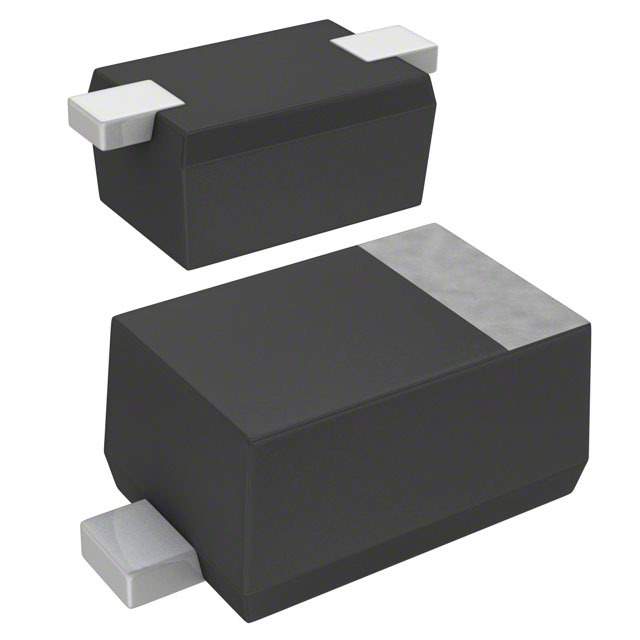
3.9V zener, 150mW ceiling, SSMini2-F5-B package, 1V at 10mA forward-drop limit
Quick Engineering Summary
| Field | Value |
|---|---|
| Manufacturer | Panasonic |
| Category | Diodes - Zener - Single |
| Package | SSMini2-F5-B |
| Core function | DIODE ZENER 3. |
| Key electrical range | Current - Reverse Leakage @ Vr: 10μA @ 1V; Maximum Power Dissipation: 150mW; Supply and Demand Status: Balance; Tolerance: ±5% |
| Reported stock | 1 pcs reported — confirm on RFQ |
Not for power shunt duty; usable in small 3.9V clamp roles
Wrong for power shunt duty, this zener also carries too much lifecycle ambiguity to be the starting point for a new platform. The 150mW maximum power dissipation is a ceiling, not a place to operate, and the record stays split between Unknown and Active.
It fits narrower jobs. A single 3.9V zener in an SSMini2-F5-B SMD body still has a place when board area is tight and the dissipation budget stays modest. EU RoHS is straightforward. For sustaining designs, DZ2S03900L is a reasonable hold choice if that exact footprint is already on the board and a thin buy position is acceptable.
150mW closes the door on casual margin
150mW sets the tone. DZ2S03900L belongs in light clamp or reference service, and without thermal resistance or a derating curve, there is no basis for assuming much ambient headroom.
3.9V nominal is useful, but the tolerance and impedance matter
3.9V is the deciding number. It tells you fast whether DZ2S03900L belongs on the rail at all.
The listed ±5% tolerance leaves real spread around that nominal value, so this is not a tight reference by default. The 130 Ohm maximum zener impedance pushes the same point from another angle: when current shifts, the clamp will not behave like a stiff one.
The forward side sets a separate limit. The listing gives 1V maximum at 10mA, useful as a ceiling for accidental forward bias or polarity mistakes, not as a normal operating point. Reverse leakage is 10µA at 1V, but that test point says little about leakage near the 3.9V zener region. In practice, DZ2S03900L reads better as a simple protection or bias part than as a precision clamp.
Buy it only to cover an existing board
This is a sustaining buy.
Availability is the real constraint. Stock quantity is 1, packaging is Reel - TR, and the lifecycle picture is still muddy enough that I would not anchor a new BOM to DZ2S03900L. If an existing production board needs it, pull that requirement forward and lock the reel format now instead of assuming supply will still be there later.
The missing curves are what would settle the argument
And that is why the omissions matter more than one more headline spec. There is no derating curve, no thermal resistance, and no surge or overload figure such as IFSM, so the listing never shows how much ambient room DZ2S03900L really has before the 150mW ceiling turns into a reliability problem.
The electrical gaps are just as practical. There is no zener test current attached to the 3.9V nominal value, no voltage-versus-current curve, and no package drawing or pinout detail here. Those are the details that decide whether the clamp is stiff enough for the job, whether assembly already matches the land pattern, and whether DZ2S03900L can go onto the board without reopening layout and thermal assumptions.
That missing context also keeps the lifecycle debate from resolving cleanly. When a part already shows mixed continuity signals, the absence of concrete thermal and characterization data makes it harder to justify fresh adoption, even if the basic 3.9V zener target and small package look right at first glance.
View the Win-Source product page for DZ2S03900L.
Key Takeaways for Engineers & Buyers
- Keep DZ2S03900L on low-power clamp or reference duty; 150mW is the dissipation ceiling.
- Check rail tolerance against the 3.9V nominal zener value and the listed ±5% tolerance.
- Do not count on spot buys; stock is 1 and DZ2S03900L lifecycle status is not clean.