
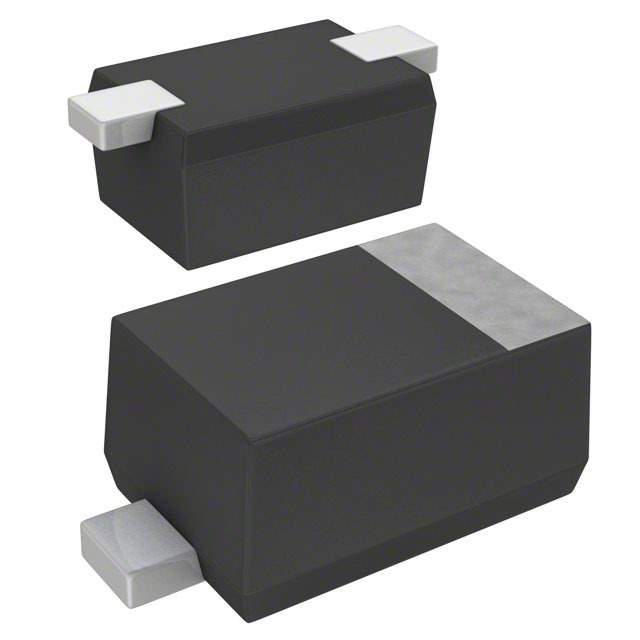
6.2V zener, 150mW ceiling, SSMini2-F5-B package, 1V at 10mA forward-drop limit
Quick Engineering Summary
| Field | Value |
|---|---|
| Manufacturer | Panasonic |
| Category | Diodes - Zener - Single |
| Package | SSMini2-F5-B |
| Core function | DIODE ZENER 6. |
| Key electrical range | Current - Reverse Leakage @ Vr: 200nA @ 4V; Maximum Power Dissipation: 150mW; Supply and Demand Status: Sufficient; Tolerance: ±5% |
| Reported stock | 50800 pcs reported — confirm on RFQ |
150mW is the number that decides this part
150mW is the ceiling that makes this zener either sensible or pointless. That limit rules out any job that expects real surge absorption or much thermal slack, and the page still leaves out thermal resistance and a derating curve, so there is no clean way to judge ambient headroom or copper-area dependence from the listing alone.
The other key number is 6.2V nominal zener voltage. It places DZ2S06200L in the usual small-signal clamp or reference role around a 6V rail, but the listed ±5% tolerance does not make it a precision reference by itself. The 30 Ohm maximum impedance matters too; if the circuit needs a tight knee, that figure sets the argument.
The lifecycle story is weaker than the stock story
Unknown lifecycle is the weak point; 50800 on hand is the reassuring one. For DZ2S06200L, near-term builds look serviceable, but new design-in should wait for a clean status because the page also lists Active, and those two signals conflict.
Use it where leakage and size matter more than power
And that is the real fit. DZ2S06200L belongs in compact SMD housekeeping work, where the SSMini2-F5-B package and SMT mounting help, and where a 150mW ceiling is not the first limit you hit.
The reverse leakage listing is useful: 200nA at 4V. In bias networks and light-load sensing nodes, that keeps the off-state penalty small. It does not say anything about behavior at the 6.2V zener point, so it should not be stretched into a blanket low-leakage claim across the full operating range.
Forward conduction is bounded too. The listing gives 1V at 10mA as a limit, and with a package this small, that is enough to make the point: don’t treat DZ2S06200L like a general-purpose current-carrying diode just because it can conduct forward.
The no-go cases are just as clear. Repetitive energy dumping is out. Loose thermal layouts are out. Any rail clamp that depends on a published surge current figure is also out, because that figure is not listed here. Reverse-recovery time and junction capacitance are missing as well, and those are the numbers that decide whether the part stays unobtrusive on fast edges or starts loading the node it is supposed to protect.
The missing thermal and dynamic data still blocks closure
The constraint is not voltage but missing limits. The listing does not give thermal resistance, a derating curve, surge current, or a package drawing or pinout.
Without those, you can place DZ2S06200L in a low-power zener role, but you cannot close ambient headroom, pulse tolerance, or land-pattern confidence from this page alone.
View the Win-Source product page for DZ2S06200L.
Key Takeaways for Engineers & Buyers
- Keep DZ2S06200L on low-power clamp and reference duties; 150mW is the dissipation ceiling.
- Check tolerance stack with the ±5% Vz window before using DZ2S06200L as a rail reference.
- Resolve the Unknown lifecycle versus Active status conflict before releasing DZ2S06200L to a new BOM.